Culture is the quiet force in language learning: it decides what sounds natural, what feels polite, what counts as “normal,” and what accidentally lands as awkward. In IB German Ab Initio, culture is not a side quest you do after memorising vocabulary. It is the reason the vocabulary matters at all. And if you are coming from the mindset of IB Language B (themes, context, purpose, audience), you already have the right map: culture is the context that turns a correct sentence into a meaningful one.
In this 2025 guide, you will see exactly what role culture plays in IB German Ab Initio, how it shows up in assessments, and how to revise it efficiently without collecting random facts you never use.
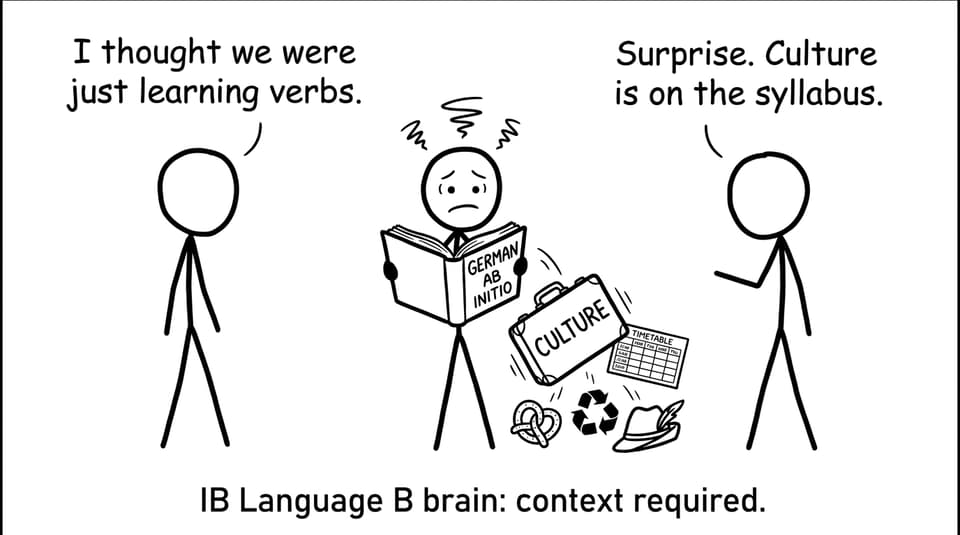
A suitcase labeled culture falls out of a German textbook
Culture in IB German Ab Initio: a fast checklist
If you want the quickest way to study culture (and keep it exam-relevant), use this list:
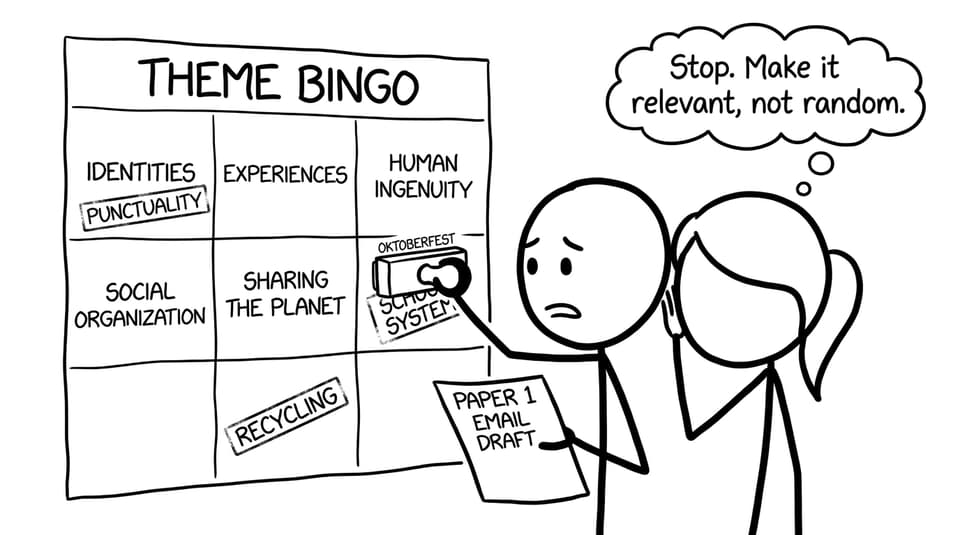
Know the five themes and attach 2--3 cultural examples to each.
Practise cultural references in Paper 1 formats (email, blog, diary, article).
Train your eyes to spot cultural context in Paper 2 reading and listening.
Prepare 3 “comparison moves” for the individual oral (German-speaking context vs your context).
Keep culture usable: short phrases, specific examples, and simple opinions.
When you need the exam map, keep open while you revise.
Why culture matters (even when your German is still basic)
Beginners often think culture is something you discuss only when you have advanced language. But in practice, culture helps you speak sooner. It gives you ready-made topics (food, school, festivals, routines), predictable opinions (“I think recycling is important”), and familiar situations (shopping, transport, greetings) that make it easier to build sentences.
The IB also cares about culture because it is a shortcut to international-mindedness. You are not asked to be a historian of Germany. You are asked to show awareness that language sits inside real lives, real values, and real communities.
This is where IB Language B thinking helps: you are rewarded for communicating meaningfully to an audience, not for sounding like a perfect grammar engine. If you want a broader strategy framework, read What to Expect in Your IB Language B Exams: Format, Timing, Strategy.
This theme is where culture becomes personal: food habits, greetings, family roles, routines, and lifestyle choices. A simple cultural angle (like bread culture, punctuality, or meal timing) can immediately upgrade a basic paragraph because it adds specificity.
Experiences: festivals are memorable because they are social
Experiences is where students naturally enjoy culture: travel, celebrations, leisure, and traditions (think Christmas markets, Karneval, Oktoberfest). The value is not the festival facts. The value is what the festival reveals: community, seasons, food, music, tradition, and how people spend time together.
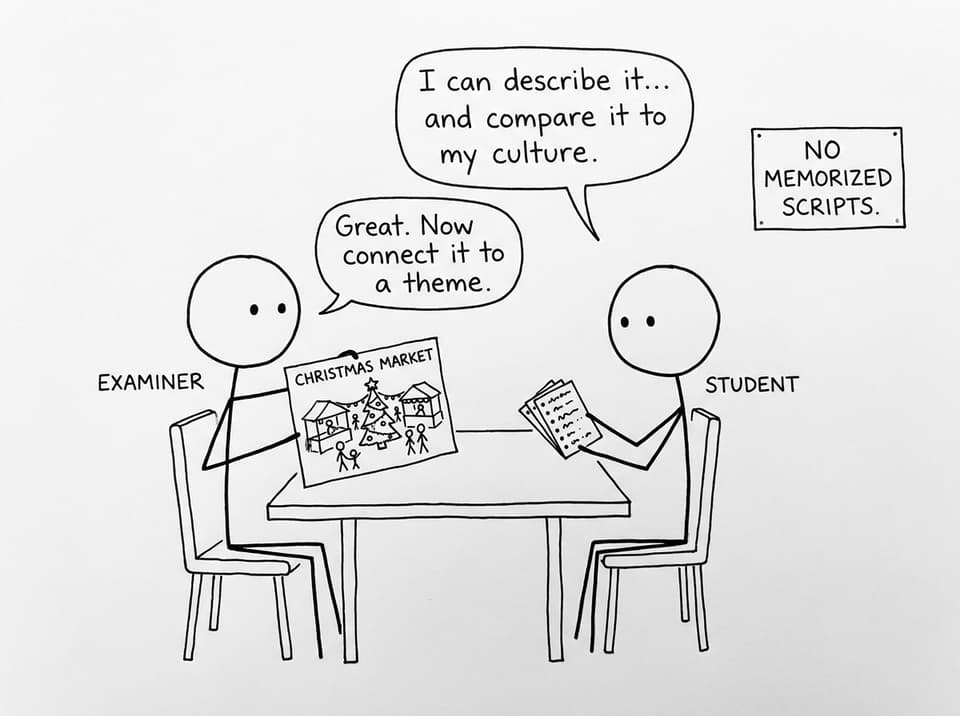
Revision move: practise describing one celebration and then comparing it to your own culture in two sentences. That is an IB Language B style skill: compare, reflect, communicate.
Human ingenuity: culture shapes media and tech behaviour
This is where you talk about media, communication, and creativity. Culture appears in what a society watches, reads, shares, and debates. Even at Ab Initio level, you can handle simple contrasts: traditional media vs social media, privacy habits, technology in school.
Revision move: learn 5 opinion starters and 5 connectors, then attach one cultural example. RevisionDojo’s system makes this easier because you can turn your best phrases into Flashcards and drill them until they are automatic.
Social organization: schools and work reveal values
School systems, apprenticeships, community norms, and social expectations are cultural by default. Even a simple comparison like “In my country school starts at..., but in Germany...” shows cultural awareness.
Sharing the planet: culture includes how societies handle responsibility
German-speaking countries are often discussed through recycling systems, public transport, renewable energy, and environmental attitudes. The point is not to praise one country. The point is to show you can discuss shared problems with a grounded example.
Where culture appears in assessments (and how to earn marks)
Culture shows up in every component, often quietly.
Paper 1 writing: culture is your realism
Paper 1 tasks reward writing that fits a real situation: a blog post about an experience, an email to a host family, a diary entry after a trip. Cultural detail makes the writing feel authentic, which helps purpose and audience.
Practical method: prepare two cultural “plug-ins” per theme. They should be flexible, like “a local festival,” “public transport,” “school routine,” “food tradition,” rather than niche trivia.
Paper 2 reading and listening: culture is your comprehension shortcut
Many Paper 2 texts are culturally situated: adverts, timetables, travel notes, short interviews, community announcements. You often do not need to translate every word if you recognise the situation.
To practise in a targeted way, use a topic hub like Paper 2 Reading (IB German ab initio) and train yourself to identify: Who is speaking? Where are they? What is the purpose?
Individual oral: culture becomes your easiest expansion tool
In the oral, culture is a safe way to move from description to discussion. You describe what you see, then interpret, then connect to a theme, then compare to your own context. That final step is where many students jump a level.
Closing: culture is the difference between “correct” and “convincing”
In 2025, culture in IB German Ab Initio is not an extra topic you revise at the end. It is the thread that ties the five themes together, the logic behind many Paper 2 contexts, and the easiest way to expand your oral beyond basic description. If you approach the course with IB Language B habits--theme thinking, purpose, audience, comparison--culture stops feeling abstract and starts feeling useful.
Build your cultural examples into your daily routine: a few Flashcards, a short Questionbank set, a weekly timed speaking run. And when you want everything in one place--Study Notes, Flashcards, Questionbank, AI Chat, Grading tools, predicted papers, Mock Exams, Coursework Library, and Tutors--RevisionDojo is built to make that loop repeatable until exam day.
Markus studied Germanistik at the Ludwig-Maximilians-Universitat Munchen and has specialised in IB German B for 15 years across schools in Munich and Singapore. His focus is IB German grammar and the Paper 2 productive-writing tasks, showing students the underlying system rather than isolated rules.