


You don’t notice a theme is difficult when you’re learning vocabulary in neat little lists.
You notice it when you’re under time pressure, staring at a prompt, and your brain offers exactly three German words: und, aber, and Hallo.
That moment is why IB Languages can feel strangely personal. The course content isn’t hard in the same way as a complicated math proof. It’s hard because it asks you to think about big ideas (technology, society, climate) with beginner tools. And in IB German Ab Initio, those big ideas live inside five themes: Identities, Experiences, Human Ingenuity, Social Organization, and Sharing the Planet.
This 2025 guide breaks down which themes tend to be the most challenging, why they feel heavier than the rest, and how to make them manageable using an exam-focused approach.
If you want a quick overview of the course itself, start with What Is IB German Ab Initio? Complete 2025 Guide.
Quick checklist: why certain themes feel harder
Before ranking anything, here’s the simplest way to predict difficulty in IB Languages:
-
Abstractness: Is the topic about feelings and routines, or systems and global issues?
-
Vocabulary load: Does it require many low-frequency words (e.g., environment, politics, innovation)?
-
Opinion pressure: Will the oral or writing ask you to give a viewpoint, compare cultures, or justify a solution?
-
Grammar demand: Does the theme push you toward structures like weil/obwohl, modal verbs, and past time frames?
For the assessment breakdown (and what each paper expects), keep IB German Ab Initio Exam Format (2025 Guide) open while you revise.
Theme difficulty ranking (typical for IB German Ab Initio)
Most students experience the themes in roughly this order (from most to least challenging):
-
Sharing the Planet (usually the hardest)
-
Social Organization
-
Human Ingenuity
-
Experiences
-
Identities (usually the most accessible)
That ranking isn’t about intelligence. It’s about how far each theme is from your daily life, and how many “new types of words” it demands.
Sharing the Planet: the most challenging theme for many students
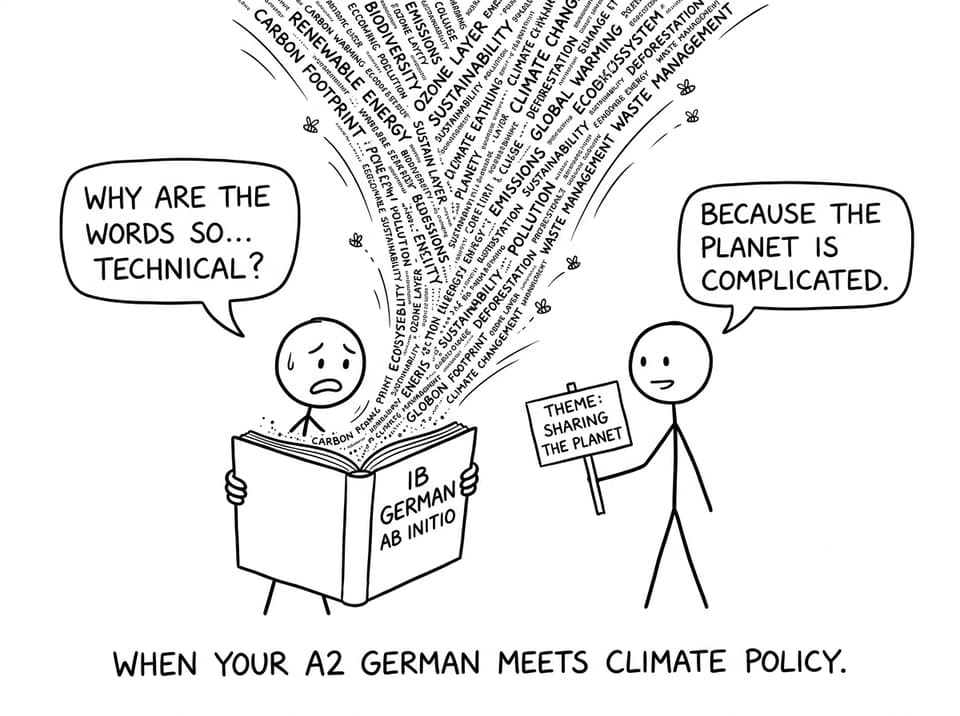
Sharing the Planet often becomes the stress test of IB Languages because it combines three hard things at once: technical vocabulary, global context, and opinion-based tasks.
Why it’s difficult
-
Technical nouns pile up quickly (Umweltschutz, erneuerbare Energien, Klimawandel).
-
The theme invites solution language, which forces modal verbs and justification.
-
Oral prompts frequently use images about recycling, pollution, or activism, which pushes you to interpret, not just describe.
How to revise Sharing the Planet without drowning
-
Build a small “action toolkit” you can reuse:
-
Wir sollen… (We should…)
-
Man muss… (People must…)
-
Wir können… (We can…)
-
Es ist wichtig, dass… (It’s important that…)
-
-
Keep your grammar simple but accurate, then add range with connectors.
-
Use theme practice inside RevisionDojo’s Core Themes for IB German ab initio to drill the same ideas in multiple formats.
A quiet trick: write three “mini-opinions” you actually believe (about plastic, transport, and energy). Then reuse them in different tasks. This is how top students make IB Languages feel less random.
Social Organization: challenging because it requires comparison
Social Organization is difficult for beginners because the theme is full of systems: schools, workplaces, communities, social issues. Systems are hard to explain in any language, and harder when your vocabulary is still growing.
Why it’s difficult
-
It demands comparison: your country vs German-speaking contexts.
-
The vocabulary is often unfamiliar (jobs, institutions, civic life).
-
It pushes you toward sentence complexity (weil, obwohl, cause and contrast).
High-friction subtopic: education and society
“Education” sounds simple until you try to explain how your school works, how exams are structured, or what students value. Suddenly you need words for rules, pressure, fairness, and future plans.
How to revise Social Organization effectively
-
Make a “roles list”: student, teacher, employer, volunteer, government, community.
-
Practice two-sentence comparisons:
-
Sentence 1: your context (In meinem Land…)
-
Sentence 2: a contrast using aber/doch or obwohl
-
-
After each practice response, use RevisionDojo’s AI Chat to rewrite one sentence more clearly (not longer), then keep that improved version as a Flashcard.
RevisionDojo’s German ab initio - IB Resources is a good home base here because you can move from Study Notes to Flashcards to targeted practice in the Questionbank without losing the thread.
Human Ingenuity: hard because it’s less personal
Human Ingenuity covers technology, communication, media, and transport. The hardest part is that the topic can feel emotionally distant. You might use tech daily, but talking about it in structured German requires a new vocabulary register.
Why it’s difficult
-
Vocabulary trends abstract: media influence, privacy, innovation.
-
Tasks often ask you to evaluate pros and cons.
-
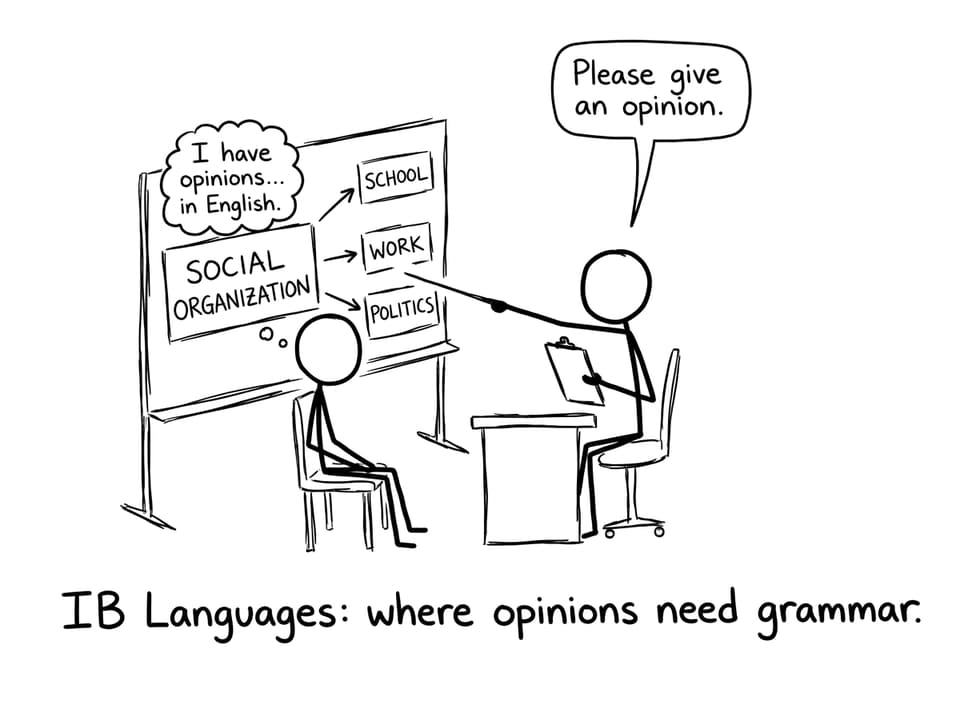
It’s a common doorway into “opinion language,” which is central in IB Languages exams.
How to revise Human Ingenuity with less effort
-
Memorize a small set of opinion frames:
-
Meiner Meinung nach…
-
Ich denke, dass…
-
Ein Vorteil ist… / Ein Nachteil ist…
-
-
Build one “reusable paragraph” on social media or smartphones, then swap details.
-
Use RevisionDojo’s Questionbank to practice short, exam-style responses and get feedback fast.
A helpful companion guide (especially for exam strategy across skills) is What to Expect in Your IB Language B Exams: Format, Timing, Strategy.
Experiences: moderate difficulty because of time and sequencing
Experiences is usually more comfortable because it’s narrative: routines, holidays, celebrations, memories. But it becomes tricky when your grammar has to track time.
Where students struggle
-
Word order with time phrases.
-
Describing past events using Perfekt.
-
Sequencing ideas smoothly in writing.
How to revise Experiences
-
Use a timeline template: zuerst, dann, danach, später, schließlich.
-
Practice telling one story in three lengths: 3 sentences, 6 sentences, 10 sentences.
-
Check your foundations with What Grammar Topics Are Most Important in IB German Ab Initio (2025 Guide).
Experiences is where IB Languages students can pick up “easy marks” by being clear and accurate, even with simple vocabulary.
Identities: usually the most accessible (but still has traps)
Identities covers relationships, daily life, food, health, lifestyle. Students typically find it manageable because the language is personal and repetitive in a good way.
The sneaky difficult corner: health and well-being
Health topics introduce medical vocabulary and reflexive verbs. It’s not impossible, but it’s easy to overcomplicate.
How to revise Identities
-
Focus on high-frequency phrases you can use immediately (Ich habe…, Mir ist…, Ich fühle mich…).
-
Keep a short “symptoms list” and a short “healthy habits list.”
-
Let RevisionDojo Flashcards do the repetition work via Flashcards.
A simple study loop for the hardest IB Languages themes
When themes feel hard, most students try to read more. But IB Languages improves fastest when you practice outputs.
Use this loop 3-4 times a week:
-
Learn: 10 minutes of Study Notes on one subtopic (keep it tight).
-
Recall: 10 minutes of Flashcards (theme phrases + connectors).
-
Apply: 20-30 minutes of Questionbank practice.
-
Fix: use AI Chat to explain one repeated mistake and rewrite two sentences.
-
Simulate: once a week, do a timed mini-session (writing plan or oral response).
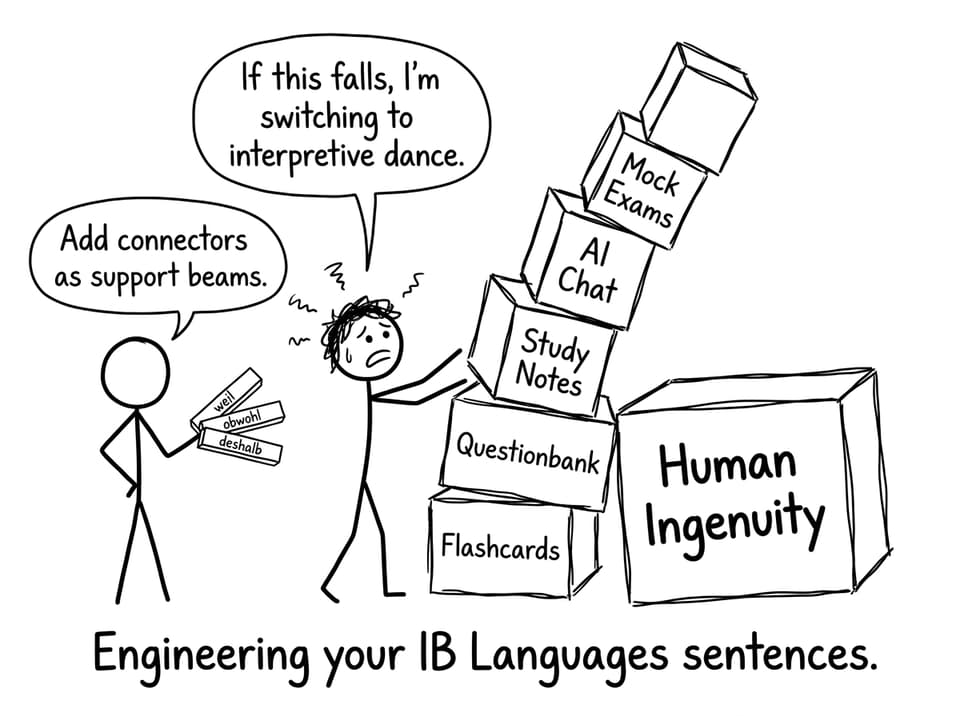
If you want the broader system across IB revision, RevisionDojo for IB lays out how the platform ties together Study Notes, Flashcards, AI Chat, Grading tools, Predicted Papers, Mock Exams, Coursework Library, and Tutors.
Closing: turn the hardest themes into your advantage
The hardest themes in IB German Ab Initio tend to be Sharing the Planet, Social Organization, and Human Ingenuity. Not because you’re “bad at German,” but because these themes ask beginner language to carry big-world meaning.
That’s also the opportunity. If you can build a small set of high-frequency phrases, practice opinions without panic, and train under exam conditions, you’ll separate yourself from the crowd of students who only revise what feels comfortable.
RevisionDojo is built for exactly that kind of IB Languages preparation: theme-aligned Study Notes, daily Flashcards, targeted Questionbank practice, AI Chat to unblock mistakes fast, Grading tools for feedback loops, and Mock Exams and Predicted Papers to make exam day feel familiar. Start from the IB German ab initio hub, pick one hard theme, and run the loop until it stops being hard.