


In IB Chemistry, the periodic table can feel like a magic trick you’re expected to explain under timed conditions. One week you’re told “atomic radius increases down a group,” and the next you’re asked to justify it in two clean sentences while your brain tries to remember whether it was radius, electronegativity, or your motivation that decreased.
The good news is that many of those “random” trends have one quiet cause. It isn’t complicated. It’s just easy to overlook.
The shielding effect is that cause, and if you learn it properly, IB Chemistry questions on periodicity stop feeling like memorization and start feeling like logic.
What is the shielding effect in IB Chemistry?
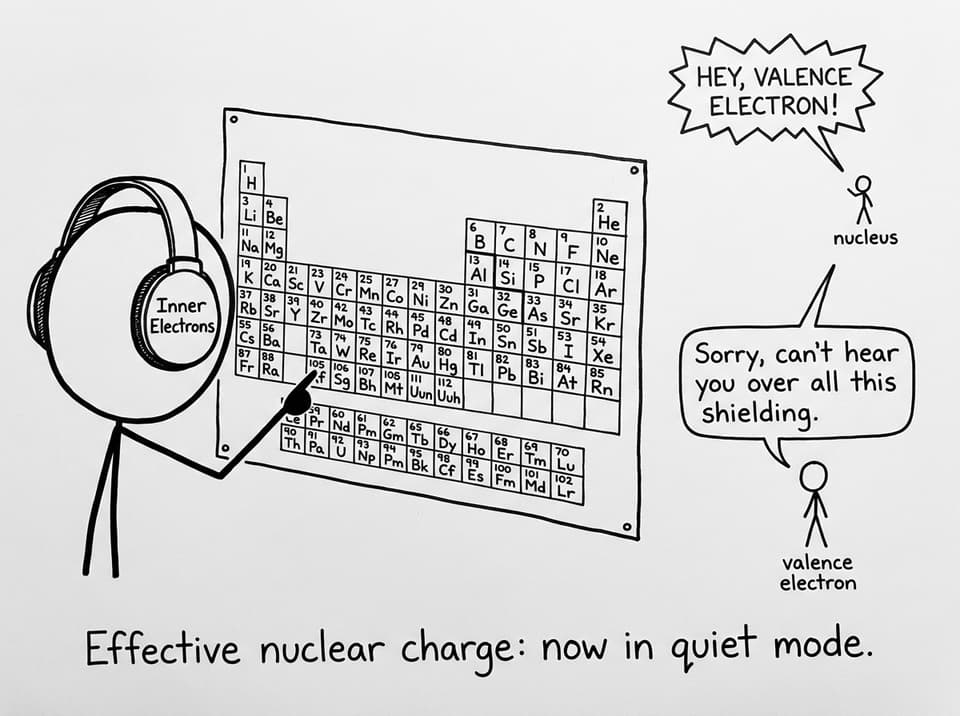
In IB Chemistry, the shielding effect (also called screening) is the reduction in attraction between the nucleus and valence electrons because inner-shell electrons repel and block some of the nuclear pull.
A tight exam-ready way to say it:
-
Inner electrons repel outer electrons.
-
This repulsion “shields” outer electrons from the nucleus.
-
Valence electrons feel a weaker attraction than you’d expect from proton number alone.
This is why “more protons” doesn’t automatically mean “outer electrons are held much more strongly.” In IB Chemistry, you’re nearly always balancing nuclear charge, distance, and shielding effect.
Quick checklist: how to use shielding effect in exam answers
When you see periodic trends in IB Chemistry, run this chain before you write:
-
Are new shells being added (down a group)? If yes, shielding effect increases a lot.
-
Are electrons added to the same shell (across a period)? If yes, shielding effect changes only slightly.
-
Convert that into one of these outcomes:
-
weaker attraction to valence electrons
-
larger atomic radius
-
lower ionization energy
-
lower electronegativity
-
-
Use the phrase effective nuclear charge if the question is explain-heavy.
For extra practice on the exact style of questions that appear in IB Chemistry, drill trends in the IB Chemistry 3.2 Periodic Trends Questionbank.
Why shielding happens (the “crowded room” idea)
Electrons have the same negative charge, so they repel each other. In an atom, inner electrons sit between the nucleus and the valence electrons. Those inner electrons don’t just exist quietly. They push outward.
So the nucleus is trying to pull valence electrons inward, while inner electrons are pushing them outward. The result is a weaker net attraction for the outer shell.
This is the intuitive heart of IB Chemistry periodicity: properties change because the nucleus can “reach” the outer electrons more or less effectively.
If you want a broader map of how this fits into the whole topic, Periodicity Explained Simply connects shielding effect to every major trend.
Shielding effect and atomic radius
One of the most tested statements in IB Chemistry is:
Atomic radius increases down a group.
Why it happens:
-
each step down a group adds a new electron shell
-
inner shells produce a stronger shielding effect
-
valence electrons are farther from the nucleus and feel less attraction
-
the atom’s electron cloud spreads out more
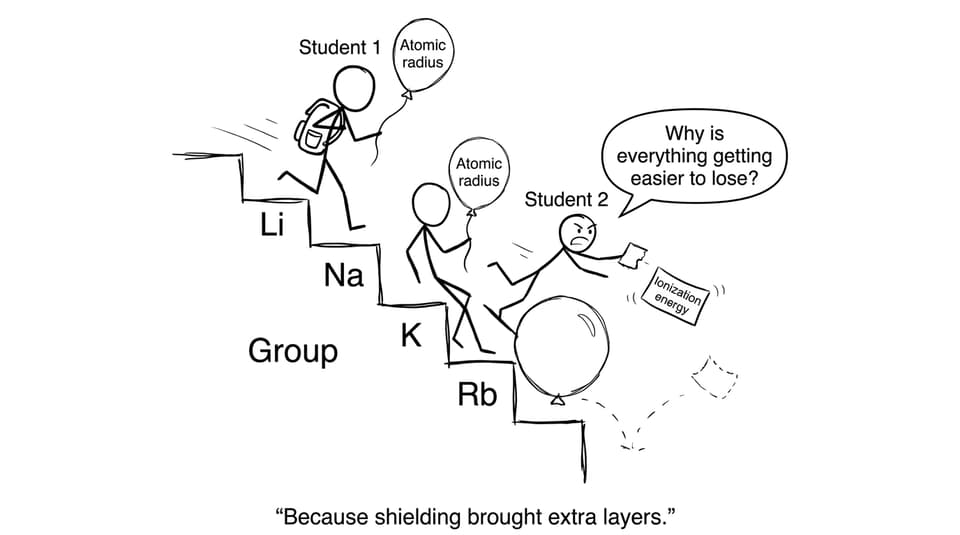
That’s why Group 1 elements get bigger as you go down: Li < Na < K < Rb (and beyond). Bigger size also makes losing an electron easier, which links straight into reactivity.
To keep your explanations tight under pressure, it helps to practise phrasing. RevisionDojo’s IB Chemistry revision notes hub is useful for building a consistent “definition + chain” style answer.
Shielding effect and ionization energy
In IB Chemistry, you’re expected to link shielding effect to this trend:
First ionization energy decreases down a group.
Reasoning:
-
more shells down a group means more shielding effect
-
valence electrons experience weaker attraction
-
less energy is needed to remove an electron
If ionization energy questions feel slippery, the calmest way to improve is repetition with feedback. Start with Ionization Energy Explained Simply, then use RevisionDojo’s Questionbank and Grading tools to spot which step in your chain is missing.
Shielding effect and electronegativity
Electronegativity is an atom’s ability to attract a shared pair of electrons in a bond. In IB Chemistry, the trend down a group is:
Electronegativity decreases down a group.
Because:
-
the bonding electrons are farther from the nucleus
-
shielding effect reduces how strongly the nucleus attracts those electrons
So even though nuclear charge increases down a group, the added shielding effect (and extra distance) usually dominates. If you want a clean bonding link, read Electronegativity and Bond Polarity Explained.
Shielding effect and effective nuclear charge (Zeff)
A powerful way to summarise shielding effect in IB Chemistry is through effective nuclear charge, often written as Zeff:
Zeff = nuclear charge - shielding
You don’t usually need to calculate it in detail for standard questions, but you do need to think like it.
-
High Zeff means valence electrons feel a strong pull.
-
Increased shielding effect lowers Zeff.
-
Lower Zeff explains larger radius and lower ionization energy.
When you’re revising periodicity, keep the IB Chemistry Data Booklet nearby so you can practise turning tables into explanations quickly.
Shielding effect in transition metals (why d-electrons matter)
Transition metals add electrons into d-subshells, and in IB Chemistry there’s a key detail:
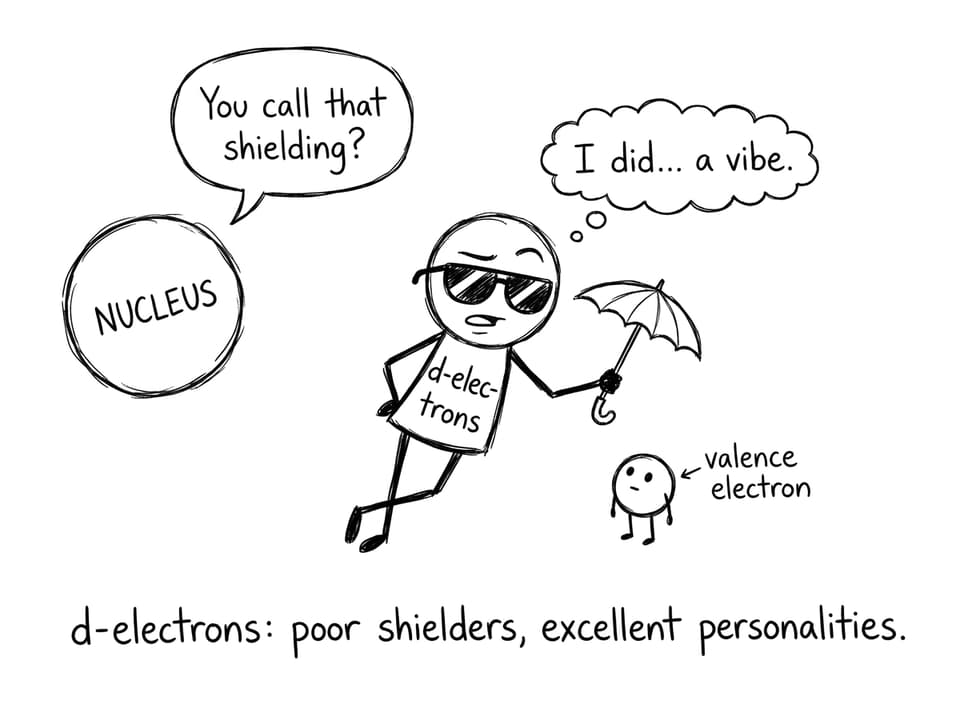
d-electrons shield poorly.
That poor shielding effect helps explain why atomic radius changes only slightly across much of the d-block, and why transition metals show their own “special behaviour” compared to s- and p-block trends.
Common IB Chemistry mistakes about shielding effect
-
“Shielding effect increases across a period.” Not much. Electrons are added to the same main shell, so shielding effect stays roughly similar while nuclear charge rises.
-
“More protons always means stronger attraction.” Only if shielding effect and distance don’t increase enough to cancel it.
-
“Big atoms hold electrons more tightly.” In general, the opposite is true because shielding effect is larger and valence electrons are farther away.
If you want to get faster at writing what markschemes reward, use Breakdown of IB Chemistry Marking Schemes and practise converting your thinking into two sharp points.
Closing: the one idea that unlocks periodic trends
The shielding effect is simple: inner electrons reduce the nucleus’s pull on valence electrons. But in IB Chemistry, that one sentence explains why atoms get larger down a group, why ionization energy falls, why electronegativity drops, and why effective nuclear charge is the hidden logic behind so many markschemes.
If you want to turn this understanding into marks, build a loop: learn the idea with Study Notes, lock it in with Flashcards, then attack trend questions in the Questionbank with AI feedback. Start from the IB Chemistry Resources hub and use Mock Exams, Predicted Papers, Grading tools, the Coursework Library, and Tutors when you need structure as the exam gets closer.
When the question says “account for the trend,” you’ll know what to write: shielding effect, effective nuclear charge, and a chain that ends in the property they asked for.