
RevisionDojo logoRevisionDojo logo
FeaturesSubjectsPricingSchools
Back to all posts
  1. Home
  2. /Blog
  3. /IB Chemistry: Periodicity Explained Simply

IB Chemistry: Periodicity Explained Simply

IB Chemistry
RevisionDojo Team
•Last updated: 19 Jul 2026•7 min read
ShareShare on XShare on WhatsAppShare on LinkedInShare on Facebook
Add as a preferred source on Google
IB Chemistry: Periodicity Explained Simply

Join 650k+ students breezing through the IBReady to breeze through the IB?

Footer

General

  • Download apps
  • For parents
  • For schools
  • Pricing
  • Gift RevisionDojo
  • Tutoring
  • IB syllabus
  • MYP syllabus
  • Blog
  • Student Questions

Features

  • Question Bank
  • Test Builder & Exam Mode
  • Predicted Papers
  • Past Papers
  • Study Notes
  • Interactive Lessons
  • Flashcards
  • Jojo AI Tutor
  • Coursework Studio
  • View all features

Research

  • All research
  • Jojo AI vs leading AI study tools
  • 2026 State of Learning Survey
  • 2025 State of Learning Survey
  • IB Moderation Analysis
  • Jojo AI vs ChatGPT
  • Jojo AI vs Gemini
  • Jojo AI vs Perplexity
  • Jojo AI vs Claude
  • Jojo AI vs Poe

Platform

  • About RevisionDojo
  • RevisionDojo vs Others
  • Content philosophy
  • Trustpilot
  • Join usWe're hiring
  • Student Ambassador
  • Help center
  • Contact us
  • Terms of Service
  • Data & privacy
  • Privacy policy
  • Cookie policy
  • Trust Center

IB Subjects

  • Arabic A
  • Arabic A Lit
  • Arabic ab initio
  • Arabic B
  • Biology
  • Business Management
  • Chemistry
  • Chinese A Lang & Lit
  • Chinese B
  • Computer Science (CS)
  • Computer Science (First Exam 2027)
  • Design Technology (DT)
  • Design Technology (First Exam 2027)
  • Digital Society (DS)
  • Economics
  • English A Lang & Lit
  • English A Lit
  • English B
  • Environmental systems and societies (ESS)
  • French A
  • French A Lit
  • French ab initio
  • French B
  • Geography
  • German A
  • German A Lit
  • German ab initio
  • German B
  • Global Politics
  • History
  • History (First Exam 2028)
  • Mathematics Analysis and Approaches (AA)
  • Mathematics Applications & Interpretation (AI)
  • Philosophy
  • Physics
  • Psychology
  • Psychology (First Exam 2027)
  • Spanish A
  • Spanish A Lit
  • Spanish ab initio
  • Spanish B
  • Sports, exercise and health science (SEHS)
  • Theory of Knowledge (TOK)
  • World Religions
  • Arabic A
  • Arabic A Lit
  • Arabic ab initio
  • Arabic B
  • Biology
  • Business Management
  • Chemistry
  • Chinese A Lang & Lit
  • Chinese B
  • Computer Science (CS)
  • Computer Science (First Exam 2027)
  • Design Technology (DT)
  • Design Technology (First Exam 2027)
  • Digital Society (DS)
  • Economics
  • English A Lang & Lit
  • English A Lit
  • English B
  • Environmental systems and societies (ESS)
  • French A
  • French A Lit
  • French ab initio
  • French B
  • Geography
  • German A
  • German A Lit
  • German ab initio
  • German B
  • Global Politics
  • History
  • History (First Exam 2028)
  • Mathematics Analysis and Approaches (AA)
  • Mathematics Applications & Interpretation (AI)
  • Philosophy
  • Physics
  • Psychology
  • Psychology (First Exam 2027)
  • Spanish A
  • Spanish A Lit
  • Spanish ab initio
  • Spanish B
  • Sports, exercise and health science (SEHS)
  • Theory of Knowledge (TOK)
  • World Religions

MYP Subjects

  • MYP Biology
  • MYP Chemistry
  • MYP Design
  • MYP English Lang & Lit
  • MYP Extended Mathematics
  • MYP History
  • MYP Individuals & Societies
  • MYP Integrated Sciences
  • MYP Physics
  • MYP Standard Mathematics
  • MYP Biology
  • MYP Chemistry
  • MYP Design
  • MYP English Lang & Lit
  • MYP Extended Mathematics
  • MYP History
  • MYP Individuals & Societies
  • MYP Integrated Sciences
  • MYP Physics
  • MYP Standard Mathematics
RevisionDojo logo

© 2022 - 2026 RevisionDojo (MyDojo Inc)

RevisionDojo was developed independently of the IBO and as such is not endorsed by it in any way.

Download on the App StoreGet it on Google Play
GDPR compliant

Periodicity is the moment IB Chemistry stops feeling like a list of disconnected facts and starts feeling like a map.

You know that feeling when a question asks you to compare two elements you barely revised, yet the markscheme expects confidence? Periodicity is how you earn that confidence. It’s the reason the periodic table isn’t just a poster on the wall, but a tool for predicting atomic size, attraction for electrons, and reactivity patterns without memorising every single element.
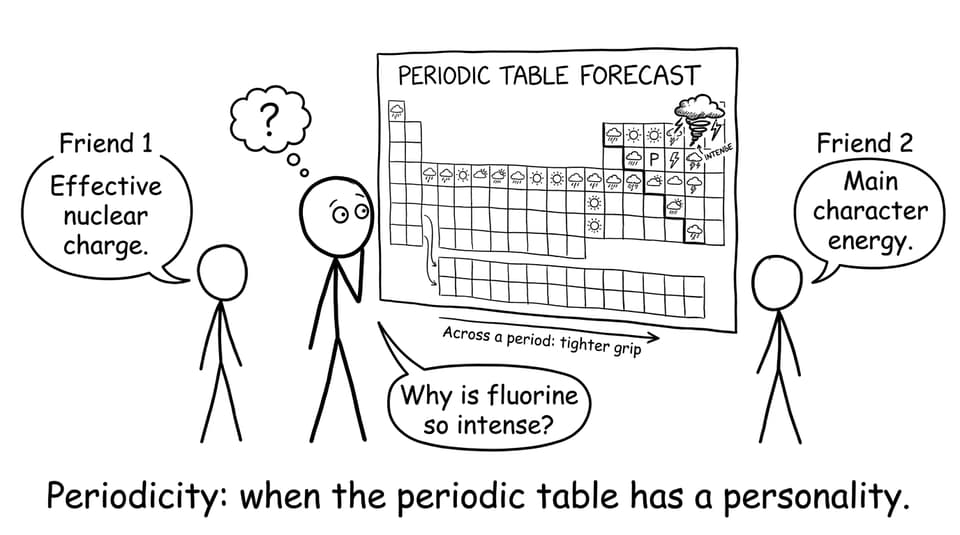
Periodicity: when the periodic table has a personality.

Periodicity in IB Chemistry (the simple definition)

In IB Chemistry, periodicity means repeating patterns in physical and chemical properties as you move across periods and down groups.

Those patterns exist because the periodic table is organised by increasing atomic number. That sounds basic, but it triggers two slow, powerful changes:

  • Across a period: nuclear charge increases, electrons go into the same main energy level

  • Down a group: atoms gain extra shells, so distance and shielding increase

If you want the syllabus-aligned overview in one place, keep the main topic page open while you revise: IB Chemistry Periodicity.

Quick periodicity checklist (what to mention in exam explanations)

When IB Chemistry questions say “explain,” they usually want cause-and-effect. Use this checklist before you write:

  • Does nuclear charge increase?

  • Are electrons added to the same shell or a new shell?

  • What happens to shielding?

  • What happens to atomic radius?

  • Does the atom hold electrons more tightly (affects ionization energy) or pull bonding electrons more strongly (affects electronegativity)?

This checklist matches the style you’ll train through RevisionDojo’s IB Chemistry Questionbank and topic-specific sets.

Why periodicity happens: two forces that never stop

Increasing nuclear charge across a period

Across a period, each element has one more proton than the last. More protons means a stronger positive pull from the nucleus.

Crucially, the added electrons usually go into the same main energy level, so shielding doesn’t jump dramatically. The result is higher effective nuclear charge felt by valence electrons.

If you want an exam-ready script for this, the focused guide Why Atomic Radius Decreases Across a Period turns the explanation into a repeatable paragraph.

More shells down a group (distance + shielding)

Down a group, atoms gain an extra shell each step.

That does two things:

  • increases the distance between nucleus and valence electrons

  • increases shielding from inner electrons

So even though nuclear charge increases down a group too, the outer electrons feel less of it.

The four trends you must own for IB Chemistry

Atomic radius (IB Chemistry trend)

Across a period, atomic radius decreases because effective nuclear charge increases and pulls electrons closer.

Down a group, atomic radius increases because added shells place valence electrons further out.

This isn’t just “size trivia.” It underpins reactivity, bond lengths, and why metals and non-metals behave so differently.

Ionization energy (IB Chemistry trend)

Across a period, ionization energy increases because electrons are held more tightly.

Down a group, ionization energy decreases because distance and shielding make electrons easier to remove.

For the exact wording IB examiners like, revise with Ionization Energy Explained Simply and then practise the same logic under timed conditions.

Electronegativity (IB Chemistry trend)

Across a period, electronegativity increases because atoms attract bonding electrons more strongly as radius decreases and effective nuclear charge rises.

Down a group, electronegativity decreases because bonding electrons are further from the nucleus and more shielded.

If this is a weak spot, the micro-topic guide Electronegativity Across a Period is built around the explanation chain you can reuse in any response.
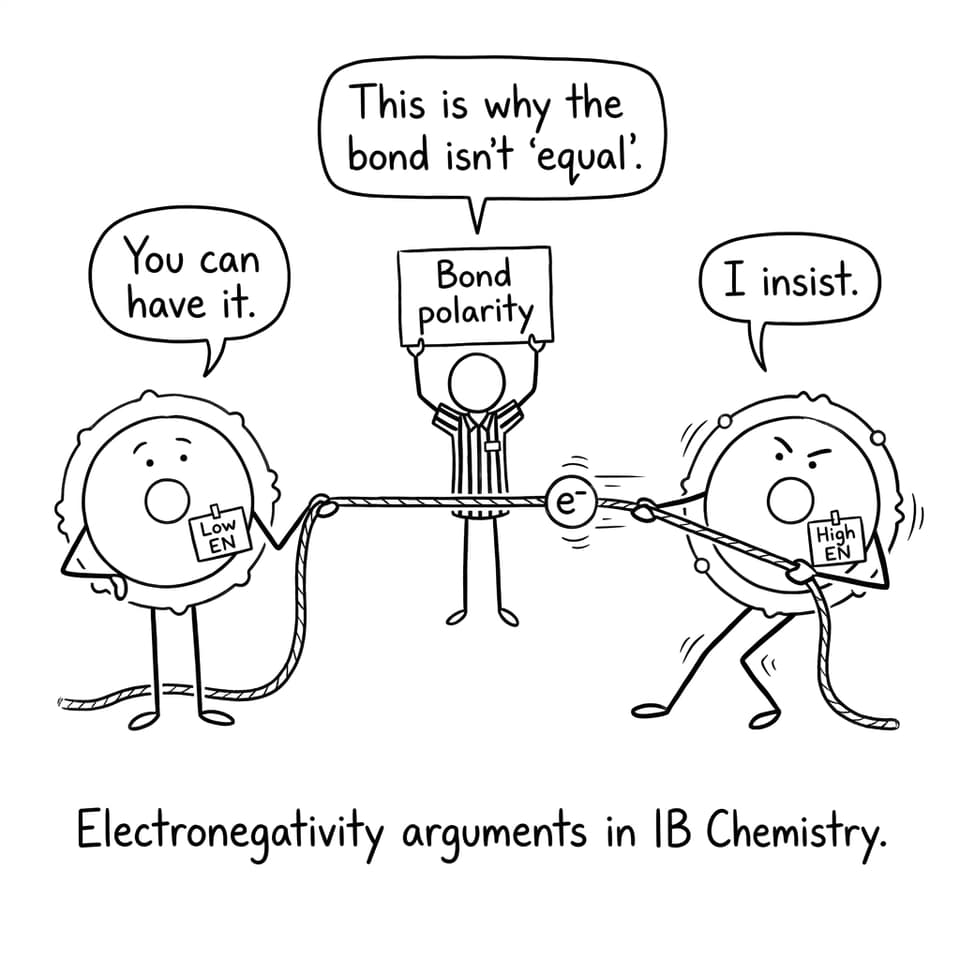
Electronegativity arguments in IB Chemistry.

Electron affinity (what to say without overcomplicating it)

In IB Chemistry, you can describe electron affinity trends cautiously:

  • across a period, adding an electron often becomes more exothermic (stronger attraction)

  • down a group, it often becomes less exothermic (more distance and shielding)

If a question pushes you, mention electron-electron repulsion and subshell effects as reasons real data can have exceptions.

Chemical periodicity you can actually use in answers

Periodicity isn’t only about graphs. It predicts behaviour.

Metallic character

  • across a period: metallic character decreases

  • down a group: metallic character increases

That’s why Group 1 metals get more reactive down the group (outer electron is easier to lose), while halogens get less reactive down the group (harder to gain an electron strongly).

Oxides across a period

A high-value IB Chemistry pattern: oxides trend from basic (left) to amphoteric (middle) to acidic (right). It’s one of the cleanest ways the periodic table explains bonding and acidity together.

How to practise periodicity like an examiner wants

Knowledge is important, but marks come from explanation under pressure.

Use RevisionDojo’s topic hub S3.1.3 Periodicity of Properties to move between Study Notes, Flashcards, and the Questionbank without losing momentum.

Then build repetition:

  • drill definitions with Periodicity Flashcards

  • practise cause-and-effect sentences using the Periodicity Questionbank

  • step up to timed paper-style practice with IB Chemistry Predicted Papers

If you like structured exam training, the strategy in Custom IB Mock Exams: Build Practice Tests by Topic helps you turn trends into automatic performance.
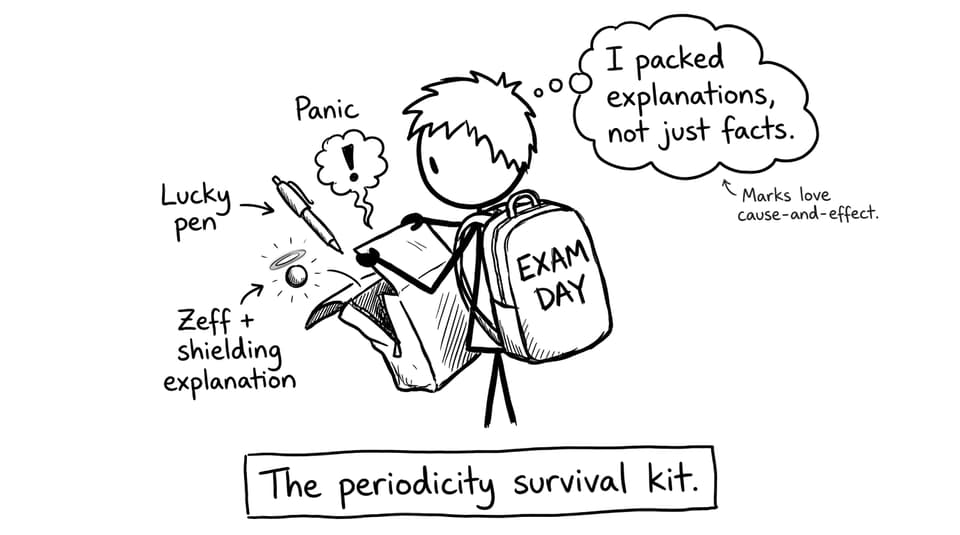
The periodicity survival kit.

Closing: the calm power of IB Chemistry periodicity

Periodicity is the quiet shortcut at the heart of IB Chemistry. It lets you predict properties instead of memorising them, and it turns the periodic table into an argument you can write under time pressure.

If you want periodicity to feel automatic, revise the key ideas on IB Chemistry Periodicity, drill them with Flashcards and Study Notes, and then pressure-test your explanations using the Questionbank, Mock Exams, and Predicted Papers. Add RevisionDojo’s AI Chat and Grading tools to get feedback that’s immediate and specific. That’s how trends become marks.

How helpful was this article?
Add as a preferred source on Google

Continue studying with RevisionDojo

  • IB Coursework GraderCheck an IA, EE, or TOK draft against IB assessment criteria.
  • IB Coursework ExamplesLearn from high-scoring coursework across IB subjects.
  • IB Grade CalculatorEstimate an IB grade using session-specific boundaries.
  • IB Grade BoundariesExplore historical grade boundaries by subject and session.

Frequently Asked Questions

Related Articles

IB en España · Oct 17, 2026 · 10 min read

Cómo estudiar Química del IB en inglés

Aprende a estudiar Química del IB en inglés con vocabulario técnico, estrategias para interpretar preguntas y métodos de redacción para NM y NS.

IB en España · Oct 17, 2026 · 12 min read

Cómo estudiar Química IB: guía completa para NM y NS

Aprende cómo estudiar Química IB en NM y NS con un plan de dos años, técnicas para cálculos y mecanismos, y estrategias para las Pruebas 1 y 2.

IB en España · Oct 16, 2026 · 10

TdC química IB: conexiones y estrategias

Aprende a conectar Química del IB y TdC mediante preguntas de conocimiento, objetos de exposición y ejemplos eficaces para el ensayo.

IB Chemistry · Oct 15, 2026 · 11

IB Chemistry IA Criteria: How It Is Actually Marked

Understand the IB Chemistry IA criteria, four 6-mark bands, best-fit marking, moderation, and practical ways to improve each section clearly.

IB en España · Oct 15, 2026 · 12

Monografía de Química del IB: ventajas, riesgos e ideas

Descubre si te conviene hacer la monografía de Química del IB, cómo formular la pregunta de investigación y qué temas y riesgos debes valorar.

IB Chemistry · Oct 14, 2026 · 9

How to Build an IB Chemistry Study Group for Fall

Build a productive IB Chemistry study group for September-November with clear roles, weekly agendas, exam practice, accountability, and IA safeguards.

min read
min read
min read
min read