
Ionization energy feels like one of those IB Chemistry phrases you can recite perfectly… right up until a question asks why oxygen breaks the trend, or what a “big jump” in data actually means.
Here’s the calmer way to learn it: imagine every atom is holding onto its outer electron like a phone at the end of a long day. Some atoms grip tightly. Others are basically tossing it to you. Ionization energy is just the “letting go price” of that electron.
In IB Chemistry, that price shows up everywhere: periodic trends, reactivity, electron configurations, and those data-based questions that reward understanding over memory.
Ionization energy (IB Chemistry definition you must know)
In IB Chemistry, first ionization energy is defined as:
The energy required to remove one mole of electrons from one mole of gaseous atoms to form one mole of gaseous 1+ ions.
You’ll often write it as:
X(g) -> X⁺(g) + e⁻
Why examiners care about the wording:
-
Gaseous means no intermolecular forces confusing the measurement.
-
One mole keeps the units consistent (kJ mol⁻¹).
-
1+ ions tells you it’s the first electron being removed.
If you want the official phrasing handy while revising, the IB Chemistry Key Definitions glossary is a quick reset.
A quick checklist to answer any IB Chemistry ionization energy question
Before you write a single sentence, run this mental checklist:
-
What changes in nuclear charge?
-
What changes in distance (atomic radius / shell number)?
-
What changes in shielding?
-
Are we removing an s or p electron?
-
Is there pairing repulsion involved?
That checklist is basically the marking scheme in disguise.
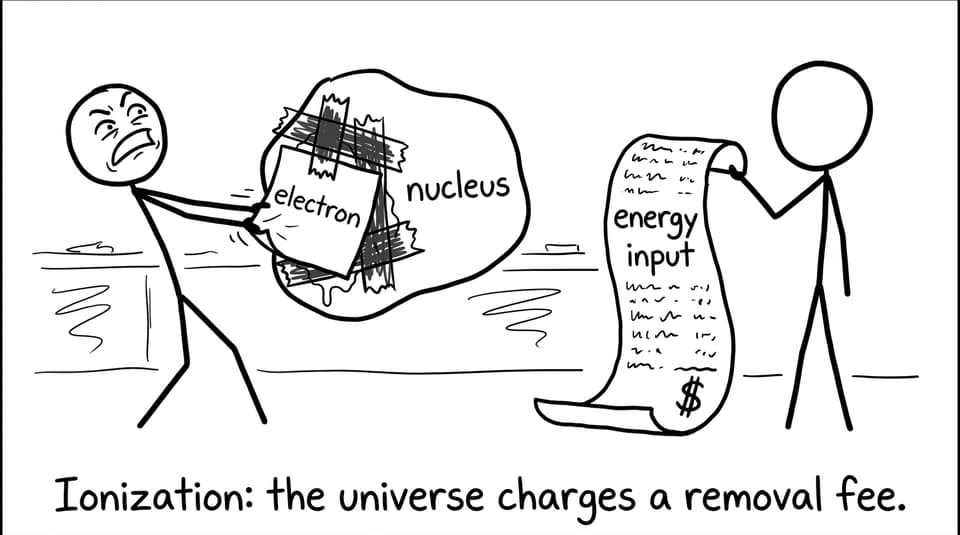
Why ionization energy always needs energy input
In IB Chemistry, ionization energy is about electrostatic attraction.
-
The nucleus is positive.
-
Electrons are negative.
-
Attraction exists.
So to remove an electron, you must supply energy to overcome that attraction.
Strong attraction -> high ionization energy.
Weak attraction -> low ionization energy.
This is the deep reason metals form cations easily: low ionization energy makes “electron loss” a cheap move.
If you’re building the bigger picture, it pairs well with how nuclear charge affects electron arrangement, because that same pull explains multiple periodic trends in IB Chemistry.
The three factors that control ionization energy in IB Chemistry
Nuclear charge (protons)
More protons generally means a stronger pull on electrons. In IB Chemistry language, you’re describing increased attraction between the nucleus and the outer electron.
Distance from the nucleus (atomic radius)
The farther the valence electron is from the nucleus, the weaker the attraction, so ionization energy drops.
Atomic radius trends matter here, so keep this close: What is the periodic trend for atomic radius?
Electron shielding
Inner electrons repel outer electrons and reduce the effective pull from the nucleus.
More shells -> more shielding -> lower ionization energy.
Periodic trends: what to say and what to mean
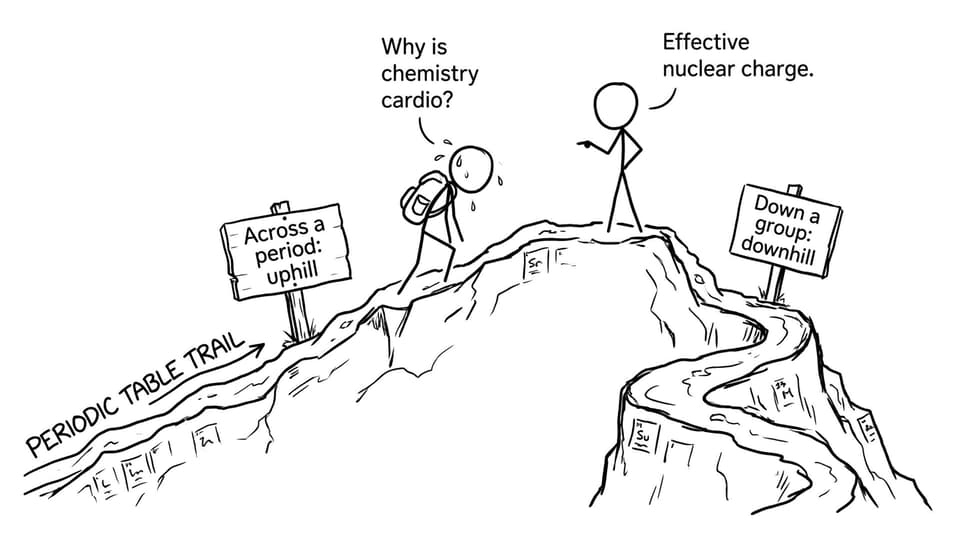
Across a period: ionization energy increases
In IB Chemistry, this is the standard explanation chain:
-
Nuclear charge increases
-
Electrons are added to the same shell
-
Shielding is roughly constant
-
Atomic radius decreases
-
Attraction increases
-
Ionization energy increases
To reinforce all periodicity together (not as isolated facts), review IB Chemistry 3.2 Periodic Trends.
Down a group: ionization energy decreases
Down a group in IB Chemistry:
-
A new shell is added
-
Distance increases a lot
-
Shielding increases
-
Outer electron feels a weaker effective nuclear charge
-
Ionization energy decreases
This is why Group 1 metals become more reactive down the group: it gets easier to remove that outer electron.
The famous exceptions (and how to explain them in one clean paragraph)
Examiners love exceptions because they show whether you understand orbitals, not just arrows on a graph.
Be vs B exception
Boron’s electron removed is from a 2p orbital, which is higher in energy than 2s. So it’s easier to remove, meaning B has a lower first ionization energy than Be.
N vs O exception
Nitrogen has 2p³: three unpaired electrons, relatively stable. Oxygen has 2p⁴: one orbital contains a pair, causing electron-electron repulsion. That repulsion makes it easier to remove one electron, lowering oxygen’s first ionization energy.
For orbital logic that makes these exceptions feel obvious, Hund’s Rule explained for IB Chemistry is the missing bridge for many students.
If you want targeted HL practice on these discontinuities, the syllabus-aligned videos at S3.1.7 Discontinuities in ionization energy trends are perfect for tightening explanations.
Successive ionization energies: the “big jump” that reveals the group
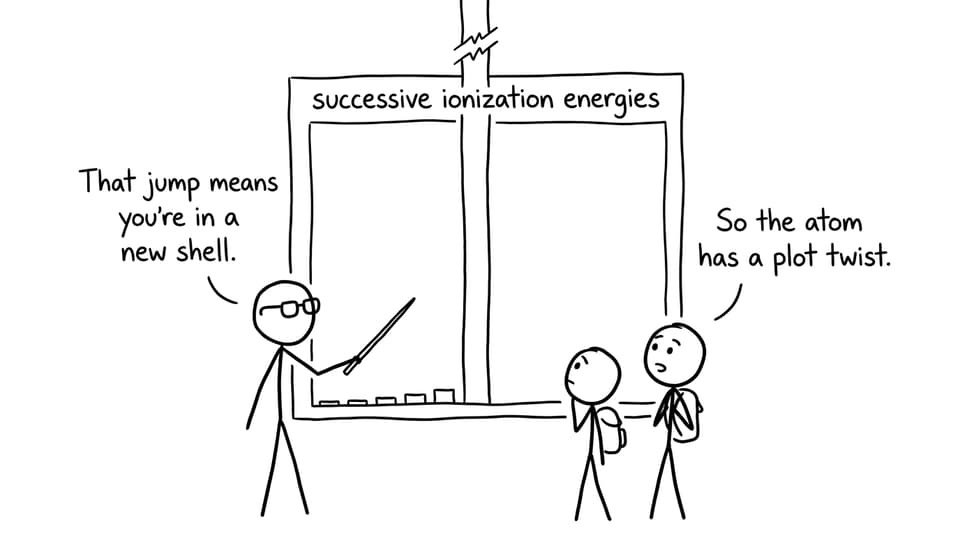
Successive ionization energies remove electrons one-by-one from the same atom. Each removal is harder because the ion is more positive, so attraction increases.
The exam trick in IB Chemistry is the large jump.
-
Small increases: still removing valence electrons.
-
Huge jump: you’ve started removing a core electron from a lower shell.
That jump tells you how many valence electrons existed in the neutral atom, which points to the group.
To drill this exactly how it appears in exams, use Successive Ionization Energies Notes alongside the Ionization Energy Questionbank.
A simple way to master ionization energy (and stop memorizing it)
If ionization energy is showing up as a blur in your IB Chemistry revision, don’t add more flash highlighting. Add repetition with feedback.
RevisionDojo is built for this: use the Study Notes to lock the definitions, Flashcards to keep trends automatic, and the Questionbank for exam-style practice that exposes weak spots early. When you’re stuck on an explanation, AI Chat can help you rewrite it in examiner language, and the Grading tools show what would (and wouldn’t) earn marks. Closer to exams, Predicted Papers and Mock Exams help you practise pacing without guessing what matters. And if you want a human to tighten your explanations, the Tutors and Coursework Library support the full IB journey.
Ionization energy is not a chapter to memorize. In IB Chemistry, it’s a lens. Once you see nuclear charge, shielding, and distance working together, the periodic table starts to feel less like a chart and more like a story you can explain under pressure.