



The moment you realise your feed is revision
A strange thing happens when you start preparing for IB English: the world stops feeling like “content” and starts feeling like evidence. A headline becomes a set of choices. A charity poster becomes an argument. Even a recipe starts to look like a voice with a goal.
That shift is basically the doorway into non-literary texts.
In IB English, non-literary texts matter because they show you language doing its day job: informing, persuading, instructing, warning, selling, recruiting, recording. They are built to act on a reader, not simply to exist beautifully on a page.
If you want a course-level map of how this fits into the subject, see Overview of IB English Language and Literature (Lang Lit).
What are non-literary texts?
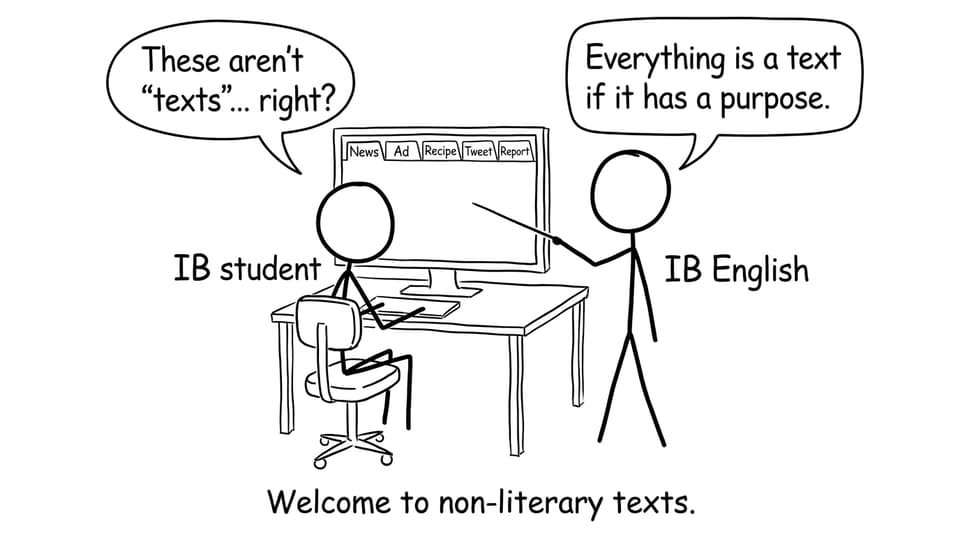
Non-literary texts are real-world texts (written, spoken, or multimodal) designed for a practical purpose. In IB English, you’re expected to treat them seriously: not as “easy texts,” but as carefully constructed messages shaped by audience, context, and medium.
A useful rule: if the creator wants a specific response from a specific audience, you’re probably looking at a non-literary text.
For a deeper definition and examples, read Understanding Non-Literary Texts in IB English A.
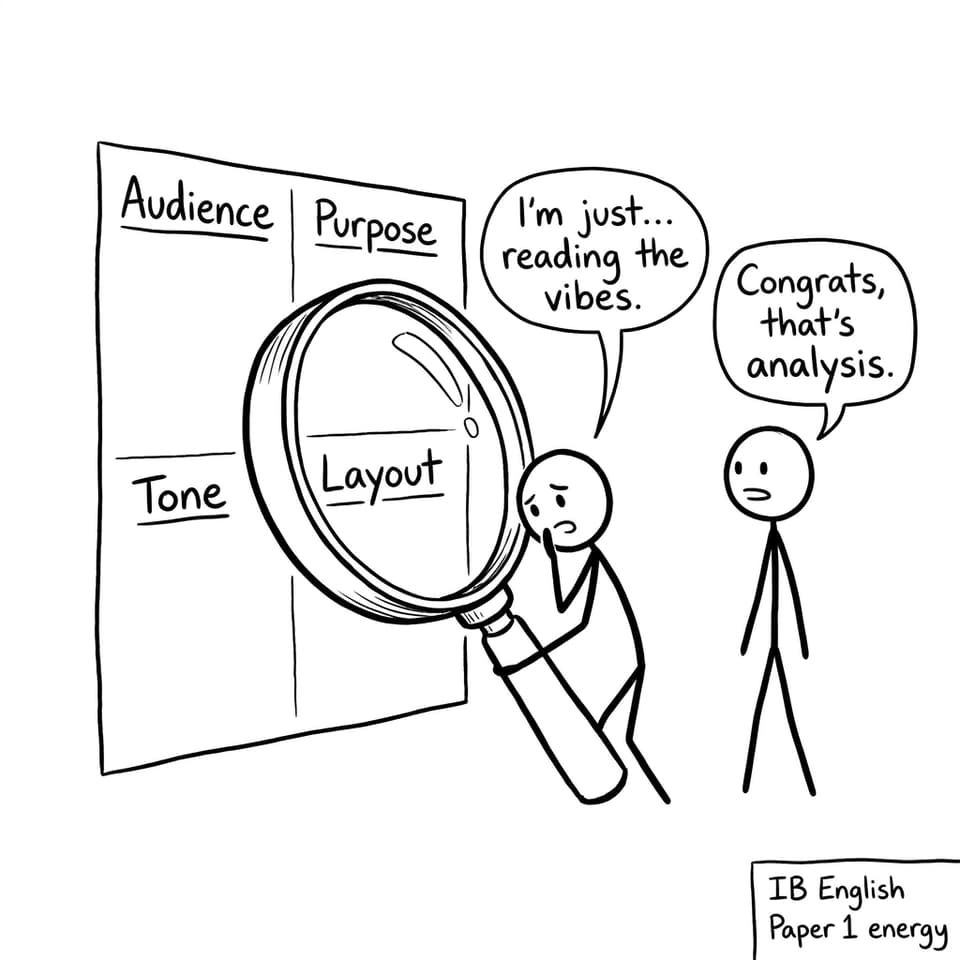
Quick checklist (the 30-second definition test)
Use this when you meet an unseen in IB English:
-
Text type: article, speech, ad, report, infographic, website?
-
Purpose: inform, persuade, instruct, critique, record?
-
Audience: who exactly, and what do they value?
-
Context: what situation made this necessary?
-
Techniques: language, structure, visuals (if any)
If you want the full exam routine, bookmark IB English: How to Analyze Non-Literary Texts Fast.
Common types of non-literary texts (with what to look for)
Non-literary texts show up everywhere in IB English Paper 1 style practice, and they’re easier to handle when you stop listing features and start asking what each feature is for.
News articles
News texts often project authority through structure: headlines, leads, quotes, data, and an “objective” tone that may still contain bias. Track what gets foregrounded, what gets omitted, and how the story frames responsibility.
Advertisements
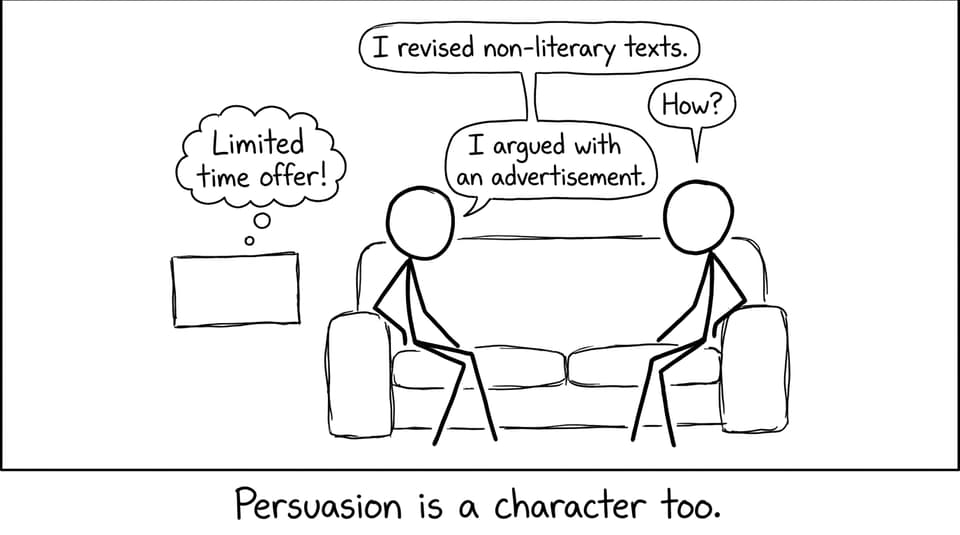
Ads compress persuasion into seconds. Look for emotional triggers, promises, fear of missing out, and identity language (“people like you”). Analyze how image and text collaborate to make the choice feel obvious.
Essays, editorials, and opinion pieces
These argue. The interesting part is not the topic, but the scaffolding: claims, evidence, counterarguments, and credibility. For targeted practice, use How to Critically Evaluate Arguments in Editorials and Opinion Pieces.
Instructional texts (manuals, recipes, guidelines)
These are built for clarity, so techniques show up as sequencing, imperatives, warnings, diagrams, and formatting. Ask how the text reduces confusion and controls outcomes.
Reports and official documents
Reports often use headings, charts, cautious modality (“may,” “suggests”), and formal register to sound reliable. The key skill in IB English is linking that “professional voice” to its purpose: trust.
Personal correspondence (letters, emails, diary-style entries)
Even personal writing has a designed reader effect. Watch intimacy, tone shifts, selective detail, and implied relationships.
Literary vs non-literary texts: the differences that actually help in exams
Students sometimes treat this as a memorisation task. In IB English, it’s more practical: these differences tell you what to prioritise when you annotate and plan.
Purpose
-
Literary texts often prioritise aesthetic experience, narrative complexity, ambiguity, and thematic resonance.
-
Non-literary texts prioritise function: to influence what readers know, feel, or do.
Language
-
Literary texts may lean on imagery, symbolism, and layered voice.
-
Non-literary texts usually prefer clarity or strategic persuasion: loaded diction, slogans, rhetorical questions, statistics, selective framing.
If you want technique vocabulary that fits non-fiction, see Identifying and Explaining Rhetorical Devices in Non-Fiction.
Structure and design
Non-literary structure is often conventional on purpose: headings, bullet points, columns, captions, hyperlinks, branding. In IB English, those design choices count as meaning, not decoration.
To strengthen your overall routine, use Step-by-Step Guide to Revising IB English Paper 1.
How non-literary texts are assessed in IB English
Non-literary analysis rewards one habit: moving from observation to effect.
Instead of “There is a statistic,” try: “The statistic functions as logos, narrowing the reader’s room to disagree and positioning the organisation as credible.”
A strong response in IB English usually does three things:
-
Names choices (language, structure, visuals)
-
Explains effects (on audience)
-
Connects to purpose (why those effects matter)
Audience is the hidden engine of most high-scoring commentary. For a focused guide, read Understanding Audience in IB English A: Language and Literature.
The takeaway: treat function like plot
Non-literary texts aren’t the “other” category in IB English. They’re the language you live inside: messages designed to shape attention, belief, and action. When you revise them well, you stop panicking about unfamiliar formats because you know what to ask every time: purpose, audience, choices, effect.
If you want one place to practise that consistently, RevisionDojo brings it together: Study Notes for foundations, a Coursework Library for examples, Tutors for feedback, and exam-focused practice through the Questionbank, Mock Exams, and Predicted Papers. The world is already full of texts. Your advantage in IB English is learning how to read the strings.