


You don’t notice persuasion when it’s working.
That’s the unnerving part.
A headline nudges your mood. A charity poster makes you feel responsible. A school email quietly makes “optional” sound mandatory. In IB English, analyzing non-literary texts is basically learning to see the strings: how writers and designers shape what you think, feel, and do.
If you’re preparing for Paper 1, this skill isn’t extra. It’s the whole game. And the best news is that non-literary analysis becomes easier once you stop hunting for “fancy devices” and start tracking one simple chain: choice → meaning → reader effect.
A quick IB English checklist (the 60-second plan)
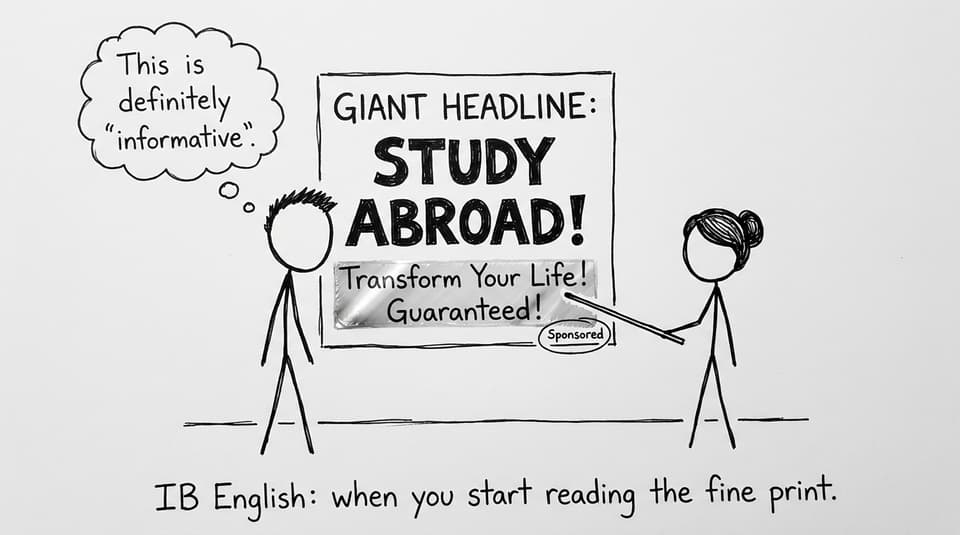
Before you write a single paragraph, run this mini-checklist. In IB English, it keeps you from summarizing and forces you into analysis.
-
Text type: ad, speech, opinion column, infographic, brochure, announcement?
-
Purpose: inform, persuade, entertain, instruct, warn, sell, recruit?
-
Audience: who exactly? what do they value? what do they fear?
-
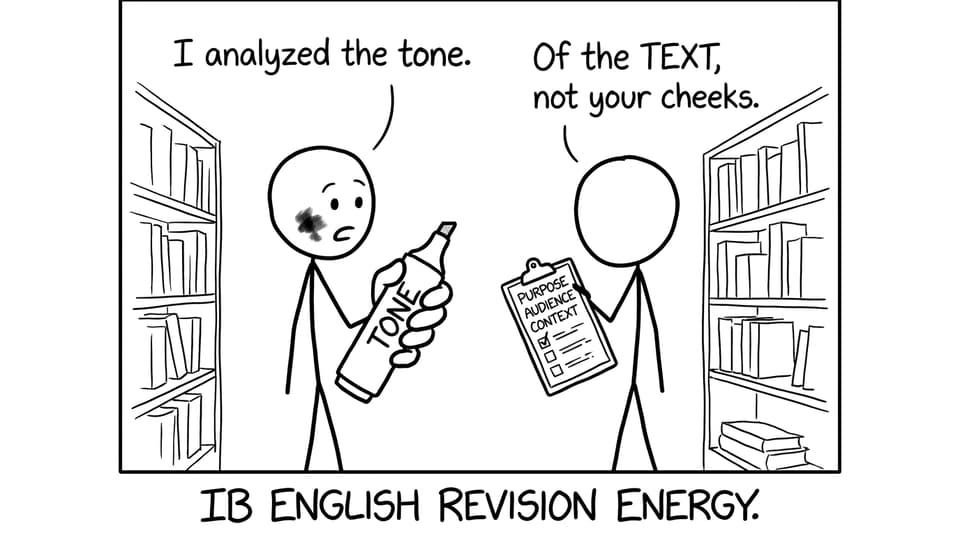
Context clues: time, place, platform, debate, cultural assumptions.
-
Big message: what “truth” does the text want to feel obvious?
-
Techniques: language + structure + visuals (if multimodal).
-
Effect: what reaction is engineered, and how successfully?
If you want a deeper map of text types, What Does IB Consider a Non-Literary Text? is a handy reference.
Start where the writer started: purpose + audience
Most students in IB English try to “spot techniques” first. That’s like describing a car by listing screws. Begin with motive.
Ask:
-
What does the creator want the reader to do or believe?
-
Who is most likely to comply?
A climate campaign aimed at teenagers doesn’t just “inform.” It might aim to turn anxiety into action, and action into identity. Once you name that purpose and audience, every choice in the text becomes easier to explain.
For more practice framing purpose and audience in Paper 1 conditions, pair this post with Step-by-Step Guide to Revising IB English Paper 1 and IB English Paper 1: Best Ways to Prepare (Expert Guide).
Context without a history lecture
In IB English, context is not a Wikipedia dump. It’s the smallest amount of background needed to clarify meaning.
Look for context that is visible inside the text:
-
Platform cues: newspaper layout, social post format, corporate letterhead.
-
Shared assumptions: “everyone knows…” claims.
-
Timing hints: references to a current crisis, election season, new policy.
A useful habit: write one sentence that begins, “Because this appears in/for ___, the creator can assume ___.” That’s contextual analysis that actually earns marks.
If you’re working specifically on how stylistic choices connect to meaning, How to Analyze Language and Style in Unseen Texts (Paper 1) layers perfectly onto this step.
Structure is persuasion in disguise
Structure is where IB English responses quietly level up.
Instead of saying “it has a headline,” ask why the headline exists and what it does.
Track common structural moves:
-
Hook → build → payoff: urgency first, reasoning second, call-to-action last.
-
Problem → solution: create discomfort, then offer relief.
-
Contrast and shifts: a tonal pivot from calm to alarm; from “we” to “you.”
-
Pacing: short sentences can feel confident, urgent, or absolute.
When you comment on structure, you’re showing the examiner you understand control: how the text guides attention like a hand on your shoulder.
Language and rhetorical techniques (but always with effect)
In IB English, naming devices is only step one. The marks come from explaining how the device positions the reader.
Choose a few techniques you can analyze deeply:
Diction and connotation
Ask what kind of world the word choice assumes. “Protect,” “restore,” and “defend” don’t just describe actions; they imply a threat.
Tone and register
Is the voice friendly, expert, outraged, intimate, amused? Then ask: Why would that tone work on this audience?
Syntax and rhythm
Long periodic sentences can sound measured and authoritative. Fragments can sound like certainty.
Persuasion (ethos, pathos, logos)
-
Ethos: credibility through expertise, professionalism, testimonials.
-
Pathos: emotion through imagery, loaded adjectives, personal stories.
-
Logos: logic through statistics, cause-effect claims, “common sense.”
Want a bigger routine for building these skills across the week? What’s the Best Way to Study for Paper 1 vs. Paper 2? offers a strong practice structure.
Visual elements: treat them like sentences
Many Paper 1 texts are multimodal. In IB English, visuals are not decoration; they’re argument.
Comment on:
-
Framing and angle: who looks powerful, who looks small, what feels distant.
-
Color and contrast: what gets attention first, and why.
-
Typography: boldness can feel like certainty; minimalist design can signal “premium.”
-
Layout and reading path: where your eye is pushed next.
A clean way to write this: “The visual design reinforces ___ by making the viewer notice ___ before ___.”
To see how RevisionDojo breaks down non-literary choices across formats, Understanding Non-Literary Texts in IB English A is a strong companion read.
A mini example you can borrow in the exam
Imagine an ad for a new phone.
-
Purpose/Audience: persuade tech-curious students to upgrade.
-
Structure: oversized headline, then three short feature bullets, then price.
-
Language: “limitless,” “next-gen,” “unmatched” creates status pressure.
-
Visuals: glossy close-up + lots of white space suggests modernity and control.
-
Effect: the reader is positioned to feel behind unless they act.
That’s analysis: a chain of decisions and outcomes. That’s IB English scoring territory.
How RevisionDojo helps you train this skill (without guessing)
The frustrating part of IB English Paper 1 is not knowing whether your analysis is “enough.” RevisionDojo solves that gap by turning practice into feedback loops.
-
Use the Study Notes to revise frameworks for purpose, audience, tone, and structure.
-
Drill interpretation under time pressure with the Questionbank.
-
Convert recurring technique-effect patterns into Flashcards.
-
Use AI Chat to test thesis statements and paragraph plans before you write.
-
Improve clarity with Grading tools, then fix one paragraph at a time.
-
Build exam stamina with Mock Exams and Predicted Papers.
-
If you’re juggling coursework, the Coursework Library keeps models and standards in one place.
-
When you want a human second opinion, Tutors can help you refine analysis fast.
A good starting point is the broader RevisionDojo workflow in RevisionDojo App: The Smarter Way to Prep for IB Exams.
Closing: make your analysis feel inevitable
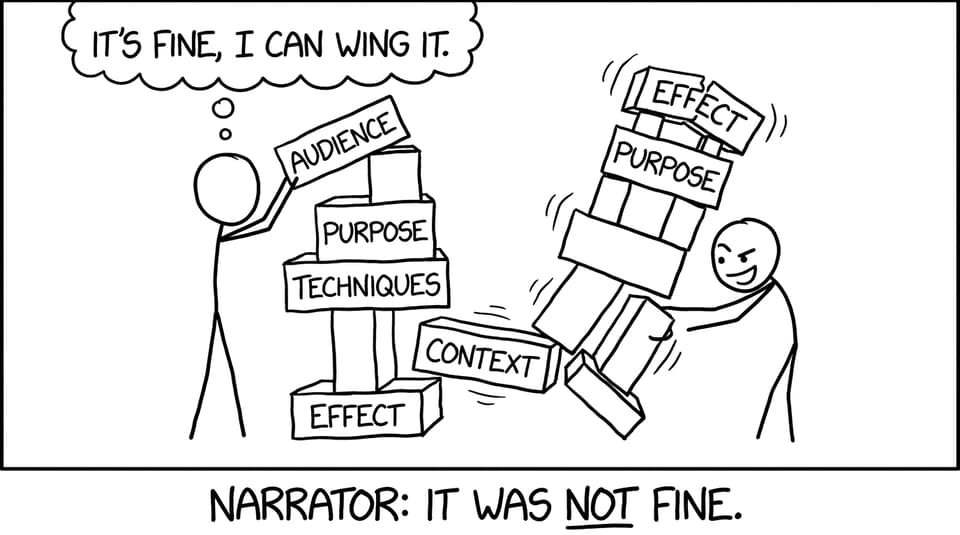
The calm confidence you want in IB English Paper 1 doesn’t come from having the “right” interpretation. It comes from building a clear chain: purpose and audience first, then choices, then effect.
If you want that chain to become automatic, practice it the way you practice anything else: short, repeated reps with feedback. Use RevisionDojo’s Questionbank for targeted drills, tighten your paragraphs with Grading tools, and pressure-test your ideas with AI Chat. When exam day arrives, you won’t be guessing what the text means.
You’ll be explaining how it works, and why it works on us.