


Magical realism doesn’t announce itself with fireworks. It walks into an ordinary kitchen, sits at the table, and quietly asks for tea.
That’s why it can feel so unsettling in IB English. You’re trained to look for “realistic” cause and effect. Then a ghost starts folding laundry, nobody panics, and the narrator moves on like it’s Tuesday. If you treat that moment like fantasy, you miss the point. If you treat it like nothing, you miss the craft.
This guide breaks down the key elements of magical realism in a way that’s practical for IB English exams, especially Paper 1 analysis and Paper 2 comparison.
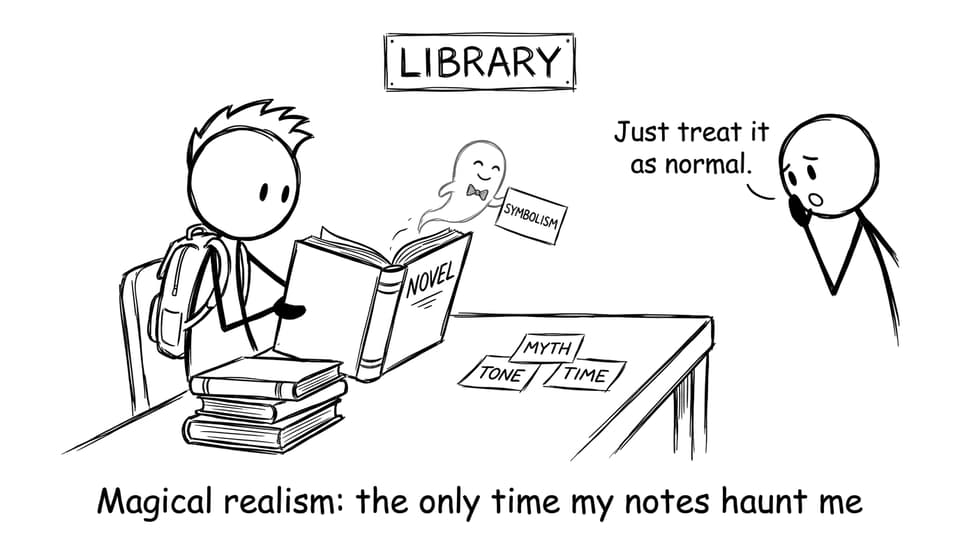
Magical realism in IB English: an exam-day checklist
Use this quick scan before you start writing (or while annotating):
-
Spot the magical detail and note how normal it’s treated.
-
Track the tone: calm? observational? almost journalistic?
-
Ask what the magic symbolizes (emotion, history, identity, trauma).
-
Notice any time or space distortions (loops, memories turning physical, dream logic).
-
Link the magic to cultural context or power dynamics.
-
Turn it into an argument: choice → effect → meaning (the core habit in IB English).
If you want your revision sessions to produce exam-ready notes, pair this with Effective Note-Taking Strategies for IB English Language and Literature.
The everyday world stays intact (that’s the trick)
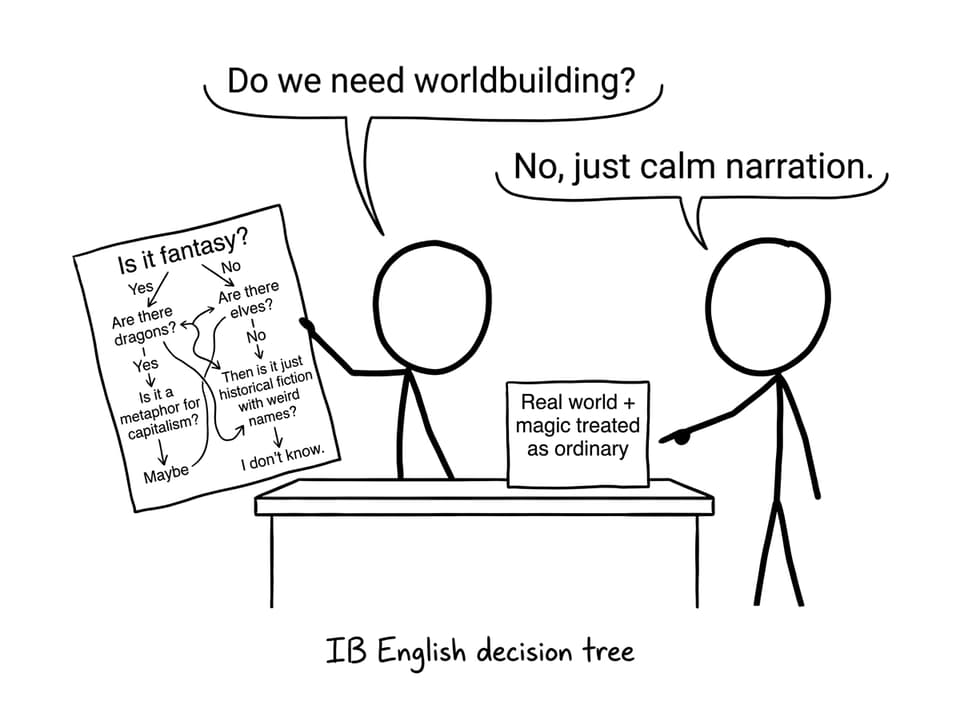
The signature move in magical realism is not “magic.” It’s placement.
In fantasy, the world changes to make room for the supernatural. In magical realism, the world mostly stays recognizable: familiar streets, social routines, domestic objects, political tensions. Then something impossible slips in, and the narration treats it as compatible with reality.
For IB English, that means your analysis should focus less on “what the magic is” and more on how the text refuses to treat it as a problem. That refusal is an authorial choice. It shapes the reader’s trust, discomfort, and curiosity.
In Paper 1 terms, it’s a structural and tonal strategy that controls audience response. In Paper 2, it becomes a comparative lens: which text normalizes the unreal more completely, and to what end?
Matter-of-fact tone: the narrator’s straight face
Magical realism often works because the narration doesn’t blink.
A miraculous event can be reported with the same calm detail as a shopping list. Characters may acknowledge it briefly, or not at all. The result is a strange emotional pressure: the reader feels the shock that the characters refuse to perform.
In IB English, tone is an easy place to earn marks because it’s observable and explainable. Don’t just label tone as “calm.” Explain what it does:
-
It normalizes the extraordinary, making the magic feel socially real.
-
It pushes readers to look for symbolic meaning instead of plot logic.
-
It can create irony: the narration sounds stable while reality is not.
To sharpen this skill, RevisionDojo’s breakdown of exam technique in Mastering IB English Paper 1: A Complete Guide helps you turn observations into thesis-driven paragraphs.
Symbolism and mythic resonance: magic that carries history
In magical realism, supernatural moments rarely exist for spectacle. They carry weight. Often, they echo folklore, spiritual belief, collective memory, or inherited trauma.
So when you write IB English analysis, treat magical elements as compressed meaning:
-
A ghost can be a figure for unresolved history.
-
A transformation can represent identity conflict or social labeling.
-
An impossible object can stand in for power (who controls reality?)
The strongest exam paragraphs make a clear chain: symbol → theme → context. This is where cultural context becomes more than background knowledge; it becomes interpretive evidence.
If you’re building lines of inquiry for coursework or Oral preparation, the approach in Choosing Your Line of Inquiry shows how to turn technique (like magical realism) into a focused analytical question.
Fluid time and porous space: when chronology becomes meaning
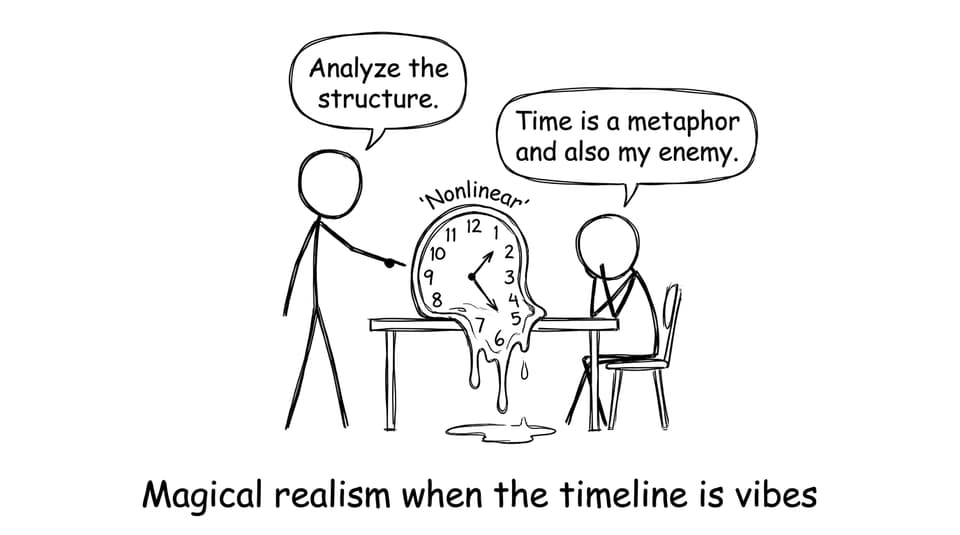
Magical realism often bends time, not to confuse you, but to reveal something.
Memories may intrude into the present as if they’re physical. Generations can overlap in a single scene. Places may feel haunted not by ghosts, but by unfinished experience.
For IB English, time shifts are a gift if you treat them as structure:
-
Nonlinear sequencing can mirror trauma (the past refuses to stay past).
-
Cyclical time can suggest fate, repetition, or social stagnation.
-
Dream-like space can expose inner truth more clearly than realism can.
This is also where comparison becomes powerful in Paper 2: one text might use time distortion to explore family memory, while another uses it to critique national history.
Social and political commentary: the quiet argument under the miracle
Magical realism frequently emerges from contexts shaped by colonialism, dictatorship, inequality, or cultural suppression. The “unreal” becomes a way to say what realism can’t safely say, or can’t fully capture.
In IB English, this is where you can move from identifying features to making a high-scoring claim:
-
The text uses normalized magic to question official truth.
-
The supernatural can give voice to people history ignored.
-
The blended reality can expose how “rational” systems still produce injustice.
If you want to avoid the most common trap (retelling the story instead of analyzing authorial choices), RevisionDojo’s Common Mistakes to Avoid in IB English A Essay Writing is a strong reset.
How RevisionDojo helps you turn magical realism into marks
Knowing the elements is step one. Training them under exam conditions is step two.
On RevisionDojo, you can practice IB English analysis using the Questionbank and build timed sets with the Exam builder inside IB English A Lang & Lit Resources. When you draft paragraphs, AI Chat can help you pressure-test thesis statements, and the Grading tools can flag where you slip into summary.
For Literature-focused preparation, the hub at IB English A Lit Resources connects you to Study Notes, Flashcards, Mock Exams, Predicted Papers, and the Coursework Library, and you can loop in Tutors when you want human feedback on the same rubric examiners use.
If your current struggle is building arguable claims quickly, IB English Thesis Statements: A Clear Writing Guide is a practical companion.
Closing: make the impossible do real work
Magical realism is not an escape from reality. It’s a way of insisting that reality is bigger than the obvious.
When you spot the key elements of magical realism, the everyday setting, the matter-of-fact tone, symbolic magic, flexible time, and quiet social critique, you stop reading for “what happened” and start reading for “what it reveals.” That shift is exactly what IB English rewards.
If you want to turn that understanding into consistent marks, use RevisionDojo to drill the skill: practice with the Questionbank, refine paragraphs with AI Chat and Grading tools, lock in recall with Flashcards, and stress-test your readiness with Mock Exams and Predicted Papers. Then walk into the exam with a calm narrator’s confidence: the strange can appear, and you’ll know what to do with it.