



In IB English, the moment you realise an advertisement can be as “serious” as a poem is the moment the course starts making sense.
It usually happens late at night. You are scrolling, half-revising, half-avoiding revision, and you see a post that looks harmless: a headline, a photo, a confident caption. Then you remember Paper 1. Suddenly the post feels like a machine with gears you are supposed to name: purpose, audience, context, and the choices that quietly push a reader toward belief.
That is the point of non-literary texts in IB English. The IB is not asking you to become suspicious of everything. It is asking you to become literate in the real world.
What IB English means by a non-literary text
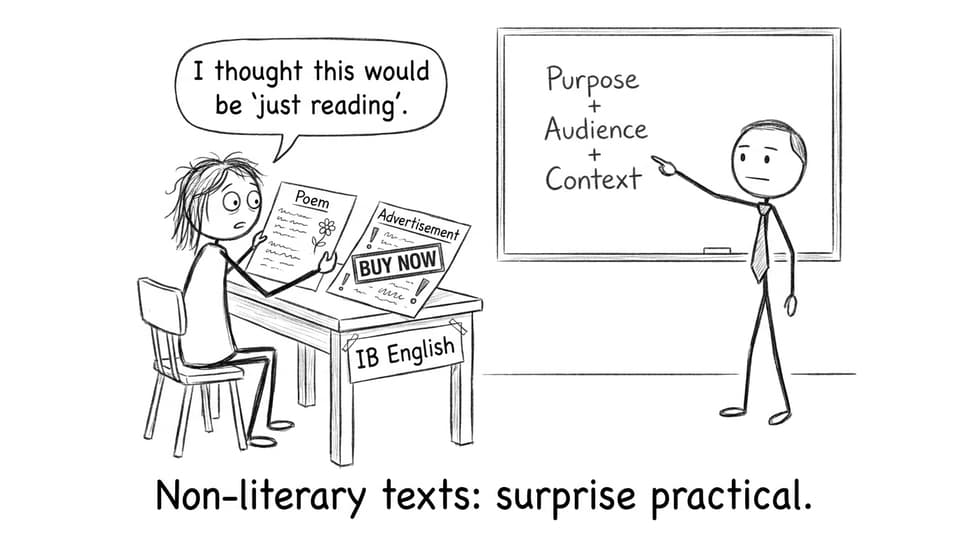
In IB English Language and Literature, a non-literary text is a text (often multimodal) created mainly for a functional purpose: to inform, persuade, entertain, instruct, warn, sell, recruit, or shape opinion.
This does not mean non-literary texts are “simple.” Many are more engineered than fiction. Their craft just wears different clothing: headlines instead of stanza breaks, layout instead of narrative arc, data instead of symbolism, design instead of imagery (though imagery appears plenty too).
If you want a deeper Paper 1-ready method, keep this open: How to Analyze Non-Literary Texts in IB English Language and Literature.
Quick checklist: how to spot a non-literary text fast (exam-ready)
Use this 30-second filter in IB English before you annotate.
-
Text type: article, ad, speech, report, infographic, blog, website, letter, email, poster, campaign?
-
Primary purpose: inform, persuade, critique, instruct, entertain?
-
Target audience: who is this for, and what do they value or fear?
-
Context: when/where was it made, and what debate does it sit inside?
-
Mode: purely written, spoken, or multimodal (image + text + layout + interactive elements)?
-
Effectiveness: does it achieve what it tries to do, and at what cost?
For practice loops (timing, annotation, structure), pair the checklist with: IB English Paper 1: Best Ways to Prepare.
Common non-literary text types IB English students should know
The IB is flexible about what can count as non-literary. What matters most is that you can justify purpose, audience, and choices. Here are the most common categories you will meet in IB English.
Advertisements and marketing campaigns
Ads are built to create desire, urgency, and identity. In IB English, they are perfect because every feature is deliberate: slogan length, colour contrast, testimonial placement, even what is left out.
Look for:
-
Direct address (“you”), imperatives, calls to action
-
Emotional appeals (fear, pride, belonging)
-
Visual hierarchy (what your eye is forced to notice first)
News articles and features
News writing sits on a spectrum: from “neutral reporting” to subtly persuasive framing. In IB English, the best analysis notices how objectivity is performed: quotation choice, statistics, headline tone, and what background is assumed.
Look for:
-
Headline bias, loaded verbs, selective sourcing
-
Structure (inverted pyramid, human-interest hook)
-
Balance claims (what counts as “evidence” here?)
Editorials, opinion columns, and comment pieces
These texts argue. That makes them very friendly for Paper 1 because you can track the argument’s spine.
Look for:
-
Concessions (“Some may argue…”) and refutations
-
Rhetorical questions, parallelism, repetition
-
Shifts from “problem” to “solution” framing
For technique language you can reuse in paragraphs, see: Identifying and Explaining Rhetorical Devices in Non-Fiction.
Speeches and talks
Speeches are written to be heard. Rhythm, pause, emphasis, and shared values matter. In IB English, speeches reward you for noticing how speakers construct credibility and closeness.
Look for:
-
Inclusive pronouns (“we”), personal anecdotes
-
Triadic structures, repetition, crescendo endings
-
Tone management: inspirational, urgent, defiant, reassuring
Reports, formal documents, and institutional writing
Reports often look “dry,” which is exactly why they are powerful. Their authority comes from structure: headings, passive voice, graphs, and careful hedging.
Look for:
-
Formal register, cautious modality (“may,” “suggests”)
-
Data presentation and what it implies
-
How objectivity is used to build trust
To strengthen your foundations in real-world prose, RevisionDojo’s notes section on non-fiction is a strong companion: Prose Non-Fiction Study Notes.
Instructional texts (manuals, guidelines, how-to writing)
These texts aim to reduce ambiguity. In IB English, they are great for analysing clarity: sequencing, imperative verbs, warnings, diagrams, and user assumptions.
Look for:
-
Step-by-step structure, numbered procedures
-
Safety language, conditional statements
-
Audience knowledge assumptions (beginner vs expert)
Personal correspondence (letters, emails, open letters)
Letters can be intimate or strategic. In IB English, the key is relationship: who has power, who is persuading, and what is at stake.
Look for:
-
Politeness strategies, implied pressure, softened requests
-
Tone as relationship-management
-
What is explicit vs carefully implied
Digital and multimodal texts (social posts, websites, blogs)
A digital text is rarely “just words.” It is layout, comments, hashtags, images, and platform culture. In IB English, that means you can analyse meaning-making across modes.
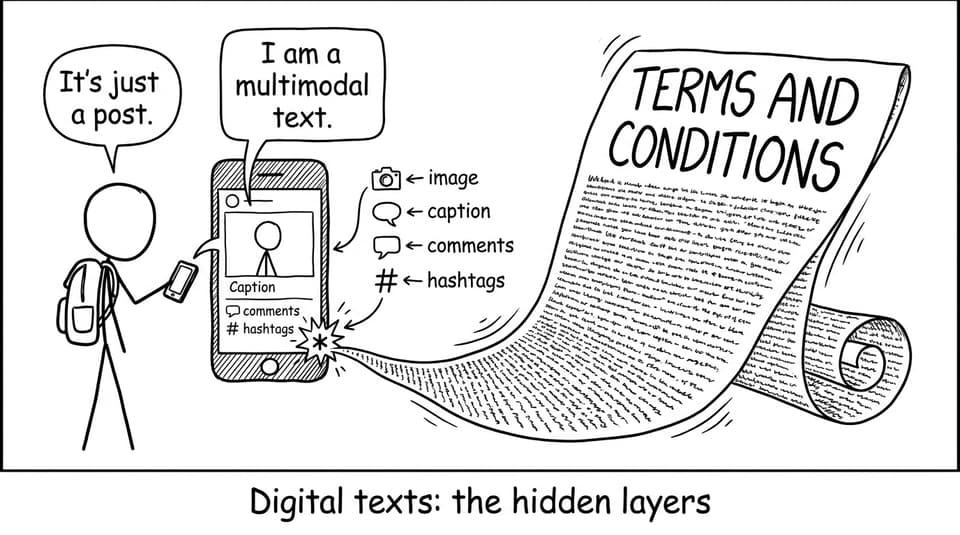
Look for:
-
Cropping, filters, typography, scrolling structure
-
Captions vs images (agreement, irony, contrast)
-
Interactivity: likes, shares, comment tone, algorithm-friendly wording
For students using film as their non-literary body of work, this is essential: How to Use Film and Media Texts in IB English Language and Literature.
How to analyse any non-literary text in IB English (without panicking)
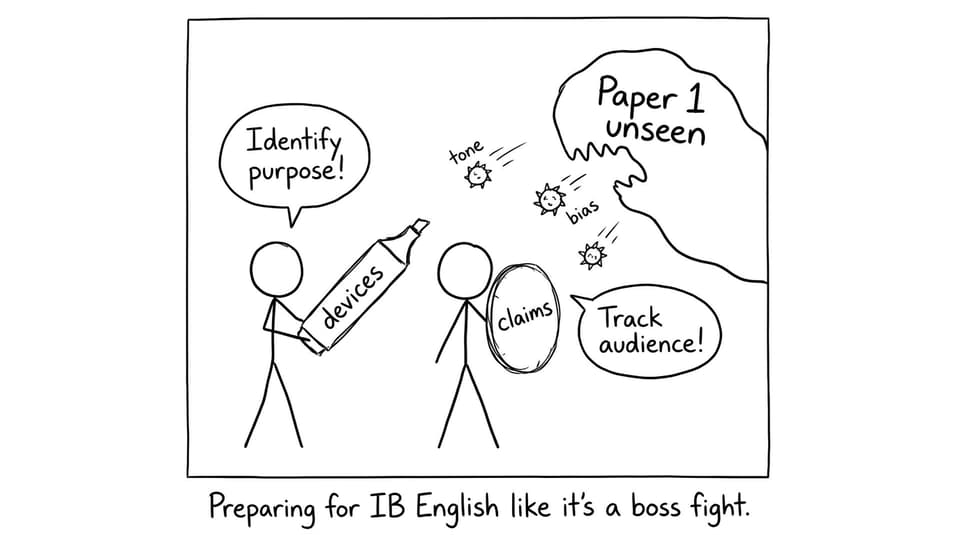
Most students freeze because they think analysis means collecting “devices.” In IB English, analysis is simpler and harder: you must show how choices create meaning for a specific audience.
Start with purpose and audience (then earn your techniques)
Write one sentence that names the purpose and audience precisely. Not “to persuade readers” but “to pressure environmentally conscious teens into seeing fast fashion as harmless.” Precision gives your commentary direction.
If you want a tight, repeatable framework, use RevisionDojo’s breakdown here: How to Analyze Non-Literary Texts.
Track structure like a map, not a list
Non-literary texts often move in stages: hook, problem, evidence, emotional turn, solution, call to action. In IB English, you get marks for noticing progression because it proves you understand design.
Translate observations into examiner-friendly claims
Use this chain:
Choice leads to effect on audience, which leads to meaning/message, which links to purpose
That one line stops you from summarising. It also keeps your paragraphs coherent when time is tight.
Build practice loops with feedback
At RevisionDojo, students often improve fastest when they combine:
-
Questionbank drills for unseen text variety
-
Study Notes to name techniques accurately
-
Flashcards to turn recurring mistakes into memory
-
AI Chat to test thesis ideas and paragraph direction
-
Grading tools to see what “top band” actually looks like
-
Mock Exams to train timing under pressure
-
Predicted Papers for realistic exam-style practice sets
-
Tutors when you need human feedback on argument clarity
If you are organising your overall revision routine, this is a strong companion: Effective Study Techniques for IB English A: Language and Literature.
Closing: make IB English feel like real life (because it is)
Non-literary texts are the language you live inside: headlines, policies, campaigns, posts, instructions, promises. IB English asks you to slow down and notice the machinery behind them, not to become cynical, but to become clear.
If you want to practise with variety, feedback, and structure, start inside the IB English A Lang & Lit Resources hub. Use the Questionbank to build confidence, the Study Notes to keep your terminology accurate, and the Grading tools to learn what top-band analysis actually looks like under time pressure. In IB English, calm is rarely talent. It is usually just repetition with the right tools.