



The moment it becomes real
It usually happens in a boring moment: you open your CAS portfolio, expecting a quick tick-box, and realize there’s a hole in it. A missing reflection. Not a missing photo, not a missing supervisor signature, a missing explanation of what changed in you.
That’s the part many students underestimate about IB CAS. CAS isn’t “extra credit” for being busy. It’s a core requirement. And reflections are the proof.
If you’re deep in exam prep right now, this can feel unfair: you did the thing, why do you also have to write about the thing? But the IB logic is simple: without reflection, there’s no evidence of learning.
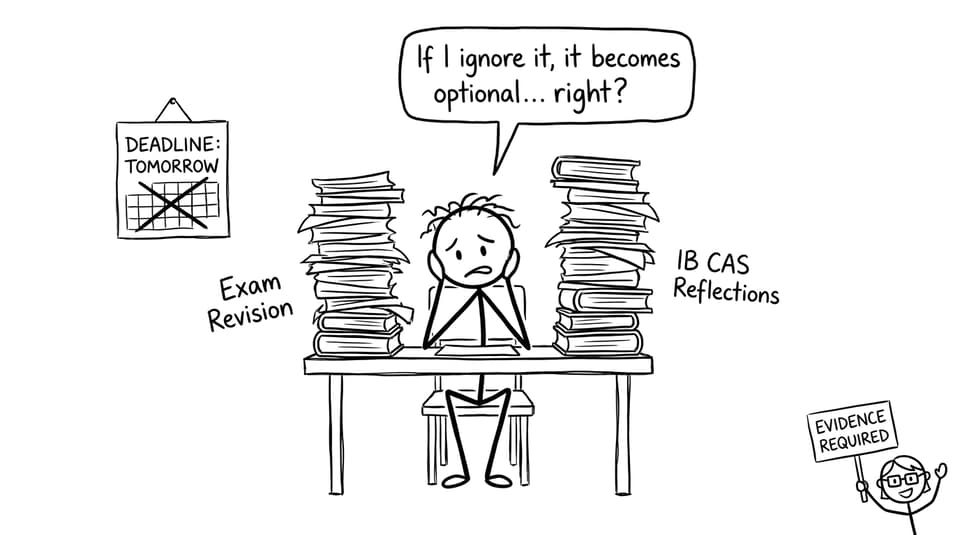
Quick checklist: what happens if you don’t submit a reflection
If you skip a reflection in IB CAS, schools may:
-
Mark the CAS experience as invalid (even if you really did it)
-
Flag your CAS portfolio as incomplete
-
Ask you to write a catch-up reflection (sometimes with stricter requirements)
-
Require additional CAS experiences to cover missing learning outcomes
-
Report CAS as incomplete, which can block your IB Diploma award
For a wider view of how CAS fits into the core, read What Is the Core Requirement in IB?.
Why reflections matter in IB CAS (and why “I showed up” isn’t enough)
A CAS reflection is not a diary entry. It’s evidence that an experience created learning: a challenge faced, a decision made, an impact noticed, a skill developed.
In IB CAS, the coordinator is looking for signs you’re meeting the CAS learning outcomes over time. The emphasis is growth, not perfection. But growth has to be visible. And in CAS, visibility comes from reflections.
If you want a practical template that makes reflections faster and better, start with IB CAS: 10 Tips for a Standout Reflection. It’s the difference between “I helped at an event” and “I learned how to lead when plans break.”
Can you fail IB CAS for missing reflections?
Yes, you can.
Here’s the key: IB CAS is verified through your school, not by external examiners. Your CAS coordinator checks whether your portfolio shows ongoing engagement, balance across creativity/activity/service, progress on your CAS project, and evidence across the outcomes.
When reflections are missing (or thin, rushed, and repetitive), your coordinator may not be able to confirm completion. If CAS is reported as incomplete, you may not be awarded the diploma, even if your exam scores are strong.
To understand how that verification process works in real life, see IB CAS Verification: Official Process Explained.
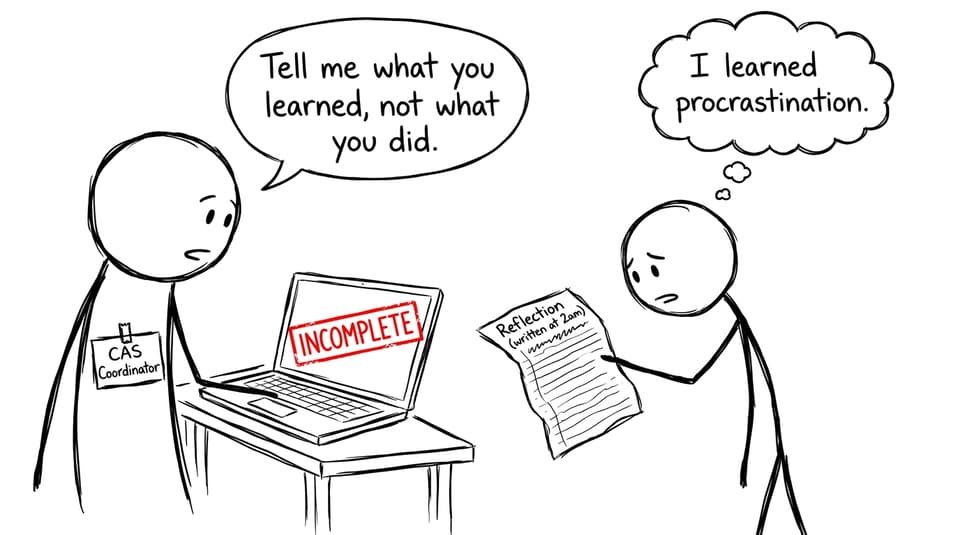
What if you submit an IB CAS reflection late?
Late reflections are a school decision, but they come with two risks.
First, late reflections often feel less credible because they can sound generic. It’s hard to write honestly about a challenge you barely remember.
Second, CAS is designed to be ongoing. If your portfolio suddenly fills up in one weekend, it can look like “catch-up compliance,” not sustained learning. Some coordinators allow late submissions, some don’t, and most will ask for higher quality when timing is off.
A calmer approach is to keep CAS sustainable during exam season rather than pausing it entirely. This guide helps: How to Balance CAS with Academics and Social Life.
How many reflections do you need for IB CAS?
The IB doesn’t set a fixed number. Schools usually expect at least one reflection per experience, and multiple reflections for longer projects.
What matters most is coverage: you need enough reflective evidence across your portfolio to show the learning outcomes are met over time.
If you’re unsure whether you’re logging an “experience” or building a “project,” clarify it early with What Counts as a CAS Project vs. a CAS Experience?. That single distinction can save you weeks of rework in IB CAS.
What to do right now if you forgot a CAS reflection
Don’t panic-scroll your portfolio. Do this instead:
Write one honest catch-up reflection (today)
Set a 12-minute timer. Describe one specific moment, one challenge, one learning outcome, one change, and one next step. Specific beats long.
Tell your CAS coordinator early
Early communication makes coordinators more flexible because it signals responsibility, not avoidance.
Stabilize your system
If exams are the reason CAS slipped, protect two fixed weekly windows: one for the experience, one for documentation. This burnout-proof approach is explained in Balancing CAS With Real Life (Without Burning Out).
Use RevisionDojo to keep everything in one place
When your week is full, organization becomes a grade. RevisionDojo helps you keep IB CAS and exam prep from fighting each other: use Study Notes for fast clarity, Flashcards for daily recall, and the Questionbank to turn understanding into marks. When you get stuck, AI Chat helps you move again. And as exams approach, Mock Exams and Predicted Papers build timing and confidence without guessing. If you need examples of strong work or structure, the Coursework Library and Grading tools tighten feedback loops fast. And if you want a human plan, Tutors can help you triage priorities.
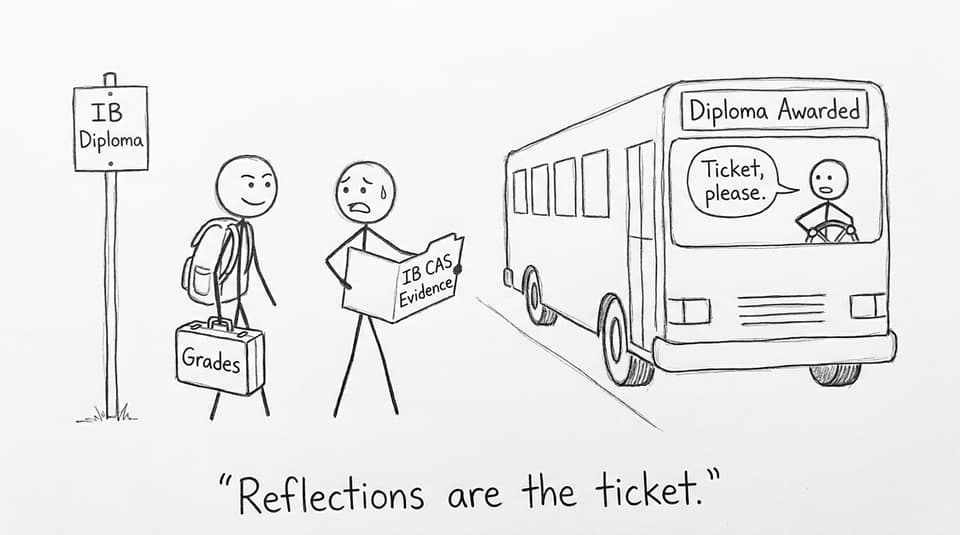
Final thought: treat IB CAS reflections like proof, not paperwork
You don’t submit IB CAS reflections to impress anyone. You submit them because they are the ticket that turns effort into verified learning.
If you’re behind, write one reflection today and message your coordinator. Then build a system that survives busy weeks. And when exam prep gets loud, let RevisionDojo hold the structure: practice with the Questionbank, lock memory with Flashcards, clarify fast with AI Chat, and rehearse pressure with Mock Exams and Predicted Papers.
In the end, IB CAS isn’t about doing more. It’s about noticing what your doing did to you, and proving it clearly.