
Coaching Students to Write Purposeful Reflections in the DP (IB)
The first time most IB students hear “write a reflection,” they don’t panic because it’s hard. They panic because it feels vague.
You can study a chapter. You can grind practice questions. You can even survive a timed mock. But reflection? Reflection asks you to explain why your brain changed when nobody can see it.
So students default to the safe sentence: “I learned a lot.” It sounds polite. It also says nothing.
Purposeful reflection is different. In the IB Diploma Programme (DP), reflection is how you prove growth: in TOK thinking, in CAS learning outcomes, in the Extended Essay process, and in the way you respond to feedback before exams. This article gives you a simple system to write reflections that feel honest, specific, and useful under pressure.
Quick checklist for purposeful IB reflection
If you want the fastest route to a strong IB reflection, use this short checklist before you submit anything:
-
Name one specific moment (not the whole week).
-
Describe the decision you made, not just what happened.
-
Explain the “So what?” with one insight (assumption, bias, skill gap, value conflict).
-
Add evidence (a quote from feedback, a data point, a mistake pattern).
-
End with a “Now what?” action that you can actually do in 7 days.
When you need structure, borrow it. When you have structure, you can be yourself.
Why IB reflection matters (even when exams feel louder)
In the IB, reflection isn’t a decorative extra. It’s built into the culture of the programme: you’re expected to notice how knowledge is made (TOK), how you grow through action (CAS), and how inquiry changes you over time (EE). Even in subject revision, reflection is what turns practice into improvement.
Think about what happens when you do a set of questions and get half of them wrong. There are two paths:
-
Path A: you feel bad, re-read notes, and hope the topic disappears.
-
Path B: you write a two-minute reflection on the pattern of the errors, then adjust your next practice set.
Path B is reflection doing what it’s supposed to do: converting emotion into information.
RevisionDojo is designed around that loop. You learn quickly with Study Notes, test yourself in the Questionbank, lock in memory using Flashcards, then use feedback tools to reflect and iterate. Reflection is not separate from exam prep in the IB. It’s the steering wheel.
What “purposeful reflection” actually means in the IB
A purposeful IB reflection has three qualities:
It has a target
Not “my project” or “this unit.” A target is one moment, one choice, or one turning point.
It chooses depth over adjectives
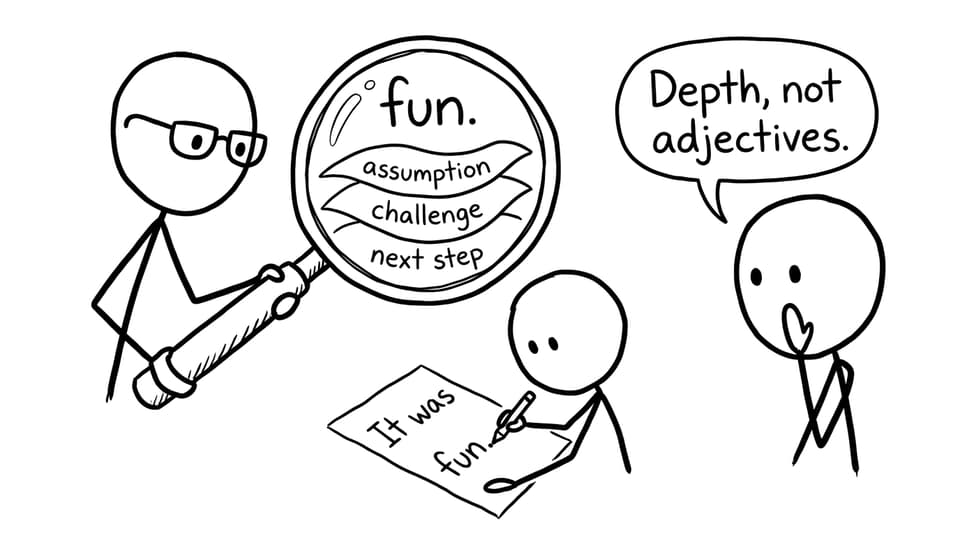
“Challenging” and “fun” are not insights. They’re mood labels. Depth means you explain why something mattered and what changed.
It creates a next step
Reflection that doesn’t change behaviour becomes journaling. Journaling can be nice. The IB wants growth you can trace.
Here’s the upgrade students usually need:
-
Descriptive: “Our group work went well.”
-
Purposeful: “I kept ‘saving time’ by doing tasks myself. It looked efficient, but it reduced my teammates’ ownership. Next time I’ll delegate one key task and accept a slower first draft.”
That last sentence isn’t just reflective. It’s coachable.
Frameworks that make IB reflection easier (and more original)
Frameworks don’t make your voice robotic. They give your voice a spine.
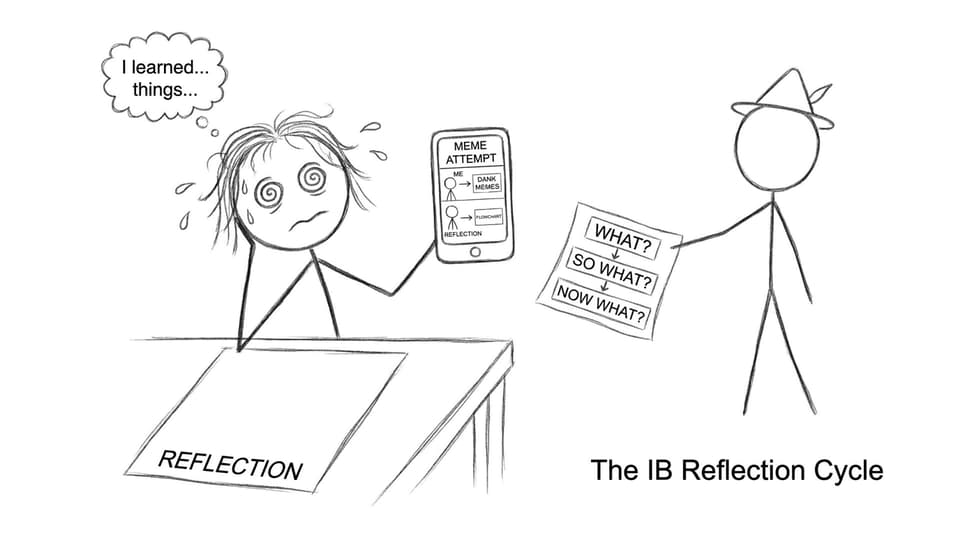
What? So what? Now what? (the most reliable IB reflection tool)
This is the simplest structure that still produces depth.
-
What? One concrete event or decision.
-
So what? What it revealed (assumption, limitation, skill, bias, value).
-
Now what? One behavioural change.
Use it for CAS entries, EE process writing, TOK exhibition planning, or even after a timed exam set.
If you’re building routines for exam season, pair reflection with feedback. After a timed set, reflect on the reason for mark loss (concept gap, command term mismatch, time panic). RevisionDojo’s exam-prep workflow explains how students can keep practice measurable: RevisionDojo App: The Smarter Way to Prep for IB Exams.
See, Think, Wonder (when you need a calmer TOK-style tone)
This works well when you’re reflecting on sources, objects, or evidence.
-
See: What is literally there?
-
Think: What might it suggest?
-
Wonder: What question does it open?
For IB students, this is especially useful when you’re trying to sound like a thinker rather than a diarist.
Learner Profile linking (use one attribute, not all of them)
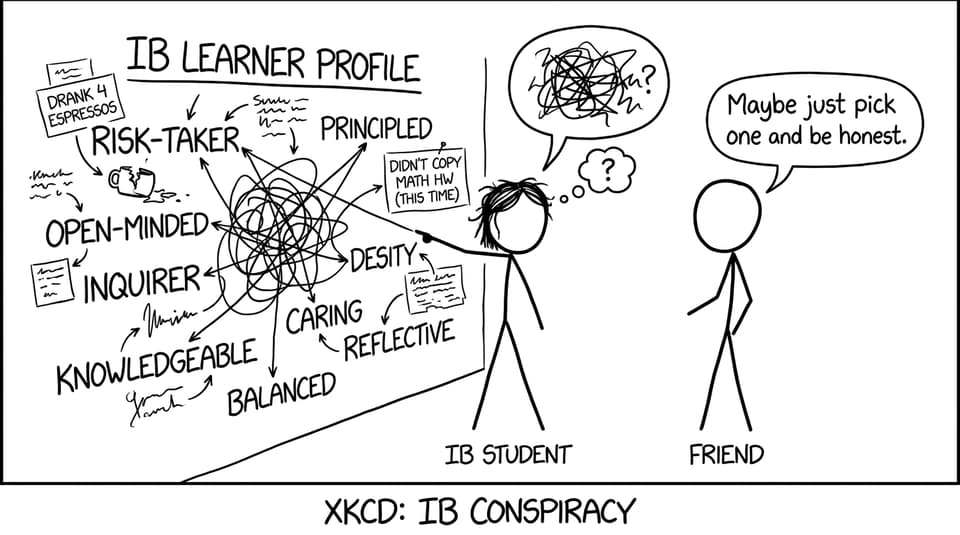
The Learner Profile is helpful when you treat it like a mirror, not a checklist.
Pick one attribute and make it real:
-
“How did I become more open-minded here?”
-
“Where did I act principled, and what did it cost me?”
-
“What risk did I take that actually mattered?”
If you try to connect your reflection to every attribute, it starts to read like a poster. The IB rewards specificity.
How to move from “nice reflection” to “useful reflection” for exams
Most IB students write reflections as if they’re writing to impress someone. A better approach is to write reflections as if you’re writing instructions to your future self.
Here’s a practical method you can run weekly:
Capture one mistake pattern
After practice, name one pattern:
-
“I explained but didn’t evaluate.”
-
“My definitions are fine, but my examples are vague.”
-
“I lose marks when the question has unfamiliar context.”
If you struggle to diagnose this, use structured practice resources. RevisionDojo articles like You’re Not Lazy, Your IB Study Method Is Broken and IB: I Study All Day but Remember Nothing show how to turn mistakes into a loop.
Write a 6-line reflection (enough to be meaningful, short enough to repeat)
A strong IB exam reflection can be six sentences:
-
What I attempted.
-
What went wrong (specific).
-
Why it went wrong (cause).
-
What feedback suggests (evidence).
-
What I will do next (action).
-
When I will retest (date/time).
Then convert the action into tools: create Flashcards for the rule you keep forgetting, drill the subtopic in the Questionbank, and ask AI Chat to quiz you on that exact weakness.
Purposeful reflection across TOK, CAS, and the EE
Reflection is not identical across the DP core. The goal stays the same (growth you can trace), but the evidence changes.
TOK: reflection as intellectual honesty
In TOK, the IB is watching for you to notice how you know, where your certainty comes from, and what could be distorting your viewpoint.
If you want a guided path, see How to Reflect Critically in TOK: A Beginner’s Guide for Top Marks.
CAS: reflection as learning outcomes, not event summaries
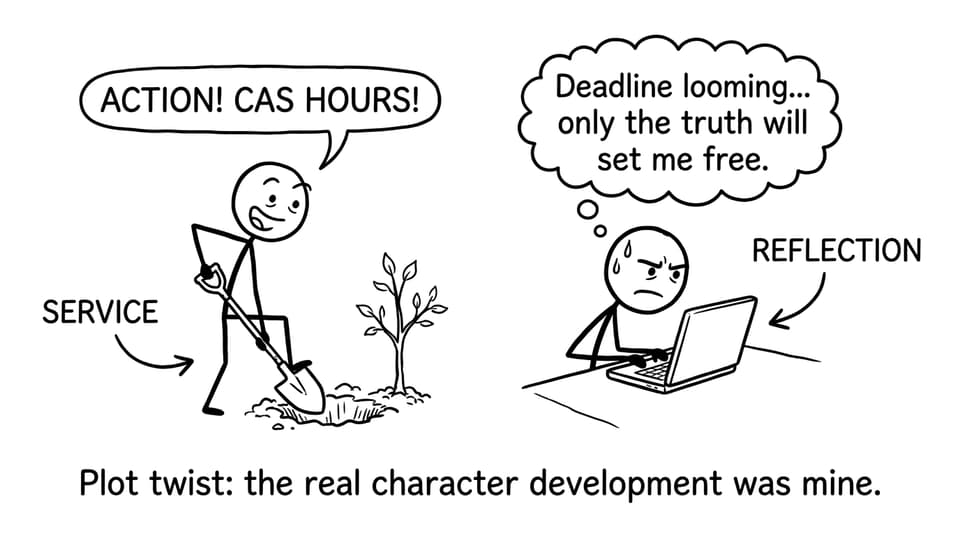
CAS reflection isn’t a travel diary. You don’t get credit for being busy. You get value from what changed in you.
For practical prompts and examples, use 10 Powerful Tips to Write a CAS Reflection That Stands Out in 2025.
EE: reflection as engagement with the process
Your EE reflection is strongest when it shows decisions, pivots, and learning from setbacks.
A helpful deep dive is How Reflection Strengthens Your IB Extended Essay, and for planning the TOK link you can explore How to Use TOK to Enhance Your Extended Essay.
How coaches and teachers can give feedback that deepens IB reflection
Students often write shallow reflections because they’re rewarded for sounding “positive.” Better coaching changes the incentives.
A high-impact feedback style is to respond with curiosity:
-
“What assumption did you have going in?”
-
“Where exactly did you change your mind?”
-
“What would you do differently if you repeated this next week?”
And if you’re a student, you can self-coach the same way. Ask Jojo AI Chat to interrogate your reflection like a mentor, then revise it for depth.
Closing: make IB reflection a tool, not a performance
In the IB, purposeful reflection is one of the few skills that improves everything else: essays get sharper, CAS becomes more meaningful, your EE process feels less chaotic, and exam practice stops being random effort.
If you want reflection to work, keep it small and specific. Pick one moment. Name one change. Commit to one next step.
Then run the loop in RevisionDojo: learn with Study Notes, test yourself in the Questionbank, reinforce with Flashcards, ask AI Chat for precision, and pressure-test with Predicted Papers and Mock Exams. That’s what purposeful IB reflection looks like in real life, not inspirational, just effective.