


The night your brain refused to cooperate (and why IB cheatsheets help)
You know the feeling: it’s late, your desk is a small city of papers, and the IB syllabus looks less like a curriculum and more like a dare. You read your notes again. And again. It feels responsible. It feels like effort.
Then a simple question lands in your head: If I understand this now, why can’t I recall it tomorrow?
That gap between “I saw it” and “I can produce it under time pressure” is the real problem most IB students face. And it’s exactly where a well-designed cheatsheet becomes more than a summary. A strong IB cheatsheet is a memory tool engineered around how learning actually works: encoding, storage, and retrieval.
If you want a clean starting point, begin with RevisionDojo Cheatsheets and treat them as the bridge between understanding and exam performance.
The science checklist: what effective IB cheatsheets must do
Before we get philosophical, here’s a practical checklist. An effective IB cheatsheet should:
-
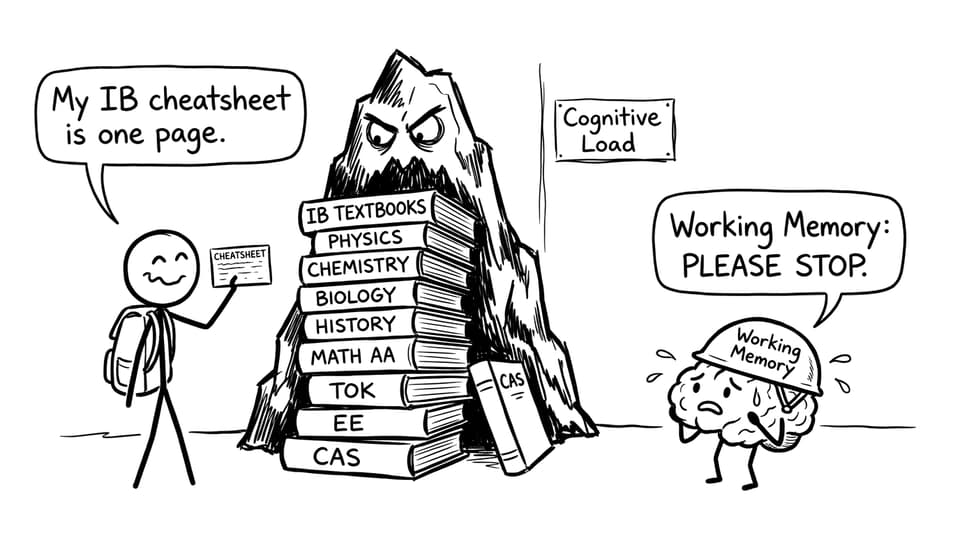
Reduce cognitive load (so your working memory doesn’t crash)
-
“Chunk” ideas into meaningful groups (so concepts travel together)
-
Use cues that trigger recall (keywords, command terms, structures)
-
Support spaced repetition (so memory strengthens over time)
-
Make retrieval practice easy (so you test, not just read)
-
Connect quickly to exam-style practice (so knowledge turns into skill)
RevisionDojo works well here because it’s not only a cheatsheet library. The cheatsheets plug into an ecosystem: Study Notes for understanding, Flashcards for daily recall, and the Questionbank for applying knowledge in exam format.
How memory really works in IB: encoding, storage, retrieval
The brain doesn’t store information like a folder system. It stores patterns of connection. Every time you revisit an idea, you either strengthen that network or you discover it was never sturdy to begin with.
For IB exam prep, three memory phases matter:
Encoding: turning “new” into “organized”
Encoding improves when material is clear, structured, and meaningful. The enemy is overload: too many details arriving without a map. This is why raw textbook reading often produces shallow familiarity but weak recall.
A strong IB cheatsheet improves encoding by:
-
Using hierarchy (headings, subheadings, consistent layouts)
-
Clustering related ideas (definitions with examples, processes with outcomes)
-
Making relationships visible (cause/effect, compare/contrast, steps)
This is cognitive load theory in practice: you want your working memory focused on thinking, not fighting the format.
Storage: keeping it alive with time and repetition
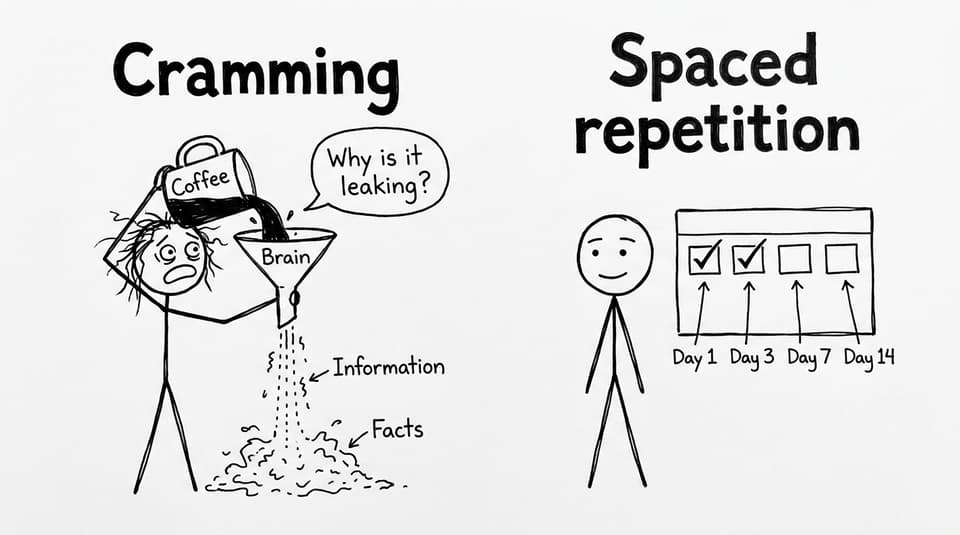
Storage improves when you revisit information across increasing intervals. This is the spacing effect: memory strengthens when you allow a bit of forgetting, then rebuild it.
This is why IB cheatsheets shine: they’re fast to review. Fast means repeatable. Repeatable means you can actually sustain the schedule.
Retrieval: producing the answer when it counts
IB exams are retrieval tests. Not “do you recognize this?” tests. That’s why you can feel confident in revision and still freeze in an exam hall.
Cheatsheets help retrieval when they are built as prompts, not paragraphs. The best ones look almost too short, because their job is to cue what you’ve already practiced reconstructing.
Why IB cheatsheets feel powerful (when they’re built correctly)
Let’s translate the cognitive science into what you should actually do.
Dual coding: words plus visuals, not words alone
Dual coding theory says you remember better when you store information in both verbal and visual forms. In IB, that might be:
-
A process diagram + a one-line explanation
-
A formula + a tiny “when to use it” note
-
A case study name + a trigger phrase for application
This doesn’t mean turning your cheatsheet into art. It means using light structure to make ideas “land” in more than one mental place.
Chunking: smaller units that travel together
Your working memory can only hold a limited number of items at once. Chunking groups multiple details into one meaningful unit.
A good IB cheatsheet doesn’t list 20 isolated facts. It builds 4-6 clusters that are easy to retrieve, then expands.
Desirable difficulty: making recall slightly uncomfortable
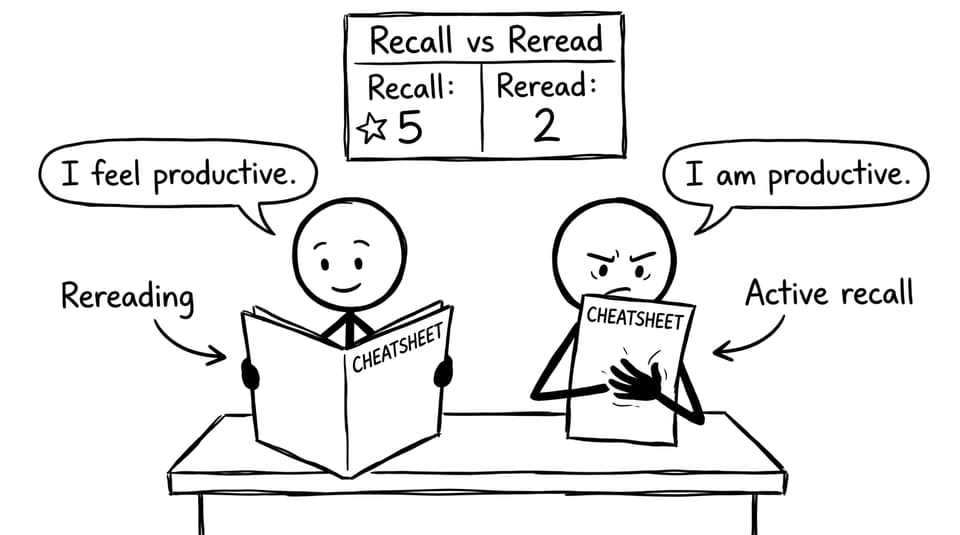
One of the strangest truths in learning science is that “easy study” often produces fragile memory. If rereading feels smooth, it may be because your eyes are doing the work, not your brain.
A strong IB cheatsheet is designed to be used with friction:
-
Cover a section and rebuild it from memory
-
Turn each bullet into a question
-
Explain it aloud in simple language
That discomfort is the signal that retrieval is happening.
A simple IB cheatsheet routine that builds long-term retention
Here’s a routine you can actually sustain during the IB year, even when assignments pile up.
Step one: start from a reliable cheatsheet
Use a syllabus-aligned base rather than rebuilding everything from scratch. Begin with RevisionDojo Cheatsheets, then add your personal examples and teacher-specific nuances.
Step two: pair it with one “spine” resource
Cheatsheets compress. They don’t explain every step. Pair each IB cheatsheet with a clear reference like RevisionDojo Study Notes so you can quickly fill gaps without getting lost.
Step three: convert weak points into active recall
If a cheatsheet section feels fuzzy, don’t reread it five times. Convert it into prompts.
-
Use RevisionDojo Flashcards or the main IB Flashcards tool to schedule daily recall.
-
Keep cards short: one idea, one answer.
Step four: prove it with exam-style practice
Memory becomes reliable when it survives context. That means practice questions.
Use the RevisionDojo Questionbank to drill the same topic you reviewed on your IB cheatsheet. If you want guidance on approach, see IB Question Bank: How to Use It Effectively.
Step five: run timed rehearsal to train retrieval under pressure
Long-term retention is not just “remembering.” In the IB, it’s remembering while stressed, timed, and slightly uncertain.
That’s why RevisionDojo also supports realistic rehearsal through Predicted Papers and Mock Exams within its broader system (alongside AI Chat, Grading tools, a Coursework Library, and Tutors). To plan the cadence, read IB Predicted vs Specimen Papers: What They Mean.
Common mistakes that make IB cheatsheets useless
Even smart IB students sabotage their own cheatsheets. Usually by making them look impressive instead of making them usable.
Making them too dense
If your cheatsheet becomes a mini-textbook, you lose the entire advantage. High density increases cognitive load and discourages repetition.
Using them passively
Reading a cheatsheet is not the same as retrieving from it. The cheatsheet should be something you test from.
Treating them as shortcuts
Cheatsheets don’t replace learning. They compress it so you can revisit it, strengthen it, and apply it.
For a deeper look at practical use, see How to Use IB Cheatsheets Effectively for Paper 1 and Paper 2 Exams.
Closing: make your IB memory boringly reliable
The best IB revision doesn’t feel dramatic. It feels repeatable. A good cheatsheet is not a last-minute lifeline; it’s a small object you return to so often that recall becomes ordinary.
If you want that kind of calm confidence, build a simple loop: start with RevisionDojo Cheatsheets, clarify with Study Notes, lock in with Flashcards, and prove it through the Questionbank. Add AI Chat when you’re stuck, use Grading tools to understand mark logic, rehearse with Predicted Papers and Mock Exams, and lean on the Coursework Library and Tutors when the wider IB workload starts to pull you off course.
Long-term retention isn’t magic. It’s design, repetition, and the courage to test yourself sooner than you feel ready.