



The final month before November exams is not enough time to relearn two years of IB content. It is enough time to identify what costs you marks, repair the most important gaps, practise under pressure, and arrive with a routine you trust.
Students searching for a “final month November exams realistic” plan usually do not need a more ambitious timetable. They need a smaller one. Your plan should work during the fall term, alongside lessons, deadlines, travel, and ordinary human fatigue.
For the November 2026 session, the official IB schedule contains examinations from 23 October to 13 November. Your first paper may be later, depending on your subjects. Confirm every date, paper, level, reporting time, and exam-zone start time with your coordinator, then use the November 2026 exam schedule and study plan to map the pressure points.
The final-month checklist
Before building individual study sessions, establish the structure:
- List every paper you will sit, in chronological order.
- Mark consecutive papers and days with both morning and afternoon sessions.
- Rate your confidence for each paper from 1-5.
- Complete one diagnostic task for each subject.
- Choose three recurring weaknesses per subject.
- Schedule five main study blocks and one timed session each week.
- Keep one weekly buffer block for unfinished work.
- Protect sleep, meals, movement, and one lighter evening.
If creating the timetable feels harder than following it, use this guide to building an IB exam timetable before planning the month.
Build backward from your actual exam dates
A generic revision calendar treats every subject equally. Your examination calendar does not.
Suppose Biology comes first, followed closely by Business Management, while Mathematics appears nearly two weeks later. Giving each subject identical time would feel organised, but it would ignore urgency. Biology needs earlier simulation. Mathematics can remain in shorter maintenance sessions before receiving more attention later.
Prioritise each paper using three questions:
- How soon is it?
- How weak am I?
- How slowly does this skill improve?
Essay structure, mathematical fluency, data interpretation, and language production usually benefit from repeated practice. A small factual gap may be repaired in one focused session. Your calendar should reflect that difference.
The guide to planning revision with the official timetable can help you identify double-session days and demanding sequences before they become surprises.
A realistic four-week November exam study plan
The goal changes each week. Early sessions diagnose and repair. Later sessions rehearse and stabilise.
| Phase | Main goal | Recommended work |
|---|---|---|
| Week 4 | Diagnose and prioritise | Short diagnostic sets, topic review, error classification |
| Week 3 | Repair weak areas | Targeted questions, active recall, structured-response practice |
| Week 2 | Build exam performance | Timed sections, mixed topics, complete simulations |
| Week 1 | Stabilise execution | Light retesting, recall, logistics, sleep protection |
Week 4: find the marks you are currently losing
Complete a representative section for each subject without notes. Use realistic timing where possible, but do not fill the week with complete papers. The purpose is diagnosis.
Classify each lost mark as one of the following:
- Knowledge: a fact, formula, quotation, study, or process was unavailable.
- Understanding: you remembered information but could not explain it.
- Application: you could not use the idea in an unfamiliar context.
- Technique: your structure or response did not match the command term.
- Timing: you knew enough but could not finish accurately.
- Carelessness: you misread, omitted units, or skipped a required step.
Use RevisionDojo Study Notes and IB resources to repair a specific concept, then move immediately into Questionbank practice. Flashcards can hold formulas, definitions, quotations, studies, and recurring correction rules. If one step remains confusing, ask Jojo AI Chat a narrow question instead of restarting an entire chapter.
Week 3: turn weak topics into repeatable skills
This week should contain more retrieval than reading. A useful 60-minute block looks like this:
- 10 minutes of closed-book recall
- 30 minutes of targeted Questionbank work
- 15 minutes of marking and correction
- 5 minutes scheduling the retest
Do not measure progress by hours alone. Track whether you can answer accurately, independently, and quickly enough. Retest the same skill 2-3 days later using a fresh question.
For written subjects, submit selected responses to RevisionDojo’s Grading tools and compare the feedback with the assessment criteria. Rewrite one weak paragraph or solution properly rather than copying an entire model response. The IB exam preparation guide provides a broader subject-by-subject workflow if you need additional structure.
Week 2: practise performance, not just knowledge
Knowing content in your room and retrieving it under a clock are different abilities. Week 2 connects them.
Complete 2-3 timed sections across the week, plus one complete Mock Exam for a high-priority paper if your schedule allows enough time to review it. Sit at a clear desk, keep your phone elsewhere, use only permitted materials, and stop when time expires.
RevisionDojo’s mock exam strategies explain how to classify errors and retest weaknesses. Predicted Papers can provide fresh, syllabus-aligned simulations, but they are practice resources rather than forecasts of exact questions. The distinction is explored in the guide to predicted and specimen papers.
Review every simulation on the same day if possible. Record no more than five correction rules. A useful rule is specific: “For evaluate questions, weigh strengths and limitations before reaching a supported judgment.” “Improve essays” is not a rule. It is a wish.
Week 1: reduce volume and protect reliability
The final week is not the moment to prove how hard you can work. It is the moment to make your performance dependable.
Move toward the subjects appearing first on your personal timetable. Use Flashcards, short Questionbank sets, essay plans, formula recall, and selected timed sections. Avoid sitting exhausting simulations immediately before the relevant examination.
Two days before each paper, focus on recurring errors and high-value recall. The day before, complete a short warm-up, check equipment and reporting times, prepare food and transport, then stop at a sensible hour. The last two weeks before IB exams guide offers a compact routine for this final transition.
A weekly timetable that survives real life
A realistic schedule leaves room for school and recovery. Try this pattern:
| Day | Main block | Short block |
|---|---|---|
| Monday | Weak subject, targeted practice | Flashcards |
| Tuesday | Writing or calculation practice | Error-log review |
| Wednesday | Second-priority subject | Flashcards |
| Thursday | Timed section | Marking and correction |
| Friday | Buffer or lighter review | Rest |
| Saturday | Mock Exam or two substantial sections | Same-day review |
| Sunday | Retest weaknesses and plan the week | Early finish |
On difficult school days, use a minimum viable session: 10 minutes of recall and one focused question. Missing a large planned block does not require punishment the next day. Move only the highest-priority task into the buffer slot.
What to stop doing in the final month
Stop rewriting complete sets of notes. Stop choosing topics solely because they feel comfortable. Stop sitting timed work without reviewing it. Stop collecting new resources when your existing ones already cover the syllabus.
Coursework should not silently consume examination preparation either. If an outstanding requirement remains, confirm the deadline and expectations with your school. RevisionDojo’s Coursework Library can help you understand structure and standards, while Tutors can provide human guidance when a persistent problem needs more than another independent session.
Most importantly, stop treating rest as time stolen from revision. A plan that requires repeated late nights is not demanding. It is structurally unreliable.
Make the final month smaller
November exams feel enormous when every subject, topic, and possible question occupies your mind at once. The practical response is not to think bigger. It is to narrow the next action.
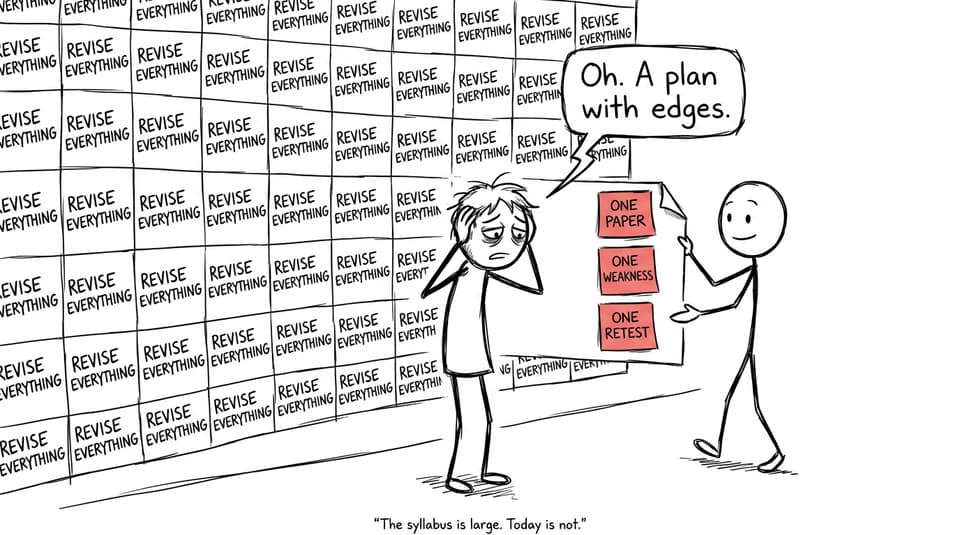
Choose one paper. Expose one weakness. Repair it with Study Notes, Questionbank practice, Flashcards, AI Chat, or Grading tools. Test it again under time. Then move forward.
RevisionDojo brings that entire loop together, including Predicted Papers written for realistic practice, Mock Exams, the Coursework Library, and Tutors. In the final month, that matters because the scarcest resource is not information. It is clear attention, applied to the right task at the right time.