



The night before an IB exam has a particular sound: pages turning too fast, highlighters squeaking, and that small fear that you studied a lot but somehow didn’t study the right things.
That’s the real job of an IB cheatsheet: not to replace learning, but to compress it. A good cheatsheet is a map of what matters, so you can stop wandering and start practicing the skills Paper 1 and Paper 2 actually reward.
On RevisionDojo, IB cheatsheets sit inside an ecosystem that makes them work: Study Notes to understand, Flashcards to remember, Questionbank to apply, AI Chat to unblock confusion, Grading tools to learn the marking logic, plus Predicted Papers and Mock Exams to rehearse under pressure. Used well, cheatsheets become the hinge between “I read it” and “I can do it in the exam.”
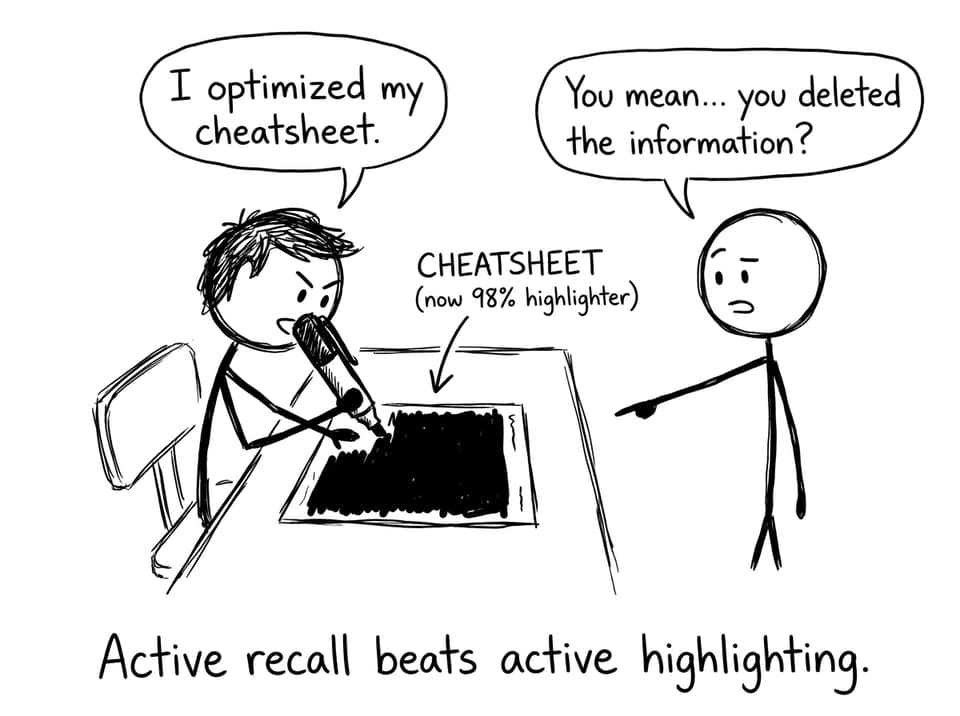
Quick checklist: what “effective” looks like
Use this as your IB cheatsheets checklist for Paper 1 and Paper 2:
-
You test yourself from the cheatsheet (you don’t just read it).
-
You can explain each bullet out loud in simple language.
-
You connect each section to at least one exam-style question.
-
You revisit the sheet repeatedly in short bursts (spaced repetition).
-
You treat the sheet as a diagnostic tool: it shows gaps quickly.
If you want a starting point, begin with RevisionDojo’s Cheatsheets and pair them with one targeted practice block from the IB Question Bank guide.
Paper 1 vs Paper 2: what the IB is really asking
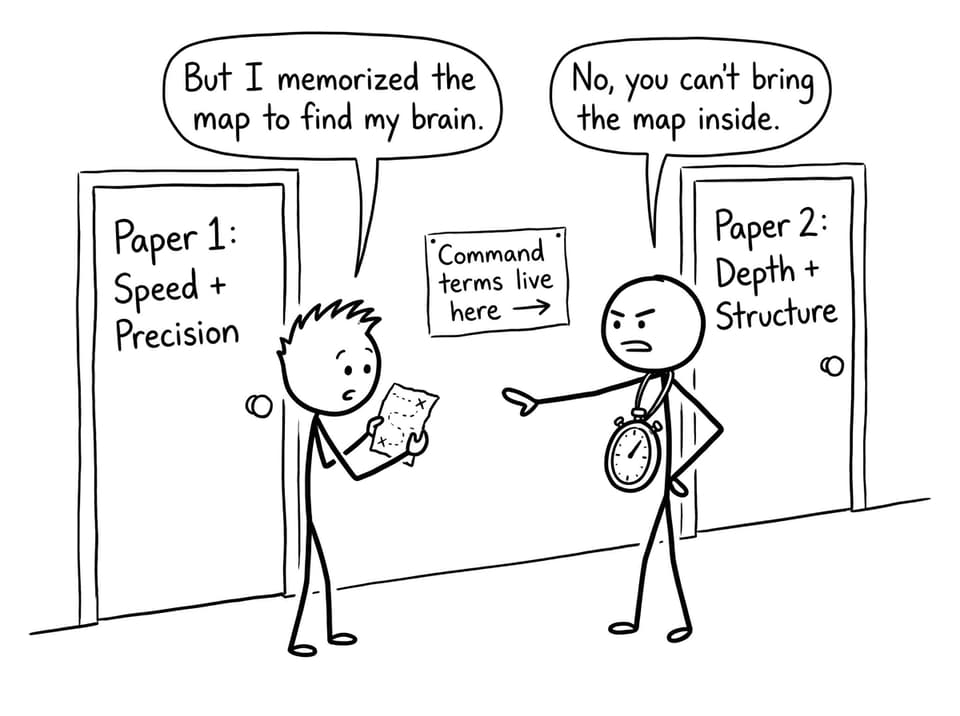
Most IB students know Paper 1 is “faster” and Paper 2 is “longer.” But that description is too gentle. The papers pull your brain in different directions.
Paper 1: recognition under time pressure
Paper 1 is usually about recall, precision, and quick application. You’re rewarded for noticing what a question is really testing and retrieving the right fragment of knowledge fast.
This is where IB cheatsheets shine because they reduce the search space. Instead of revising 30 pages of notes, you’re drilling the 10 lines that tend to show up repeatedly.
Paper 2: explanation, structure, and links
Paper 2 is more about communication and connections. You can know the content and still lose marks if your explanation is shapeless, if you misread a command term, or if you can’t link ideas across topics.
IB cheatsheets help here differently: they act as a framework for building coherent answers. The sheet isn’t the answer. It’s the scaffolding.
How to use IB cheatsheets for Paper 1 (speed + accuracy)
Paper 1 mistakes often come from a simple problem: you knew it, but you couldn’t retrieve it quickly enough. A cheatsheet should train retrieval speed.
Use the “cover-and-recall” loop
Open your IB cheatsheet. Cover one section. Then:
-
Say the definition, process, or rule out loud.
-
Write the formula or key steps from memory.
-
Uncover and correct immediately.
Do this for 8-12 minutes, not an hour. Short sessions keep attention sharp.
If you want a system that stacks well with this, turn your weak lines into spaced repetition using RevisionDojo Flashcards. Your cheatsheet becomes the source; your flashcards become the training plan.
Pair every cheatsheet session with a micro-drill
A cheatsheet session without questions can feel productive while changing nothing. After reviewing a section, do a small set of exam-style questions right away.
On RevisionDojo, that’s easiest when you use the Questionbank workflow: choose one topic, one difficulty band, and keep it tight.
Your goal is not volume. Your goal is time-to-correctness.
Train command terms as a Paper 1 skill
Even in quick-response formats, IB command terms shape what counts as “correct.” “State” isn’t “explain.” “Identify” isn’t “evaluate.”
Use your IB cheatsheet to attach the expected wording to the command term. Then test yourself by rewriting the same fact in two ways: once as a “state,” once as an “explain.” The content stays similar, but the mark-winning form changes.
How to use IB cheatsheets for Paper 2 (depth + structure)
Paper 2 is where students get stuck in a strange way: they revise a lot, then freeze because they can’t decide what to include.
A strong IB cheatsheet prevents that freeze by giving you a default structure.
Build “answer skeletons” from a cheatsheet
Choose one cheatsheet section and ask:
-
What are the 3-5 points an examiner expects?
-
What example/data/diagram typically supports it?
-
What common misconception should I avoid?
Write a 6-10 line skeleton answer. Not a full essay. A skeleton.
Then check your skeleton using a rubric-aware lens. If your subject has extended responses, RevisionDojo’s IB Coursework Grader is a helpful way to learn what “good explanation” looks like in criterion language, even when you’re practicing exam writing.
Use cheatsheets to connect topics (the hidden Paper 2 advantage)
Paper 2 loves connections. So use your IB cheatsheet like a switchboard:
-
Link Topic A to Topic B with one sentence.
-
Add a “because” that makes the link causal, not just a list.
-
Practice turning that link into an explanation.
This is also where RevisionDojo Study Notes help: if a connection feels shaky, you can quickly reopen the deeper explanation, then return to your cheatsheet summary.
Practice under exam conditions with realistic papers
Once your skeleton answers feel smoother, you need timed rehearsal. Use:
-
RevisionDojo Predicted Papers to simulate real exam distribution and stamina
-
IB predicted vs specimen guidance to choose the right type of practice at the right time
-
Collaborative rehearsal ideas from Collaborative IB Mock Exams
Your IB cheatsheet then becomes your between-sessions review, not your main activity.
A simple 3-step routine (works for Paper 1 and Paper 2)
This routine is small enough to repeat, which is why it works.
Preview (2 minutes)
Skim the IB cheatsheet section before you study. You’re telling your brain: “Here’s the shape of the topic.”
Active recall (12-15 minutes)
Cover-and-recall, quick writing, quick correction. No multitasking.
Practice integration (20-30 minutes)
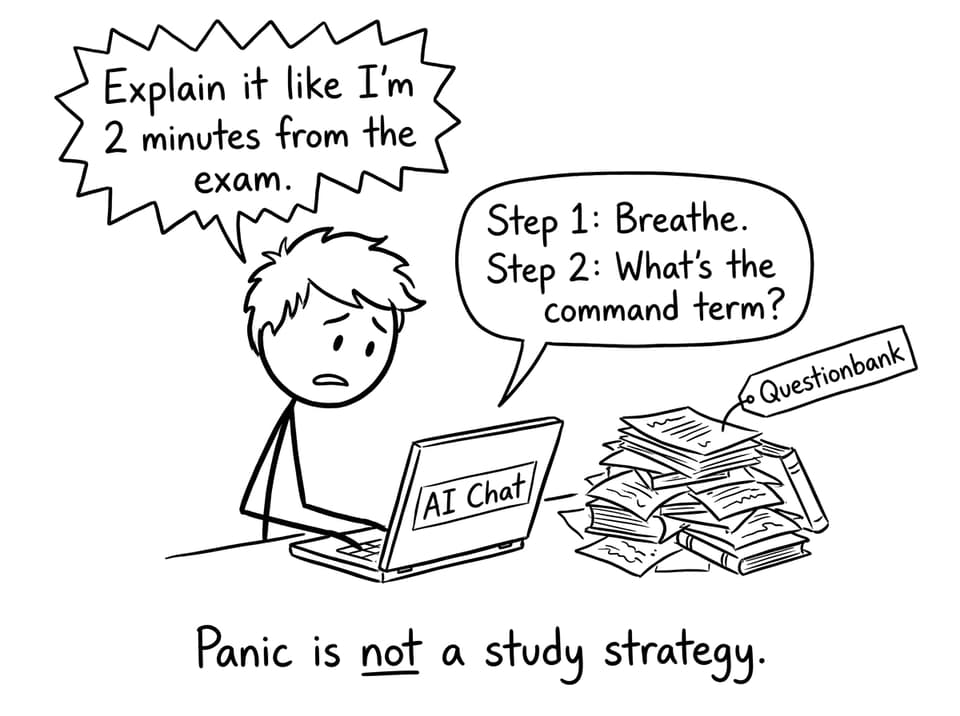
Do questions right away. If you get stuck, use RevisionDojo’s AI Chat via the RevisionDojo app guide to clarify, then return to questions.
Common mistakes with IB cheatsheets (and the fix)
-
Mistake: using cheatsheets as first-time learning. Fix: learn the concept in Study Notes first, then compress it with an IB cheatsheet.
-
Mistake: rereading instead of testing. Fix: cover-and-recall, every time.
-
Mistake: collecting sheets and never integrating questions. Fix: every cheatsheet session ends with Questionbank practice.
-
Mistake: “I’ll use it in the last week.” Fix: start early, revisit often. Repetition is what makes the sheet feel obvious in the exam.
If you want a broader system for keeping materials organized, the note workflow in Digital IB Study Notes pairs naturally with cheatsheets.
Closing: make the IB cheatsheet earn its place
An IB cheatsheet is not a shortcut. It’s a commitment to doing the hard part more efficiently: retrieval, clarity, and repetition.
Paper 1 rewards speed and precision. Paper 2 rewards depth and structure. If you use IB cheatsheets as a daily recall tool, then link them immediately to Questionbank practice and timed papers, your revision stops being “more” and becomes “sharper.”
Start with RevisionDojo Cheatsheets, then build the full loop: Study Notes for understanding, Flashcards for retention, AI Chat for quick clarification, Grading tools for mark-winning feedback, and Predicted Papers plus Mock Exams to perform under pressure. That’s how IB preparation becomes calm, repeatable, and effective.