

Every IB class looks the same from the hallway. Same desks. Same deadlines. Same "we're fine" smiles.
But inside, the distance between students can be huge.
One student reads a question once and sees the method. Another needs three examples, a hint, and a quiet second attempt before it clicks. Someone else understands everything -- right until timed conditions arrive and their brain forgets what it knows.
That is the daily puzzle of IB revision: the same exam, wildly different starting points.
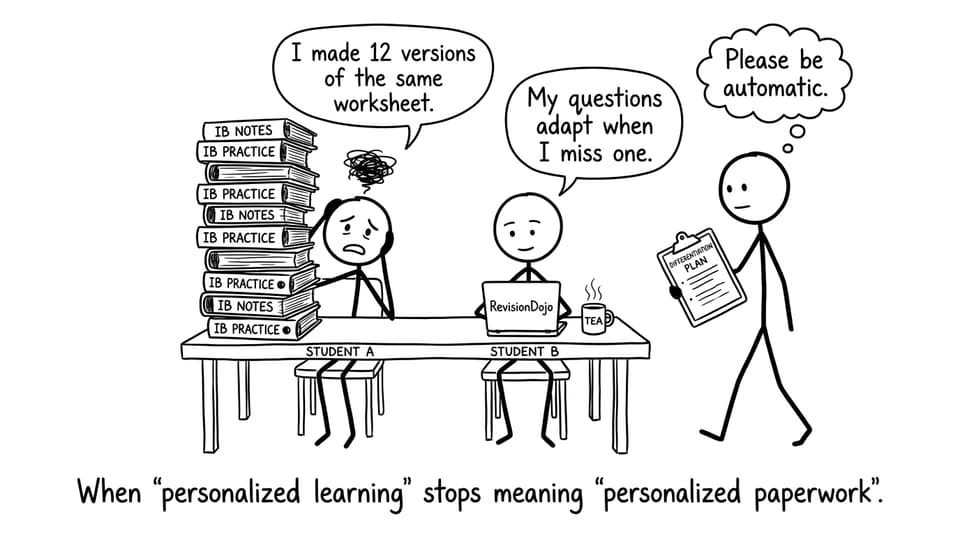
This is where differentiated learning stops being a teacher-only responsibility and becomes a system you can run. RevisionDojo is built for IB students who need that system -- adaptive practice, fast feedback, and clear next steps, without turning revision into a DIY curriculum.
If you want the short version: differentiated learning is just "the right challenge, at the right time, for the right student." RevisionDojo makes that easier to achieve using the Questionbank, Study Notes, Flashcards, AI Chat, Grading tools, Predicted Papers, Mock Exams, Coursework Library, and Tutors.
A quick checklist for differentiated IB revision
Use this as your reset when revision feels messy.
-
Pick one IB subject and one topic (not "the whole unit").
-
Set a baseline with a short Questionbank set (10--15 questions).
-
Patch only what you missed using Study Notes (small, specific reading).
-
Lock it in with Flashcards (spaced repetition, daily minimum).
-
Ask one targeted question in AI Chat (Jojo) to remove confusion fast.
-
Retest with a second Questionbank set 24--72 hours later.
-
Add exam realism weekly with Mock Exams or Predicted Papers.
-
Use Grading tools to improve written responses and coursework drafts.
That loop is differentiated learning in action: diagnose, adapt, repeat.
Why differentiated learning matters in IB (even for high achievers)
IB is not just content. It is performance under constraints: time, command terms, markschemes, and the pressure of "this counts."
Differentiation matters because students fail for different reasons:
-
Some lack understanding.
-
Some understand but cannot recall.
-
Some recall but cannot apply to unfamiliar questions.
-
Some can do all of the above -- until timing collapses their process.
A single revision plan cannot fix all four problems.
What helps is a toolset that changes what you do next based on what just happened. That is why adaptive workflows (not just static resources) are so useful for IB exam preparation.
If you want a broader "how to structure your week" approach, this post pairs well with How to Study for IB Exams Without Burning Out and IB: I Study All Day but Remember Nothing.
How RevisionDojo supports differentiated learning through adaptive tools
RevisionDojo works best when you treat it like a quiet coach: it notices patterns, shows you your weakest link, and gives you the next rep.
Adaptive practice that responds to your performance (Questionbank)
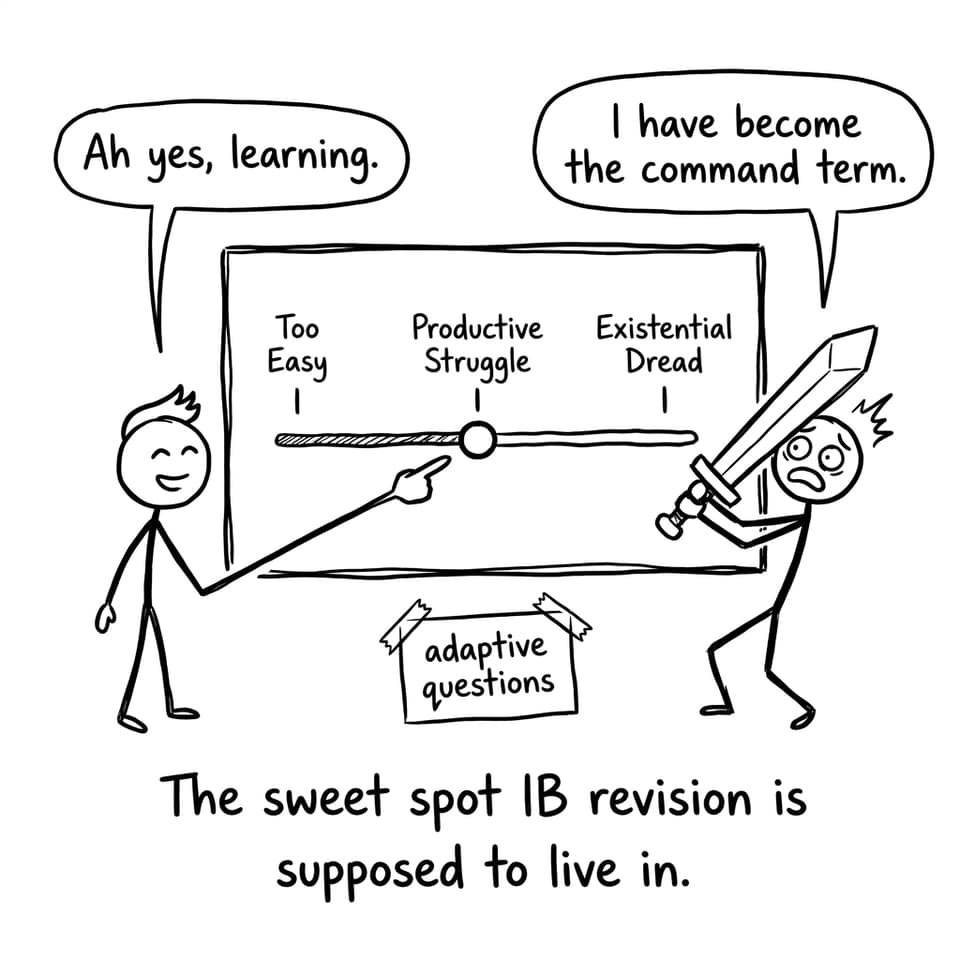
In IB revision, volume is not the same as progress. The Questionbank becomes powerful when it is used as a decision tool: it tells you what to do next.
On RevisionDojo, the Questionbank gives you curriculum-aligned, exam-style practice with feedback loops that make differentiation automatic: when you miss a type of question, you can stay inside that skill until it becomes stable.
Start here if you want to build that habit: Questionbank and the strategy guide IB Math: Targeted Revision Using the Questionbank.
Differentiation tip for IB students: don’t label yourself "good" or "bad" at a subject. Label the skill. "I lose marks on explain questions" is fixable. "I’m bad at IB Biology" is not actionable.
Personalised learning paths built from small loops (Study Notes + practice)
Differentiated learning works when you stop rereading and start cycling.
Use Study Notes like a pit stop: quick clarity, then back to questions. When you do this, revision becomes a series of small, personalised learning paths.
If you want the all-in-one workflow explained clearly, read RevisionDojo App: The Smarter Way to Prep for IB Exams and IB Revision Made Easy With RevisionDojo All-in-One.
Spaced repetition that adapts to your memory (Flashcards)
In IB, forgetting is not a flaw. It is a schedule problem.
Flashcards are differentiated learning for memory: you see difficult cards more often, easy cards less often. That is how two students can study "the same topic" but get totally different sessions that match their needs.
Keep it simple:
-
Make cards from your mistakes (not from your best notes).
-
Keep each card to one idea.
-
Review daily, even if it is only 8 minutes.
That daily minimum is what makes IB learning compound.
Fast, low-friction help when you’re stuck (AI Chat)
Differentiation breaks down when you get stuck and lose 40 minutes to confusion.
RevisionDojo’s AI Chat (Jojo) is most useful when you ask small, specific questions like:
-
"Why did my method fail on this IB question?"
-
"What does 'evaluate' require in the markscheme language here?"
-
"Give me a simpler example, then a harder one."
Used well, AI Chat shortens the gap between misunderstanding and the next attempt. That gap is where most students quietly lose momentum.
Feedback that improves writing, not just confidence (Grading tools)
A lot of IB differentiation is invisible: two students can "know" the content but write answers of very different quality.
RevisionDojo’s Grading tools help you practice that writing layer with criterion-aware feedback, which matters for longer responses and coursework.
Pair this with the Coursework Library (navigate from the main hub) when you need models to compare structure and depth. Then use Tutors when you need human strategy instead of another hour of guessing.
Exam realism that meets you where you are (Mock Exams + Predicted Papers)
Timing is a skill. So is calm.
RevisionDojo’s Mock Exams and Predicted Papers give you a controlled way to scale pressure:
-
Start with short timed sections.
-
Build to longer mixed-topic sets.
-
Review longer than you wrote.
If you want a practical plan for the final stretch, IB: The Last 2 Weeks Before Exams (What Matters) is a strong companion.
Common IB differentiation scenarios (and what to do)
Mixed-ability revision groups
If your friends are at different levels, you can still study together by differentiating the task, not the time.
-
Same topic.
-
Different Questionbank filters or difficulty.
-
Same reflection questions after ("What cost me marks? What is my next fix?").
EAL learners and command terms
If English is not your first language, IB command terms can feel like trick words.
Use revision loops that isolate the language demand:
-
Flashcards for command terms and what they require.
-
Short written responses graded with Grading tools.
-
AI Chat prompts like: "Show me the difference between discuss and evaluate in one IB-style example."
High achievers who plateau
Plateaus usually mean your revision is no longer specific enough.
Differentiate by increasing constraint:
-
Timed sets.
-
Mixed-topic practice.
-
Stricter self-marking using feedback.
Then reflect: not "what did I get?" but "what would an examiner reward here?"
Students who feel behind
If you feel behind, the goal is not to rush. It is to stabilise.
Use a smaller loop and repeat it daily. One topic, one skill, one fix. RevisionDojo’s structure helps you stop improvising, which is often the real source of stress in IB.
Differentiation at scale: how schools use RevisionDojo
When differentiated learning is only manual, it depends on heroic teacher effort.
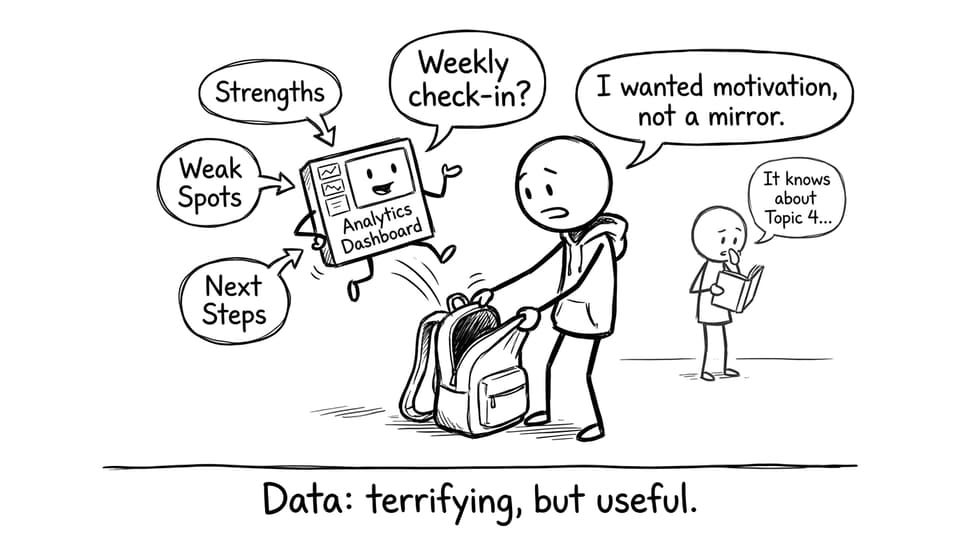
When it is supported by analytics and shared tools, it becomes consistent.
That is why RevisionDojo for Schools focuses on whole-cohort visibility: teachers can spot who needs scaffolding, who needs extension, and which topics are breaking the group.
If you’re curious how this improves outcomes across cohorts, read The Role of RevisionDojo in Enhancing IB Diploma Programme Results and Why RevisionDojo Is the Smartest Choice for Whole School IB Revision.
Closing: differentiated IB revision that feels calm
The best IB revision does not feel like panic. It feels like a quiet sequence you can trust.
Differentiated learning is that sequence: the right question, the right difficulty, the right feedback, then a retest that proves you actually improved.
If you want one place to run the whole loop -- Questionbank, Study Notes, Flashcards, AI Chat, Grading tools, Predicted Papers, Mock Exams, Coursework Library, and Tutors -- start with RevisionDojo today. Begin small: one topic, one baseline set, one fix. Then repeat.