


Supersaturated solutions are the kind of calm that makes you nervous.
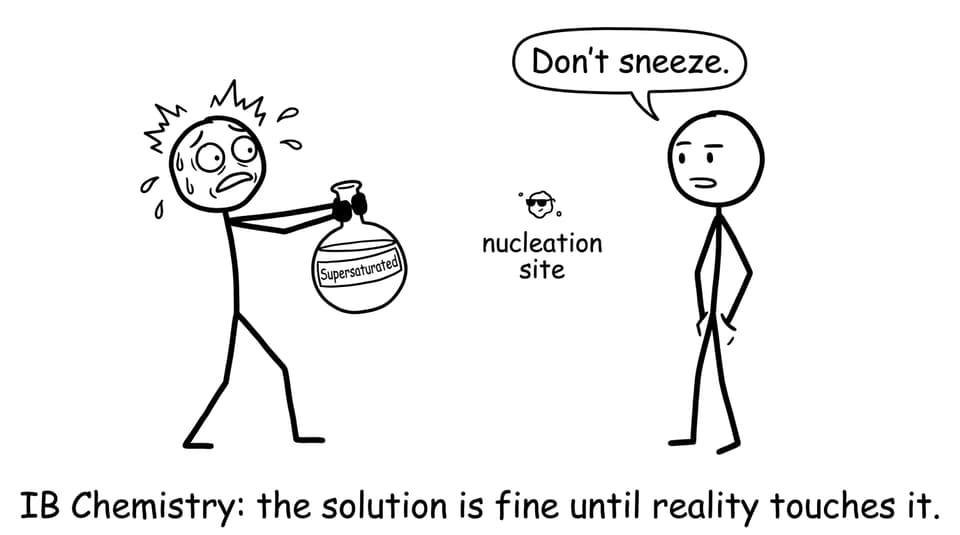
You look at a clear beaker and think, “Nothing is happening.” But in IB Chemistry, that quiet can be a trap: a solution holding more solute than it should at that temperature is basically waiting for a single excuse to crystallize. One tap, a speck of dust, a scratch on the glass, and the whole system snaps back toward stability.
This is why supersaturation is such a favourite exam idea. It connects solubility, temperature, equilibrium language, and crystallization in one neat, testable story.
Supersaturated solution definition (IB Chemistry)
A supersaturated solution contains more dissolved solute than is normally possible at a given temperature and pressure. In other words, it sits beyond the usual solubility limit.
In IB Chemistry, you’ll often describe it as:
-
Metastable (temporarily stable, but not truly stable)
-
Prone to crystallization
-
Formed by heating and careful cooling
If you want to tighten your solution vocabulary before you write explanations, keep this nearby: Solute vs Solvent Explained Simply.
A quick exam checklist for supersaturated solutions
Use this when a data-based question or short response mentions crystals, cooling, or “disturbance”:
-
State that the solution contains excess dissolved solute
-
Mention it was formed by heating (higher solubility) then cooling carefully
-
Use the word metastable or unstable
-
Name a trigger for crystallization: seed crystal, scratching, stirring, impurity, shock
-
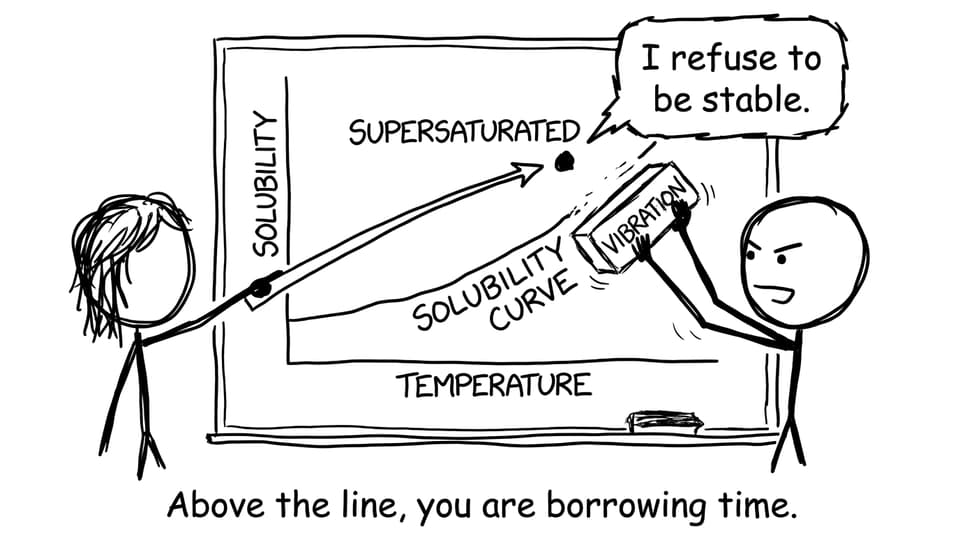
Link to solubility curves: above the solubility line
For the temperature logic behind that checklist, revise with IB Chemistry: Why Temperature Changes Solubility.
How a supersaturated solution forms (step-by-step)
Supersaturation is not magic. It’s controlled conditions.
Heat the solvent
When temperature rises, the solubility of many solid solutes increases. In IB Chemistry, you can justify this using particle motion and energy changes during dissolving.
Dissolve solute until saturated at the higher temperature
At the hot temperature, the solution can “afford” to hold more solute, so the extra solute dissolves.
Cool the solution without disturbance
As the solution cools, the solubility limit drops. But if crystallization doesn’t start (no nucleation sites), the solution can temporarily hold the extra solute anyway.
That “extra” is what makes it supersaturated.
Why supersaturated solutions are unstable
A supersaturated solution is like a crowded elevator: it works only until someone bumps the door.
The dissolved solute is at a higher-energy, less comfortable arrangement than it would be at saturation. Once crystallization begins, the solution rapidly moves back toward the stable saturated state.
Common crystallization triggers in IB Chemistry questions include:
-
Adding a seed crystal
-
Scratching the container (creates nucleation sites)
-
Stirring or shaking (introduces disturbances)
-
Dust or impurities entering the solution
This is also a good moment to connect the idea to intermolecular forces and “like dissolves like.” If that topic feels shaky, review IB Chemistry: Why Polar and Nonpolar Substances Dissolve Differently.
Supersaturated solutions and solubility curves (IB Chemistry)
Solubility curves are the examiner’s way of turning a beaker into a graph question.
-
Below the curve: unsaturated
-
On the curve: saturated
-
Above the curve: supersaturated
A key line you can reuse in answers: a supersaturated solution is not expected to remain above the solubility line indefinitely. Once crystallization occurs, concentration drops back toward the curve.
Real examples you can use in explanations
Examples help because they show you understand the process, not just the definition.
Sodium acetate “hot ice”
A classic demo: prepare a hot saturated solution, cool it carefully, then trigger crystallization. The solid forms rapidly and can release heat.
Rock candy
A concentrated sugar solution cools and crystals grow over time, often on a string or stick.
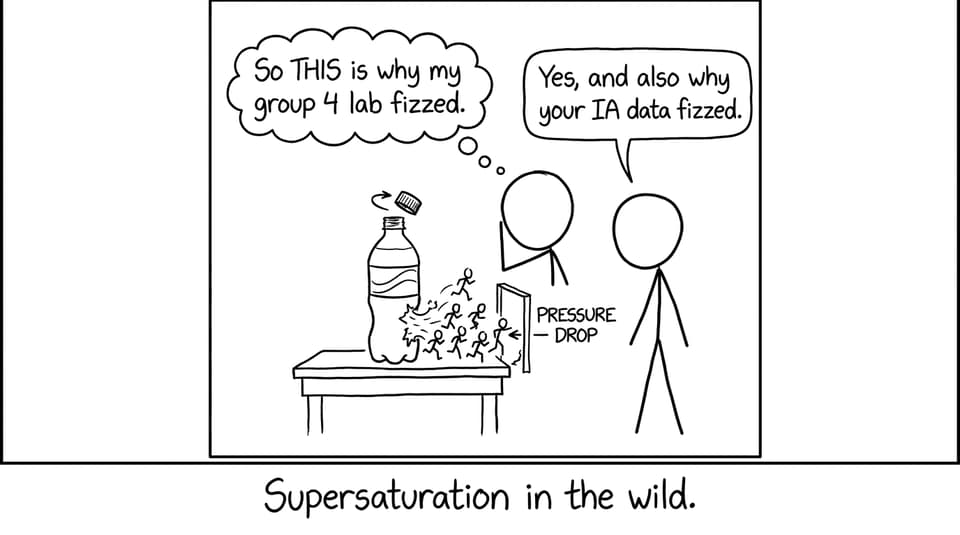
Carbonated drinks
When you open a bottle, the pressure drops. Dissolved CO₂ becomes less soluble and escapes as bubbles, temporarily behaving like a supersaturated situation for gas.
To strengthen your gas-solubility explanations in IB Chemistry, connect this idea with IB Chemistry: Pressure and Gas Solubility Made Simple.
How this shows up on IB Chemistry exams
Supersaturation often hides inside other topics:
-
Crystallization and purification (practical skills and explanations)
-
Solubility and equilibrium language
-
Precipitation logic (what forms, what stays aqueous)
If you’re mixing aqueous ions and wondering whether a solid forms, pair this with Precipitation Reactions Explained Simply and Solubility Product (Ksp) Explained Simply.
For targeted practice, build momentum with the IB Chemistry Resources hub, where you can move from Study Notes to the Questionbank and then lock in accuracy using Flashcards.
Bringing it home to RevisionDojo (and your exam)
Supersaturation is a simple idea with a powerful exam payoff: IB Chemistry loves systems that look stable but aren’t. When you can explain how heating increases solubility, how careful cooling creates a metastable state, and how nucleation triggers crystallization, you’re not just memorising a definition; you’re thinking like the markscheme.
To turn that understanding into marks, use RevisionDojo’s Study Notes to nail the wording, the Questionbank to face real exam-style prompts, AI Chat to refine explanations, and Grading tools to spot what your answers are missing. If you’re planning a bigger revision push, add Flashcards, Mock Exams, Predicted Papers, and the Coursework Library, or work with Tutors to fix weak topics fast.
When supersaturated solutions show up again (they will), you’ll be ready to answer with calm precision, the kind that actually stays stable under pressure in IB Chemistry.