


Pressure can feel invisible until it suddenly isn’t.
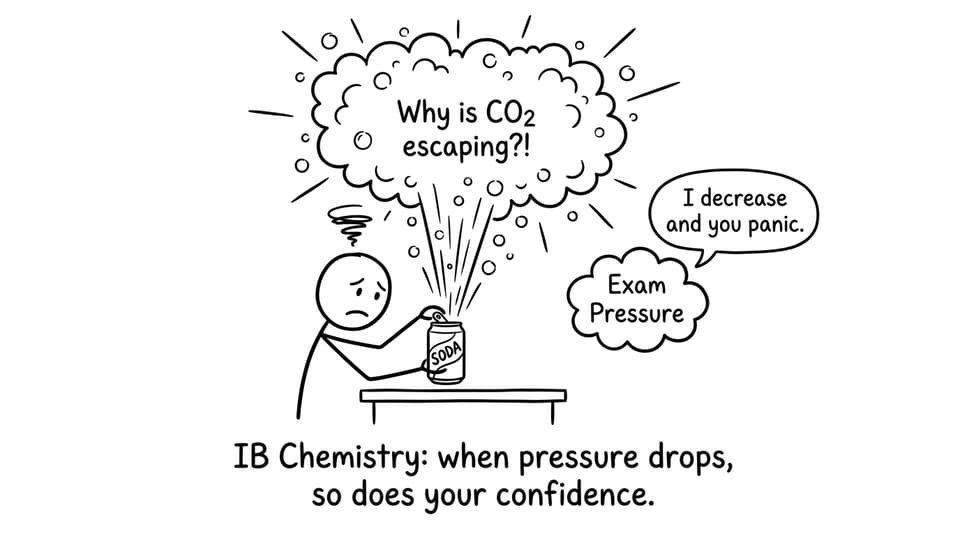
You open a bottle of soda the night before a test, and it hisses like it has an opinion about your life choices. You take one sip, look at your notes, and wonder: why does the gas stay dissolved in the first place, and why does it leave so dramatically?
That little hiss is one of the most testable ideas in IB Chemistry: increasing pressure increases gas solubility, and decreasing pressure lets dissolved gas escape. It shows up in solutions, equilibrium thinking, data questions, and real-world explanations. If you can explain it cleanly, you pick up easy marks.
Quick exam checklist for pressure and solubility (IB Chemistry)
Use this as your pre-question warm-up:
-
Gas solubility in liquids increases when pressure increases.
-
This is described by Henry’s Law.
-
Pressure changes barely affect the solubility of solids and liquids (they are not very compressible).
-
When pressure decreases, dissolved gas becomes less soluble and bubbles out.
-
Link to equilibrium language: “dynamic balance,” “shift toward dissolution,” “escape until a new balance.”
For wider equilibrium context, pair this topic with What Is Le Chatelier's Principle? IB Chemistry Explained and Le Chatelier's Principle Explained Simply.
What “gas solubility” really means in IB Chemistry
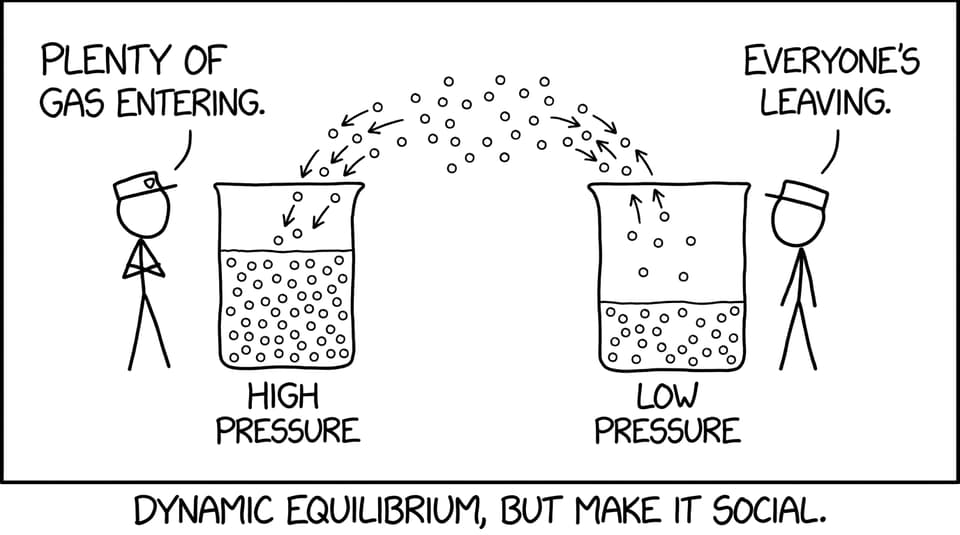
In IB Chemistry, gas solubility means the maximum amount of a gas that can dissolve in a liquid at a given temperature and pressure. It’s easiest to picture as a dynamic process: gas particles are constantly entering the liquid and leaving it.
At equilibrium, the rate of gas molecules dissolving equals the rate escaping. Nothing looks like it’s changing, but microscopically it’s busy.
If you want to connect that to the broader equilibrium definition you use in long answers, see Notes for Dynamic equilibrium.
How pressure affects gas solubility: the intuition first
Here’s the story you can tell in an exam without getting lost in symbols:
When you increase the pressure above a liquid, you increase how many gas particles are “pushing” on the surface. That increases the frequency of gas particles entering the liquid. The system settles into a new balance where more gas is dissolved.
When you decrease the pressure, fewer gas particles collide with the surface, so it becomes easier for dissolved gas to leave than to re-enter. The liquid releases gas until a new balance is reached; that’s your fizz.
This is why pressure matters so much for gases: gases are compressible and responsive to external pressure changes, unlike solids and liquids.
Henry’s Law (what you actually need for IB Chemistry)
Henry’s Law is the formal way IB Chemistry talks about this trend:
- At constant temperature, the solubility (or concentration) of a dissolved gas is directly proportional to the partial pressure of that gas above the liquid.
In many classes you’ll see it written as:
- c = kH × p
You usually don’t need heavy calculation to get marks. Examiners love clean proportional reasoning:
-
If pressure doubles (at constant temperature), the dissolved concentration doubles.
-
If pressure drops, solubility drops, and gas escapes.
For gas-related skills that often sit near this topic (units, trends, interpreting pressure changes), RevisionDojo’s IB Chemistry resource hub is a good base: IB Chemistry Resources. You can reinforce the math side with topic practice via S1.5 Ideal gases - IB Questionbank.
Real-world examples that score marks (and how to phrase them)
Carbonated drinks
At bottling, CO_2 is dissolved under high pressure, so solubility is high. When you open the bottle, pressure above the liquid drops. CO_2 becomes less soluble and escapes as bubbles.
Exam phrasing that tends to earn full credit in IB Chemistry:
- “Opening the container decreases the partial pressure of CO_2 above the liquid, so the equilibrium shifts to release dissolved CO_2 until a new equilibrium is reached.”
Scuba diving and “the bends”
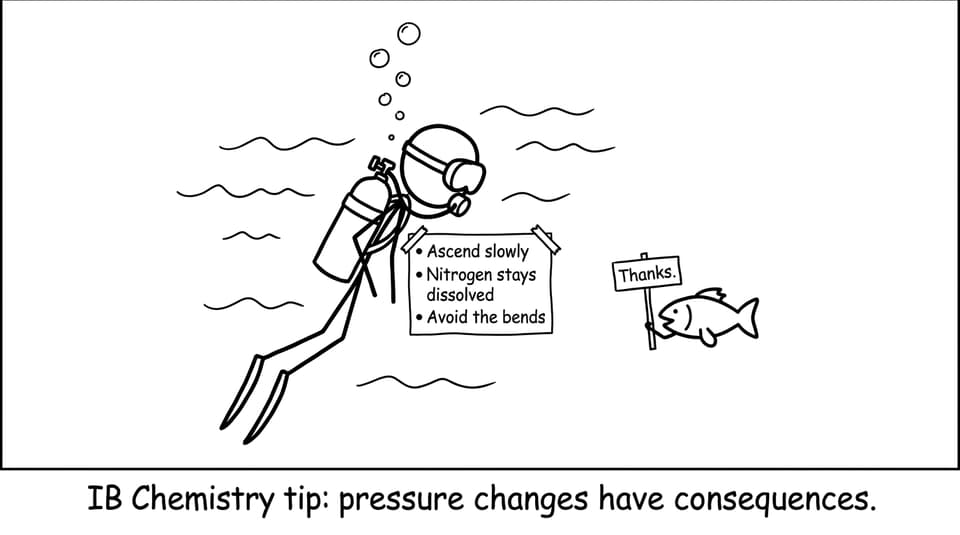
At depth, pressure is higher, so more nitrogen can dissolve in the blood. If a diver ascends too quickly, pressure decreases rapidly. Nitrogen becomes less soluble and can form bubbles in tissues and blood.
Sudden pressure changes in water systems
Rapid pressure drops can cause gases to come out of solution, which is why pressure control matters in many industrial and environmental contexts.
These examples pair well with exam technique work. If you find your explanations get messy under time pressure, How to Use Command Terms Effectively in IB Exams and The Importance Of Understanding Command Terms In IB Exams help you write in markscheme shape.
Common IB Chemistry mistakes with pressure and gas solubility
Mixing up pressure and temperature trends
A classic trap: students correctly say pressure increases gas solubility, then accidentally claim temperature does too. For gases in liquids, increasing temperature generally decreases solubility because particles have more kinetic energy and escape more easily.
Forgetting “constant temperature” in Henry’s Law
Henry’s Law proportionality assumes temperature stays constant. In data questions, always check whether temperature is controlled before applying a direct proportional relationship.
Using the wrong kind of “pressure”
Strictly, Henry’s Law uses the partial pressure of the gas above the solution (especially in mixtures). In many IB Chemistry questions it’s simplified to “pressure,” but if the prompt mentions gas mixtures, say “partial pressure” for precision.
How to practise this topic like it will appear on the exam
Pressure and gas solubility in IB Chemistry is rarely tested as a standalone definition. It’s tested as interpretation.
Try this simple routine:
-
Read the concept once (Study Notes).
-
Explain it aloud using the soda example in 20 seconds.
-
Do 10 exam-style questions that force you to interpret graphs, proportionality, or scenarios.
-
Convert every mistake into a flashcard: “When pressure decreases, what happens and why?”
RevisionDojo makes that loop fast: Study Notes for the explanation, Flashcards for recall, and the Questionbank for exam-style repetition. If you want to build stamina, use Mock Exams and Predicted Papers to practise timing. And if you keep missing the same explanation mark, ask AI Chat to critique your wording, or book a session with Tutors for targeted fixes.
For lab-style writing and data explanations that often overlap with solubility graphs, read How to Write an Equilibrium Lab Report in Chemistry. If you’re choosing an investigation that touches solutions, variables, and trend analysis, Navigating the IB Chemistry IA: From Planning to Execution is a strong starting point.
Conclusion: make pressure your easy-mark topic in IB Chemistry
Pressure and gas solubility is one of those IB Chemistry ideas that rewards calm clarity. High pressure means more gas dissolves. Lower pressure means gas escapes until a new balance forms. Henry’s Law gives you the proportional relationship, and real examples like soda and scuba diving give you the explanation marks.
If you want to turn this into guaranteed exam points, use RevisionDojo as your system: learn the concept quickly with Study Notes, lock it in with Flashcards, prove it under pressure with the Questionbank, and build stamina using Mock Exams and Predicted Papers. When you want feedback that’s immediate, use AI Chat; when you want feedback that’s human and strategic, lean on Tutors. Pressure affects gas solubility, but with the right practice loop, it doesn’t have to affect your confidence.


