

In the middle of an exam, it rarely feels like you’re being tested on “big ideas.” It feels like you’re being tested on whether you can name the right thing in a beaker.
That’s why solute vs solvent matters so much in IB Chemistry. The definitions are simple, but the marks hide in the details: which component is “doing the dissolving,” what controls the state of the mixture, and how to explain dissolving using the language examiners reward.
If you can confidently identify the solute and solvent, concentration, solubility, acidity, and energetics questions become quieter. And quiet is good on exam day.
Solute vs solvent: the exam-proof definitions (IB Chemistry)
Keep these two lines ready to drop into any short-answer response in IB Chemistry:
-
Solute: the substance being dissolved.
-
Solvent: the substance that dissolves the solute.
A quick memory hook that actually holds under pressure:
The 10-second checklist
-
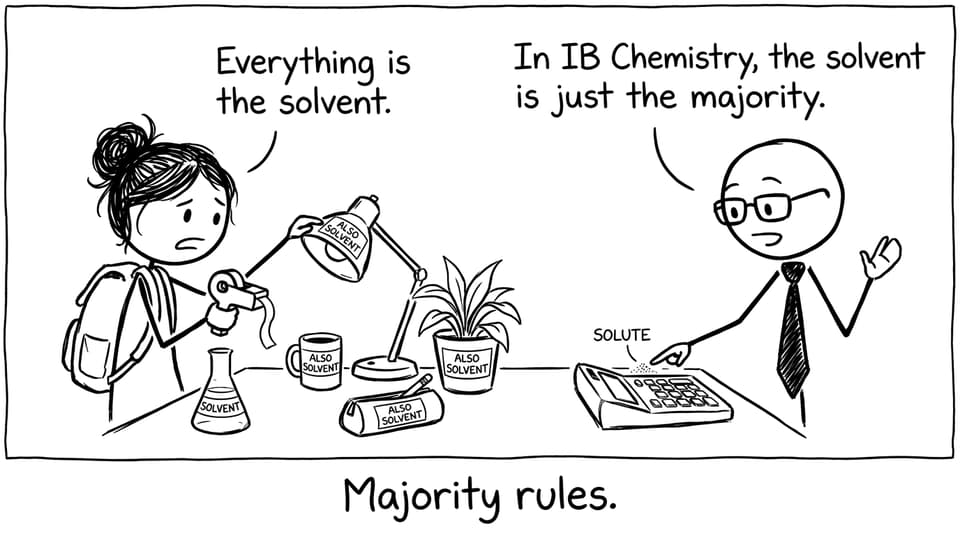
Which component is in the larger amount? Usually the solvent.
-
Which component determines the physical state (liquid, gas, solid)? That’s the solvent.
-
Everything else dispersed through it? Those are solute(s).
When you want to reinforce the language, RevisionDojo’s IB Chemistry Key Definitions is a good “tighten my wording” tool before mocks.
What is a solute? (and what students get wrong)
In IB Chemistry, a solute is the substance dissolved into the solvent. It’s often the smaller amount, but what matters most is the role: it gets separated into particles and distributed throughout the solvent.
Key solute facts that show up in markschemes:
-
A solute can be a solid, liquid, or gas.
-
A solute may produce ions in solution (which affects conductivity).
-
A solute becomes uniformly dispersed (a homogeneous mixture when fully dissolved).
Examples of solutes you can safely use:
-
NaCl in water
-
Sugar in tea
-
CO₂ in carbonated drinks
-
Water in ethanol (if water is the smaller component)
If you want a focused, exam-style explanation for the classic dissolving example, see IB Chemistry: Why NaCl Dissolves in Water.
What is a solvent? (the “majority” with power)
A solvent is the substance that dissolves the solute, and in IB Chemistry it usually:
-
Is present in the largest amount
-
Determines the phase/state of the solution
-
Strongly influences polarity and therefore solubility
Common solvents in IB questions:
-
Water
-
Ethanol
-
Hexane
-
Propanone (acetone)
When your teacher says “aqueous,” they mean water is the solvent. That single word changes how you describe ions, conductivity, pH, and equilibria.
For broader support across the topic, the IB Chemistry resources hub links Study Notes, Flashcards, and practice sets in one place.
The key differences: quantity, state, and interaction
Quantity (the usual rule)
-
Solvent = majority component
-
Solute = minority component
This is the fastest identification method in IB Chemistry, especially in mixtures like 70% ethanol and 30% water.
State (the higher-quality rule)
The solvent determines the physical state of the solution:
-
Sugar + water gives a liquid solution because water is the solvent.
-
Air is a gas solution because nitrogen (the majority gas) acts as the solvent.
Interaction (where “like dissolves like” earns marks)
Whether a solute dissolves depends on the attractions you can form:
-
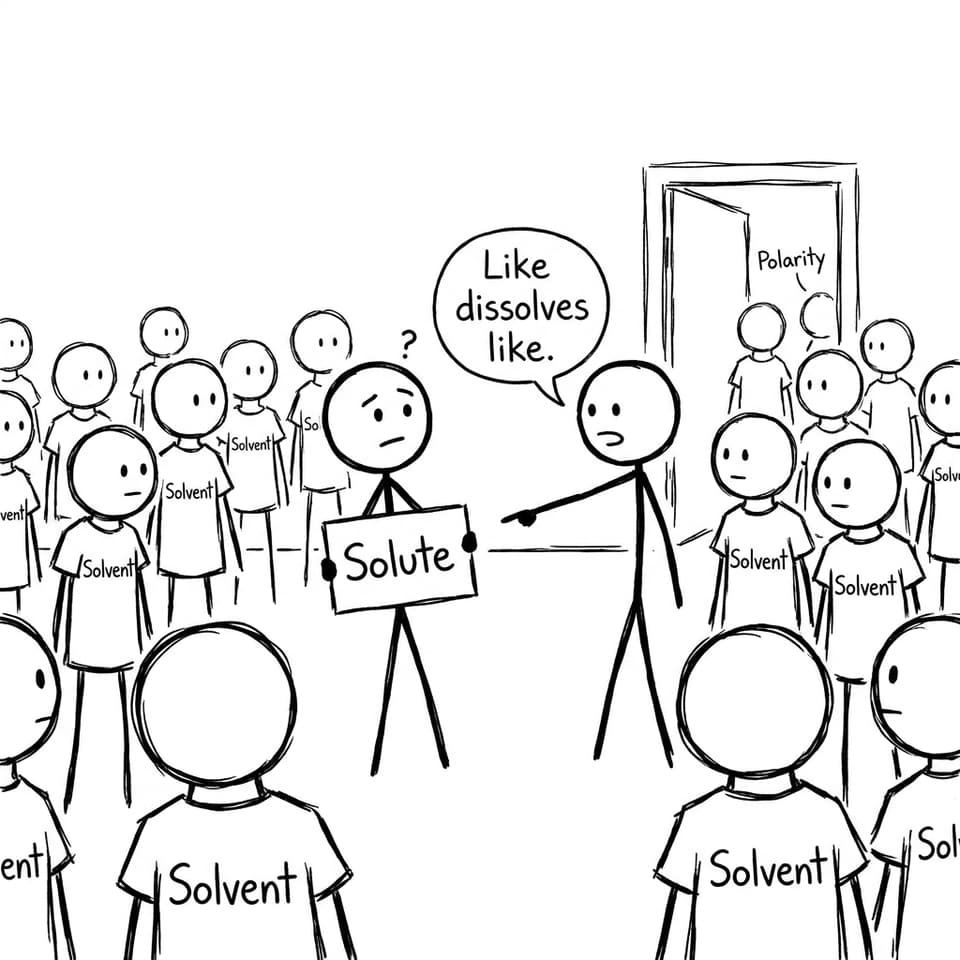
Polar solvent + polar/ionic solute (often dissolves)
-
Non-polar solvent + non-polar solute (often dissolves)
That’s the idea behind “like dissolves like,” but in IB Chemistry your best answers mention polarity and intermolecular forces.
To go deeper on that explanation style, use IB Chemistry: Why Polar and Nonpolar Substances Dissolve Differently.
How dissolving happens (3 steps IB Chemistry loves)
A solution forming is not magic. It’s a trade.
The three-step model
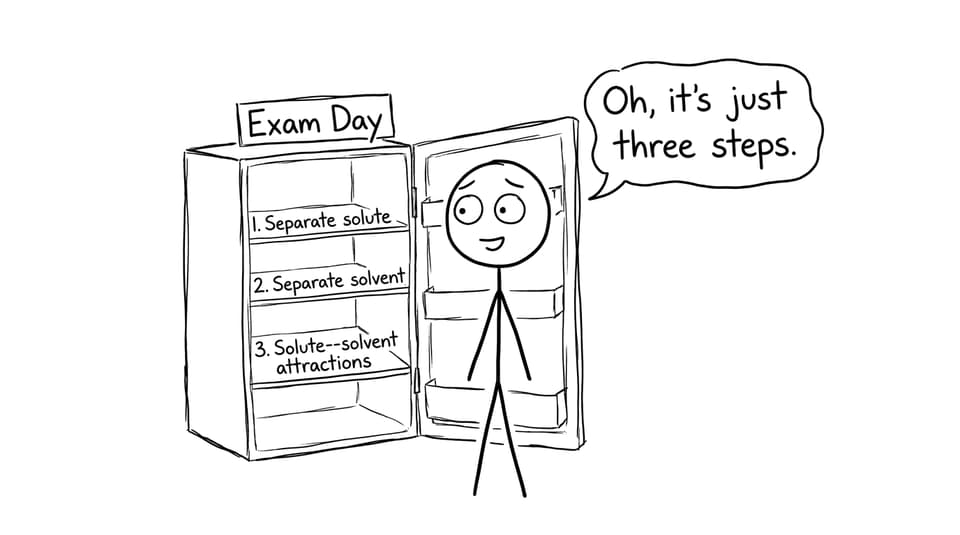
-
Separate solute particles (break ionic lattice or intermolecular forces)
-
Separate solvent particles (make space)
-
Form solute-solvent attractions (new interactions)
If step 3 “pays back” enough energy compared to steps 1 and 2, dissolving is more likely. Later, IB Chemistry connects this to energetics language such as enthalpy changes.
For energetics revision that matches the examiner tone, see Enthalpy Change Explained for IB Chemistry and practice with the Energetics and Thermochemistry Questionbank.
Fast examples (so you stop hesitating)
Saltwater
-
Solute: NaCl
-
Solvent: water
Soda
-
Solute: CO₂ (plus sugars/flavor molecules)
-
Solvent: water
Air
-
Solute: O₂ (and other minor gases)
-
Solvent: N₂
70% ethanol, 30% water
-
Solvent: ethanol
-
Solute: water
This is a quiet but powerful IB Chemistry lesson: water is common, but water is not automatically the solvent.
Why this matters in IB Chemistry exams
Solute vs solvent is the “first domino” for a lot of marks:
-
Concentration: you need the solute to use c = n/V correctly. Use How to Calculate Molarity in Chemistry and What Is the Unit for Concentration?.
-
Acids and bases: pH and ionization are discussed in the solvent (often water). See IB Chemistry: Strong vs Weak Acids Explained.
-
Solubility: temperature and polarity depend on solvent behavior. See IB Chemistry: Why Temperature Changes Solubility.
To make this automatic, do targeted practice in the IB Chemistry Questionbank and use RevisionDojo’s AI Chat to check if your explanation includes the marking points.
Closing: the calm way to remember solute vs solvent
On exam day, you don’t need a clever trick. You need a repeatable one.
In IB Chemistry, the solvent is the majority component that sets the state and does the dissolving. The solute is what gets dispersed through it. Once you name those correctly, you can explain polarity, “like dissolves like,” concentration, and even energetics with far less friction.
If you want to lock this in, build a short practice set in the IB Chemistry Questionbank, revise with Flashcards, and use RevisionDojo’s Predicted Papers and Mock Exams to rehearse the same definitions under timed pressure.