


If you have ever mixed two clear solutions in class and watched them turn cloudy, you have already met Ksp in real life. In IB Chemistry, that “mystery solid” is rarely a mystery; it is equilibrium, quietly enforcing a limit on how many ions are allowed to stay dissolved.
Ksp (the solubility product constant) is the tool that turns that cloudy moment into something you can predict, calculate, and explain with confidence in exam conditions.
Ksp in IB Chemistry: the exam-ready idea
Ksp describes the equilibrium between a sparingly soluble ionic solid and its dissolved ions.
A quick checklist before you do any Ksp problem in IB Chemistry:
-
Write the dissolution equation for the salt.
-
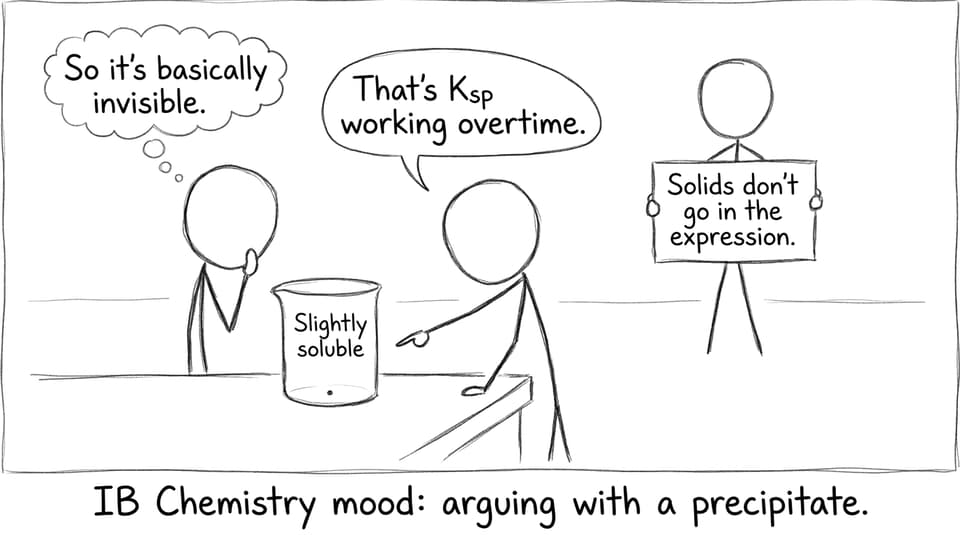
Write the Ksp expression (omit the solid).
-
Decide what the question is asking: solubility or will a precipitate form?
-
Use stoichiometry to link ion concentrations to a single variable (usually s).
-
If mixing solutions, calculate Q and compare it to Ksp.
If equilibrium constants still feel hazy, connect this to the broader equilibrium rules in R2.3.2 The equilibrium law and constant Notes.
What is solubility product (Ksp)?
In IB Chemistry, Ksp is the equilibrium constant for:
-
a solid ionic compound that dissolves only slightly
-
forming ions in aqueous solution
-
reaching a saturated equilibrium
Example:
AgCl(s) ⇌ Ag⁺(aq) + Cl⁻(aq)
At equilibrium, the ion concentrations stop changing overall. The solid might still dissolve and recrystallize, but at equal rates, a classic dynamic equilibrium.
The key expression is:
Ksp = [Ag⁺][Cl⁻]
The solid does not appear because its concentration is constant. This same “omit pure solids and liquids” logic shows up across IB Chemistry, including in your definitions and constants work in the IB Chemistry glossary.
How to write Ksp expressions (without overthinking it)
The simplest rule: your exponents come from the balanced dissolution equation.
If a salt dissolves as:
A_xB_y(s) ⇌ xA^(…)(aq) + yB^(…)(aq)
Then:
Ksp = ˣʸ
Common IB Chemistry examples
CaF₂(s) ⇌ Ca²⁺(aq) + 2F⁻(aq)
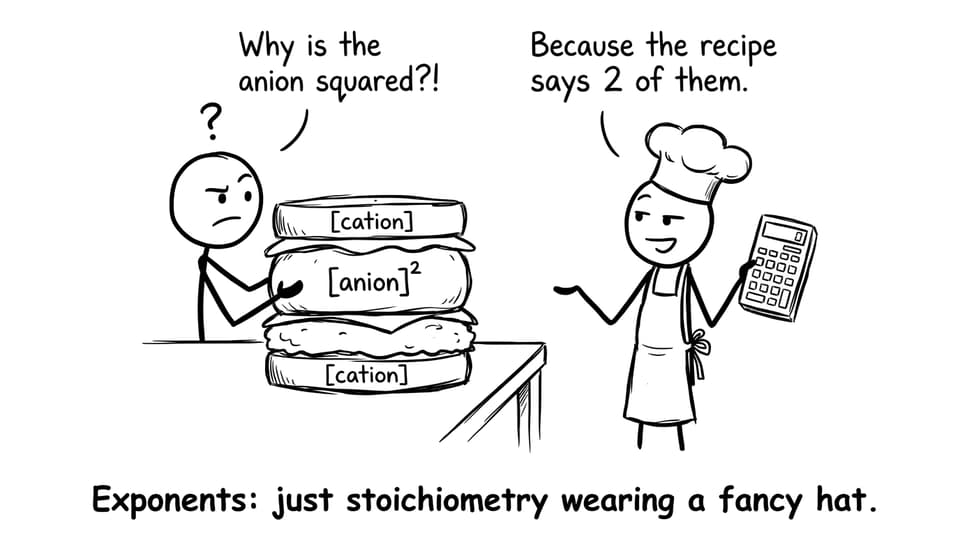
Ksp = [Ca²⁺][F⁻]²
PbI₂(s) ⇌ Pb²⁺(aq) + 2I⁻(aq)
Ksp = [Pb²⁺][I⁻]²
Fe(OH)₃(s) ⇌ Fe³⁺(aq) + 3OH⁻(aq)
Ksp = [Fe³⁺][OH⁻]³
Those bigger powers are why tiny concentration changes can suddenly trigger precipitation, a detail examiners love.
From Ksp to molar solubility (the part that scores marks)
Molar solubility, s, is “how many moles dissolve per dm³.” In IB Chemistry, you usually assume pure water and no common ions unless stated.
1:1 salts (like AgCl)
AgCl(s) ⇌ Ag⁺ + Cl⁻
If the molar solubility is s, then:
-
[Ag⁺] = s
-
[Cl⁻] = s
So:
Ksp = s²
s = √Ksp
1:2 salts (like CaF₂)
CaF₂(s) ⇌ Ca²⁺ + 2F⁻
If the molar solubility is s:
-
[Ca²⁺] = s
-
[F⁻] = 2s
Ksp = (s)(2s)² = 4s³
That “4” is not decoration; it is stoichiometry turned into math.
For fast formula checking during revision, keep the IB Chemistry Data Booklet - Formula Reference open beside you.
Predicting precipitation: Q vs Ksp
When you mix solutions, you do not start at equilibrium. You start with whatever ion concentrations you created, then ask if the system will shift to form a solid.
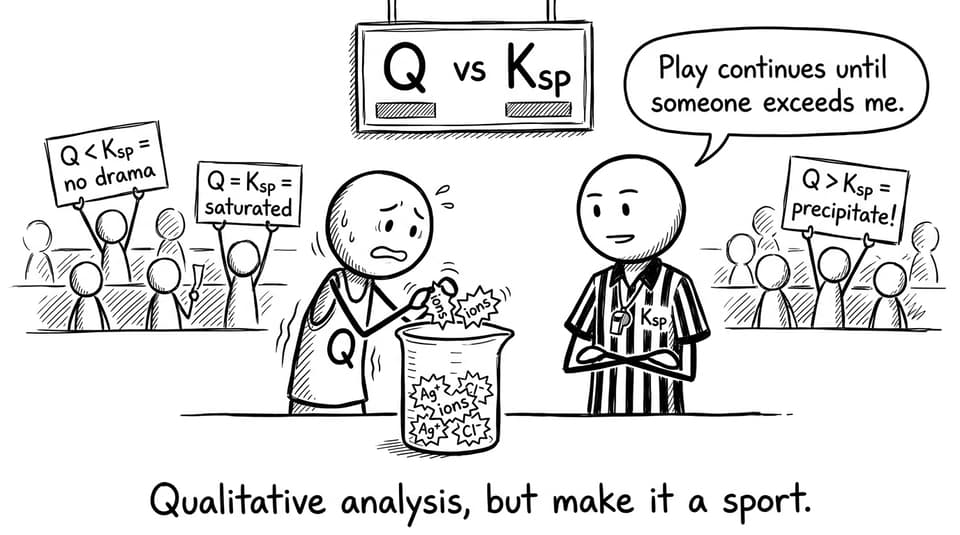
That is where Q (the reaction quotient) comes in.
-
If Q < Ksp, the solution is unsaturated, so no precipitate.
-
If Q = Ksp, the solution is saturated, at equilibrium.
-
If Q > Ksp, there are “too many ions” dissolved, so a precipitate forms until Q returns to Ksp.
This connects directly to precipitation logic covered in Precipitation Reactions Explained Simply, which is worth revising alongside Ksp in IB Chemistry.
What changes Ksp (and what does not)
A detail that separates strong answers from average ones in IB Chemistry:
-
Ksp changes with temperature.
-
Ksp does not change when you add more ions; concentrations change Q, not Ksp.
Two common “twists”:
Common-ion effect
Adding an ion already in the equilibrium reduces solubility. (You can think of it as Le Chatelier pushing back.) You will often meet this through mixing salts or using buffered conditions.
pH effects (especially hydroxides and carbonates)
In acidic solution, OH⁻ or CO₃²⁻ gets removed by reaction with H⁺, so more solid dissolves to replace it. If your acids and bases foundations are shaky, revise with IB Chemistry: Strong vs Weak Acids Explained and the 8.2 Properties of acids and bases Notes.
How RevisionDojo helps you master Ksp faster
Ksp is one of those IB Chemistry topics that feels easy while reading, then suddenly hard when numbers arrive.
RevisionDojo is built for that gap:
-
Use the Questionbank on IB Chemistry - RevisionDojo to drill Ksp, Q vs Ksp, and equilibrium set-ups.
-
Turn frequent mistakes into quick wins with Flashcards for expressions and stoichiometry patterns.
-
Ask AI Chat to check your Ksp set-up steps before you commit to the algebra.
-
Use Grading tools to see where method marks are being lost.
-
Build timed practice with Mock Exams and Predicted Papers to make Ksp feel routine.
-
If you want targeted help, use Tutors to fix your exact sticking point in one session.
Closing: make Ksp a predictable topic
Ksp is not a memorization trap. In IB Chemistry, it is a calm equilibrium idea wearing the costume of algebra: write the dissolution equation, translate it into a Ksp expression, and let stoichiometry do the rest. Once you can move between Ksp, molar solubility, and Q vs Ksp, precipitation questions stop feeling like surprises.
If you want Ksp to feel automatic before exams, practice it the smart way on IB Chemistry - RevisionDojo, using the Questionbank, Flashcards, AI Chat, and Mock Exams until the steps become muscle memory.