


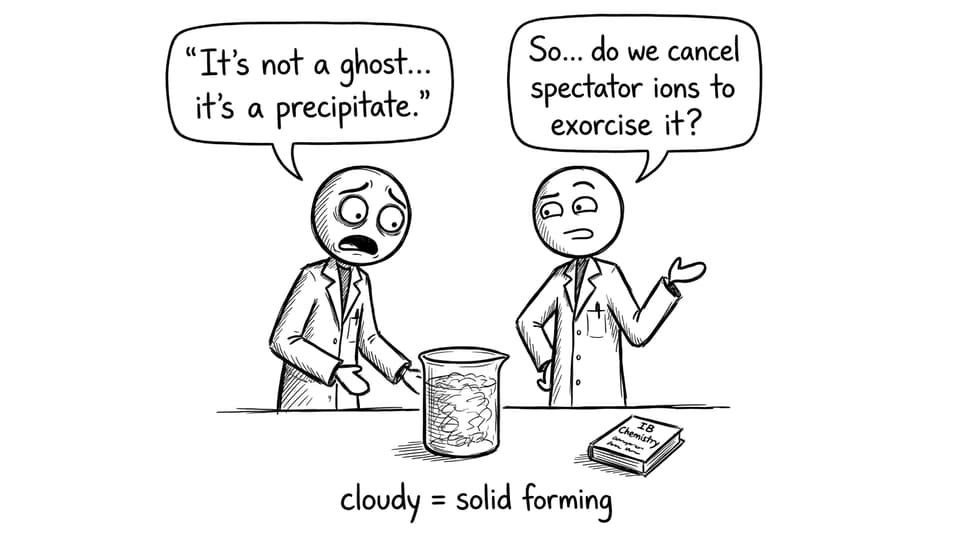
It usually starts the same way: you mix two perfectly clear solutions, you blink, and suddenly the beaker turns cloudy like a tiny weather system formed on your lab bench. In IB Chemistry, that moment matters more than it looks. Because the cloudiness is evidence of a rule-based world: ions swapping partners, an insoluble compound forming, and exam marks waiting for anyone who can explain it cleanly.
Precipitation reactions (the simple definition you can write fast)
A precipitation reaction happens when two aqueous ionic solutions are mixed and they produce an insoluble ionic solid called a precipitate.
In IB Chemistry, you’re expected to do three things with this idea:
-
Predict whether a precipitate forms (using solubility rules)
-
Write a balanced equation, then a net ionic equation
-
Describe observations (cloudiness, solid settling, sometimes color)
If you want a companion skill for the equation side, review Ionic Equations Explained Simply and Spectator Ions Explained for IB Chemistry.
How precipitation reactions work in IB Chemistry (particle story)
The core story is quiet:
Dissolve first: ions separate
Soluble ionic compounds dissociate in water:
-
NaCl(aq) (\rightarrow) Na(^{+})(aq) + Cl(^{-})(aq)
-
AgNO(_3)(aq) (\rightarrow) Ag(^{+})(aq) + NO(_3)(^{-})(aq)
Mix: ions meet new partners
Once mixed, all ions are in the same “pool.” Most combinations stay dissolved, but one pairing might be insoluble.
Precipitate: insoluble product forms
If a new ion pair makes an insoluble compound, it leaves solution as a solid:
- Ag(^{+})(aq) + Cl(^{-})(aq) (\rightarrow) AgCl(s)
That solid is your precipitate. In IB Chemistry, you can describe it as “solid forms because the lattice is more stable than the hydrated ions in water,” but you usually don’t need to over-explain unless asked.
The pattern to spot: double displacement
Most precipitation reactions follow a swap pattern:
AB(aq) + CD(aq) (\rightarrow) AD(s) + CB(aq)
Only one product needs to be insoluble for it to count as a precipitation reaction.
Example:
BaCl(_2)(aq) + Na(_2)SO(_4)(aq) (\rightarrow) BaSO(_4)(s) + 2NaCl(aq)
Solubility rules (what IB Chemistry actually tests)
Solubility rules can feel like trivia until you notice the exam prefers the same recurring families.
Usually soluble
-
All nitrates (NO(_3^{-}))
-
All Group 1 salts (Li(^{+}), Na(^{+}), K(^{+}))
-
Most chlorides (exception: Ag(^{+}), Pb(^{2+}))
-
Most sulfates (exception: Ba(^{2+}), Pb(^{2+}), Ca(^{2+}) often treated as low solubility)
Usually insoluble
-
Most carbonates (CO(_3^{2-}))
-
Most hydroxides (OH(^{-}))
-
Most sulfides (S(^{2-}))
-
Classic “named” insolubles: AgCl, AgBr, AgI, BaSO(_4)
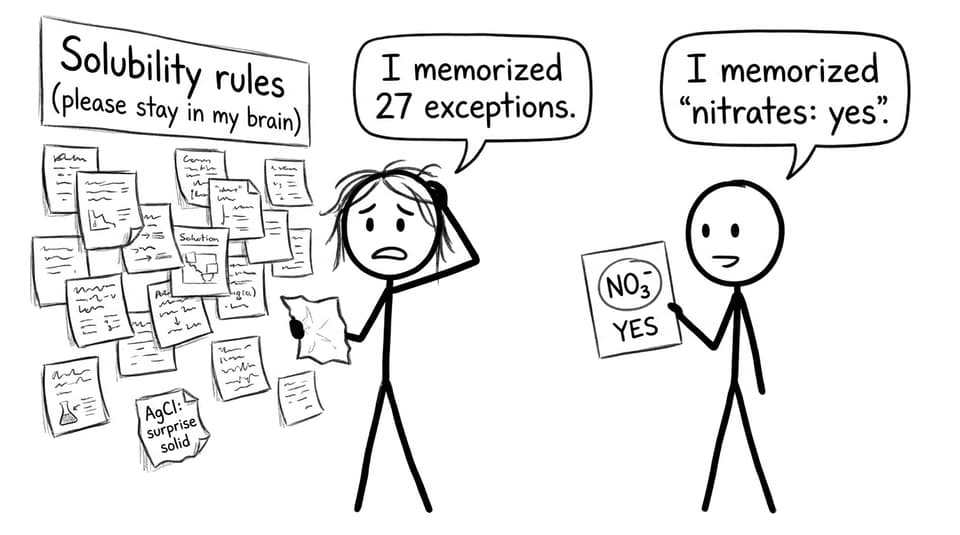
When you practise this in IB Chemistry, doing ten quick predictions beats rewriting lists. RevisionDojo’s IB Chemistry resources hub is built for that kind of repetition: Questionbank drills, Flashcards for rules/exceptions, and AI Chat when an “exception” seems to appear out of nowhere.
Common precipitation reactions and what you observe
These are the kinds of examples that keep returning in IB Chemistry:
-
Silver chloride: AgNO(_3)(aq) + NaCl(aq) (\rightarrow) AgCl(s) + NaNO(_3)(aq)
Observation: white precipitate -
Barium sulfate: BaCl(_2)(aq) + Na(_2)SO(_4)(aq) (\rightarrow) BaSO(_4)(s) + 2NaCl(aq)
Observation: white precipitate -
Iron(III) hydroxide: FeCl(_3)(aq) + 3NaOH(aq) (\rightarrow) Fe(OH)(_3)(s) + 3NaCl(aq)
Observation: brown precipitate -
Copper(II) carbonate: CuSO(_4)(aq) + Na(_2)CO(_3)(aq) (\rightarrow) CuCO(_3)(s) + Na(_2)SO(_4)(aq)
Observation: green precipitate
Net ionic equations (where marks are hiding)
In IB Chemistry, the net ionic equation is the “truth” of the reaction: only the species that actually change.
Example:
AgNO(_3)(aq) + NaCl(aq) (\rightarrow) AgCl(s) + NaNO(_3)(aq)
Complete ionic:
Ag(^{+}) + NO(_3^{-}) + Na(^{+}) + Cl(^{-}) (\rightarrow) AgCl(s) + Na(^{+}) + NO(_3^{-})
Cancel spectators (Na(^{+}), NO(_3^{-})):
Ag(^{+})(aq) + Cl(^{-})(aq) (\rightarrow) AgCl(s)
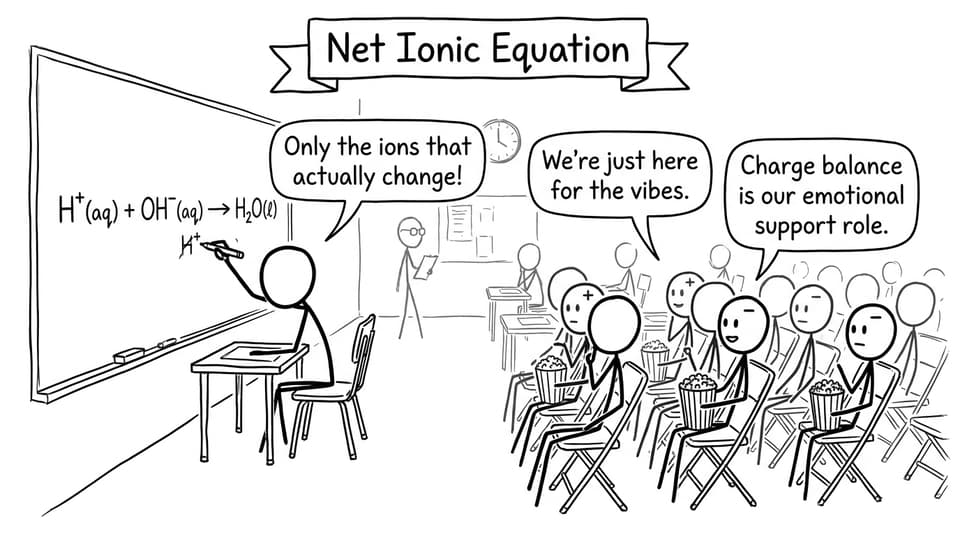
If you want the fastest way to improve this skill, build short sets in RevisionDojo’s Questionbank and check your cancellations with the Grading tools. Then convert your common mistakes into Flashcards (spectators, states, charge balance) so your IB Chemistry accuracy rises without adding extra study hours.
HL link: why “insoluble” still connects to equilibrium
At HL, you’ll meet the idea that “insoluble” really means “dissolves a tiny bit,” and that balance is measured by Ksp. That’s where you predict precipitation using ion concentrations rather than just rules. A clear next step is Solubility Product (Ksp) Explained Simply, and for the broader context you can use the Equilibrium topic page.
Conclusion: turn the “cloudy beaker” into easy marks
Precipitation reactions in IB Chemistry are less about drama and more about discipline: predict with solubility rules, write the molecular equation, cancel spectator ions, and finish with a clean net ionic equation. If you want this to feel automatic before exams, use RevisionDojo’s IB Chemistry resources alongside Study Notes, Flashcards, AI Chat explanations, and Mock Exams and Predicted Papers to rehearse the exact question styles you’ll face. The beaker turning cloudy is the hook, but your job is turning that moment into precise, repeatable marks in IB Chemistry.


