In IB Chemistry, temperature questions often look innocent. Then your teacher hands you a solubility curve, a fizzy drink, and a six-mark “explain” prompt, and suddenly it’s not about memorising trends anymore -- it’s about telling a particle-level story.
Temperature affects how well substances dissolve because dissolving is an energy negotiation. Particles need enough motion to separate, and the overall process may absorb or release heat. Once you see it as a tug-of-war between forces and energy, IB Chemistry solubility questions get a lot calmer.
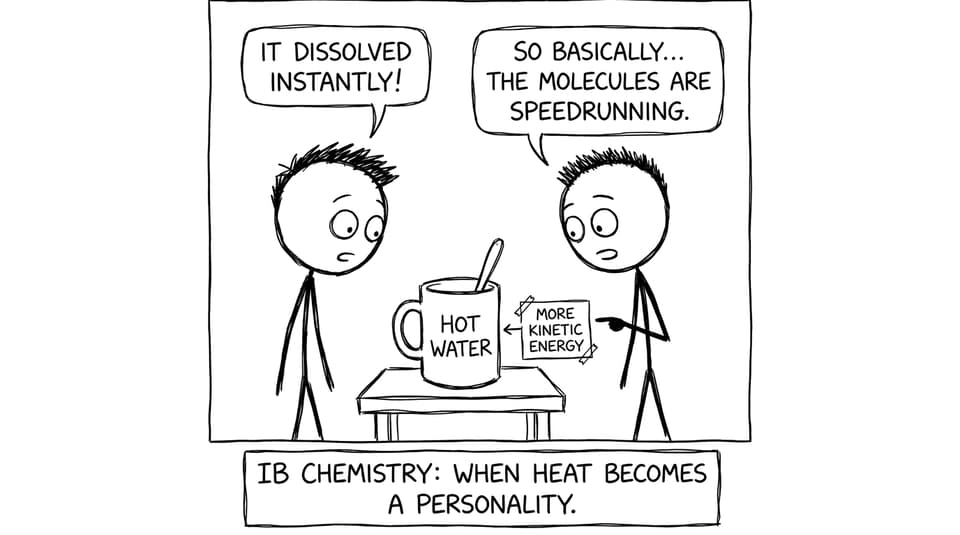
Students speedrunning dissolving
The quick IB Chemistry checklist (what examiners want)
When you’re explaining temperature and solubility in IB Chemistry, hit these points:
Temperature increases kinetic energy of particles.
Dissolving requires breaking solute--solute attractions and forming solute--solvent attractions.
For most solids in liquids, higher temperature usually means higher solubility.
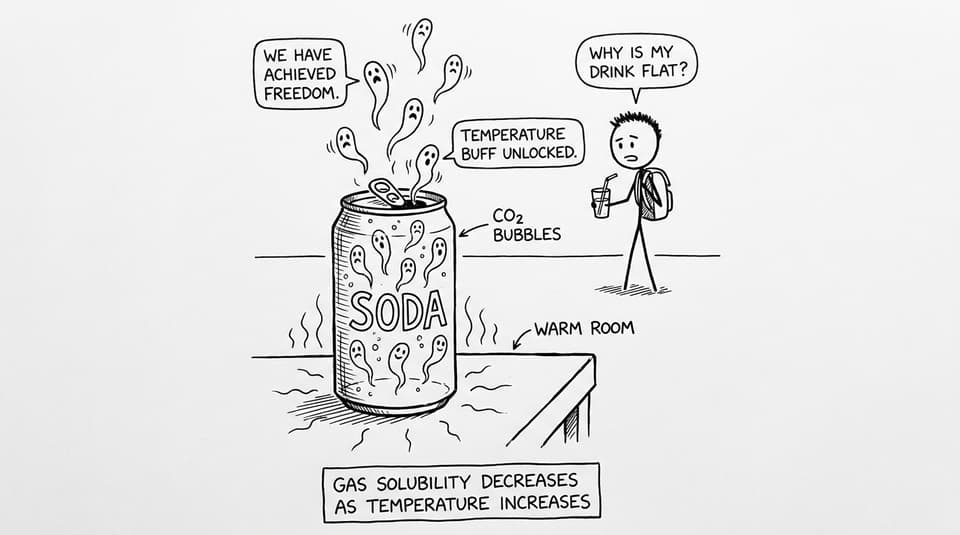
For gases in liquids, higher temperature usually means lower solubility.
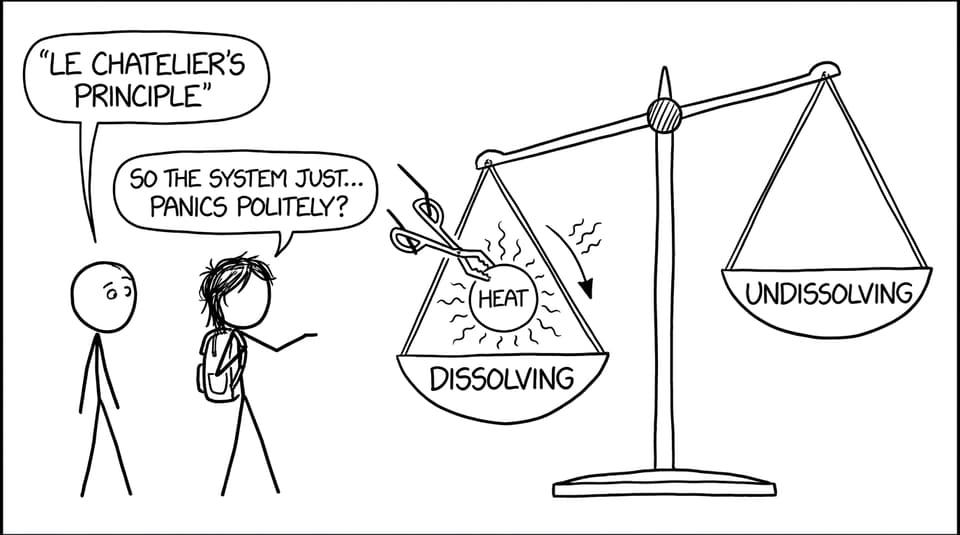
Use Le Chatelier’s principle language when dissolving is endothermic/exothermic.
Separate solubility (amount) from rate of dissolving (speed).
Particle motion: the quiet engine behind dissolving
At the microscopic level, dissolving isn’t “vanishing.” In IB Chemistry, it’s particles separating and dispersing until a dynamic balance is reached.
When temperature rises, particles in both the solute and solvent move faster. That extra kinetic energy increases the frequency and force of collisions, which helps solvent particles pull solute particles away from each other. If you need vocabulary for solution basics, keep Solute vs solvent explained simply nearby for quick definitions you can reuse in explanations.
This motion explains a key exam trap: temperature can increase the rate of dissolving even when the maximum amount that can dissolve changes only a little. In data questions, that difference matters.
Why solids usually dissolve more at higher temperature (IB Chemistry)
For many ionic and molecular solids, dissolving is effectively helped by added heat. The solvent has more energy to disrupt the solid structure, and the solute particles can escape the lattice (or molecular network) more readily.
In plain IB Chemistry terms: higher temperature makes it easier to overcome the attractive forces holding the solute together, while also improving how quickly the solvent surrounds and stabilises separated particles.
This connects naturally to intermolecular forces. If you want to tighten your language (hydrogen bonding, ion--dipole attraction, dispersion forces), review Intermolecular forces notes.
A classic extension is supersaturation: heating allows more solute to dissolve, then cooling can trap “too much” solute temporarily. RevisionDojo’s Supersaturated solutions explained is perfect for those curveball questions.
Why gases dissolve less when heated (IB Chemistry’s favourite soda example)
Gases behave differently. Dissolving a gas in a liquid generally requires gas particles to be “captured” by the liquid. When temperature increases, gas particles have more kinetic energy and are more likely to escape from the liquid back into the gas phase.
That’s why warm soda goes flat faster: carbon dioxide becomes less soluble, so it bubbles out more quickly.
The energy angle: endothermic vs exothermic dissolving
In IB Chemistry, dissolving can be endothermic or exothermic overall. If dissolving absorbs heat (endothermic), increasing temperature favours more dissolving. If dissolving releases heat (exothermic), increasing temperature can reduce solubility.
Wrap-up: make temperature questions feel predictable
Temperature affects how well substances dissolve because it changes particle kinetic energy and can shift the energy balance of dissolving. In IB Chemistry, your edge comes from explaining both trends: solids usually dissolve more at higher temperature, gases usually dissolve less -- and then naming the difference between rate and solubility.
If you want this to stick under timed conditions, RevisionDojo helps you practise it the way exams demand: targeted Questionbank sets, concise Study Notes, rapid-fire Flashcards, and AI Chat for checking your explanations. Add Mock Exams, Predicted Papers, and the Grading tools when you’re close to exam season, or use the Coursework Library and Tutors if you’re turning this topic into an investigation. For broader planning, keep IB Chemistry HL: complete guide for success open as your roadmap.
Daniel holds an MSc in Chemistry from Imperial College London and has taught IB Chemistry for over 20 years, including as Head of Chemistry. His focus is on building the conceptual understanding behind each equation rather than rote recall.