A useful MYP History study group does not divide the reading and hope everyone remembers it. It gives every member a reason to retrieve knowledge, examine evidence, defend an interpretation, and improve an answer.
The most effective study group strategies for MYP History follow a simple pattern: prepare individually, question one another, analyse sources together, write independently, and finish with specific next steps. Three or four students can complete this process in about 60 minutes using one topic, several questions, a timer, and the relevant assessment criteria.
The difference matters. A group can discuss the Industrial Revolution for an hour and leave with only the feeling of having studied. Or it can leave with corrected misconceptions, stronger source analysis, and one improved paragraph per student. Activity is visible. Learning is what remains afterward.
The same-day study group checklist
Begin with this compact setup:
- Invite three or four reliable students.
- Choose one tightly defined topic.
- Bring your teacher's instructions and relevant criteria.
- Select one source, one recall set, and one extended question.
- Rotate the roles of facilitator, questioner, evidence checker, and timekeeper.
- Set a 60-minute limit.
- Require everyone to write independently before discussing improvements.
- End with one personal weakness and one next action.
The MYP History resource hub provides a shared starting point through topic summaries, lessons, definitions, Flashcards, and practice questions. Using one common resource prevents the meeting from disappearing into a search for materials.
A 60-minute method you can use today
Minutes 0 to 5: Choose one outcome
Complete this prompt: “By the end of this meeting, we will be able to...”
“Revise industrialisation” is too broad. A stronger outcome is “explain two causes of industrialisation, compare their importance, and support our judgment with evidence.” That version gives the group something observable to produce.
Match the outcome to the expected task. MYP Individuals and Societies uses four broad assessment criteria: knowing and understanding, investigating, communicating, and thinking critically. Your teacher's year-specific rubric should guide the precise standard. Facts matter, but so does the ability to use and communicate them.
Minutes 5 to 15: Run closed-book retrieval
One student asks short questions while everyone answers without notes. Include dates, people, terminology, causes, consequences, and turning points. The evidence checker then confirms or corrects each response using an agreed resource.
The aim is not to embarrass anyone. It is to reveal knowledge the group recognizes while reading but cannot retrieve independently.
Students studying industrialisation can combine Industrial Revolution topic resources with RevisionDojo Flashcards. Keep a shared “uncertain list” instead of stopping for a long explanation after every error. Revisit the list before finishing.
Minutes 15 to 30: Analyse one source from different angles
Give every member the same written, visual, or statistical source, then assign each person a lens:
- Origin: Who created it, when, and in what context?
- Purpose: What was the creator trying to achieve?
- Value: What can historians reasonably learn from it?
- Limitation: What can it not establish by itself?
- Perspective: Whose experience appears, and whose may be absent?
Allow two minutes of silent thinking before anyone speaks. This prevents the activity from becoming a conversation between the two most confident members.
A government speech may reveal official priorities without being a neutral account of events. A protest poster may clarify a movement's objectives while offering limited evidence about how widely those aims were accepted. Connect every claim about value or limitation to the source's origin, purpose, content, or context.
Turn discussion into historical arguments
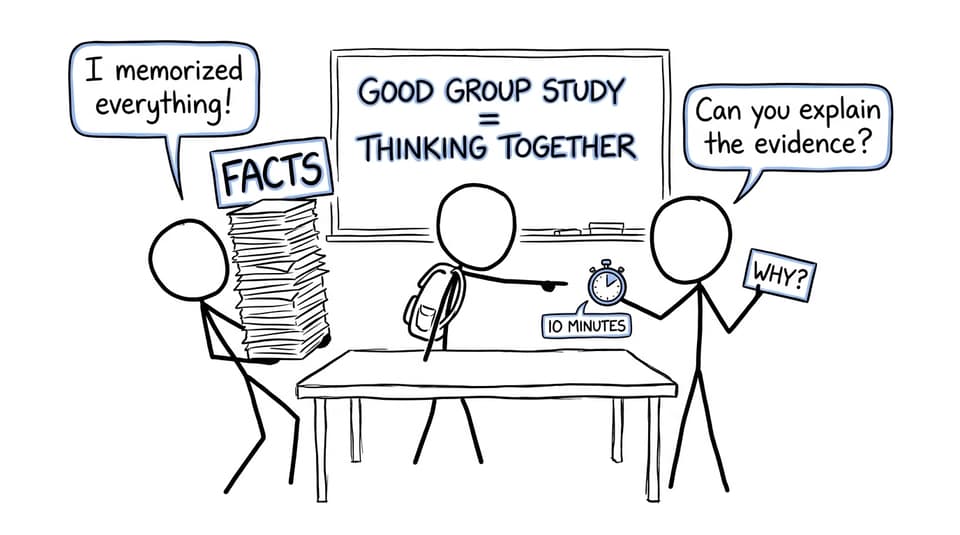
Discussion feels productive because ideas arrive quickly. Yet students must eventually communicate historical reasoning themselves. Every meeting should therefore include silent, individual writing.
Choose a question from the MYP History Questionbank, or use one supplied by your teacher. Give everyone eight minutes to write an analytical paragraph:
- Make a claim that addresses the question.
- Introduce precise evidence.
- Explain how the evidence supports the claim.
- Consider significance, perspective, or an alternative explanation.
- Link the reasoning back to the question.
Members then exchange answers and provide one strength and one exact improvement. “Add detail” is vague. “Explain why urban growth increased pressure for public-health reform” gives the writer a useful next step.
The urbanisation and demographic change notes can help students verify evidence. The civil rights struggles notes support work on political movements. Resources should strengthen an argument, not replace the student's reasoning.
Give each member a rotating role
Roles reduce uneven participation and meetings without direction. They must rotate, however. The strongest speaker should not always facilitate, while the most organised student should not become the permanent administrator.
| Role | Responsibility |
|---|---|
| Facilitator | States the goal, moves between activities, and invites quieter members to contribute |
| Questioner | Prepares retrieval and follow-up questions without revealing answers too quickly |
| Evidence checker | Verifies disputed details and asks what supports each claim |
| Timekeeper | Protects writing time and prevents one issue from consuming the meeting |
For three students, combine facilitator and timekeeper. For five, add a criterion coach who compares answers with the teacher's rubric. Roles create accountability, but the historical thinking must remain shared.
Use disagreement as a revision technique
Historical disagreement is useful when it concerns interpretation rather than basic recall. If one student prioritises economic pressures while another emphasises political leadership, ask both to present their strongest evidence. The group can judge each explanation by its scope, significance, and supporting detail.
Try a five-minute “defend the other side” round. After presenting an argument, each student builds the strongest reasonable challenge to it. This develops the ability to recognise perspectives and qualify conclusions.
Comparative topics work particularly well. Use War, Conflict and Peacemaking resources for conflict or the Imperialism and Colonisation topic collection for empire. Ask what changed, what remained similar, and which contextual difference best explains the contrast.
Avoid study-group traps
The first trap is collective rereading. Listening to someone read notes aloud requires little retrieval or judgment. Read before the meeting, then use shared time for questions and application.
The second is dividing topics so completely that each member learns only one section. Teaching others can help, but everyone should still answer questions and produce an explanation.
The third is unstructured correction. Confident delivery is not proof of accuracy. When members disagree over a factual claim, check class material, trusted Study Notes, or the teacher rather than voting.
Finally, do not let AI perform the historical thinking. RevisionDojo's AI Chat and Grading tools are most useful after students attempt a question. Ask for clarification, feedback, or a challenge to your reasoning, then revise in your own words.
Build a weekly cycle
At the end of each meeting, every student writes three lines:
- One idea I can now explain without notes.
- One weakness revealed by today's work.
- One task I will complete before the next meeting.
Begin the next meeting with those tasks. This creates continuity and prevents the group from repeatedly reviewing comfortable topics.
RevisionDojo can become the group's central study system: Study Notes establish context, Flashcards support retrieval, the Questionbank provides application, and AI Chat or Grading tools identify possible improvements. Mock Exams can later test whether those skills hold under time pressure. Across RevisionDojo's wider IB ecosystem, students can also use Predicted Papers, a Coursework Library, and Tutors when appropriate.
A good study group is not valuable because several students occupy the same table. It is valuable because each person must remember, question, judge, communicate, and revise. Begin with one topic and one hour. If everyone leaves with a better answer and a clear next action, shared time has become individual capability.

