


Your exhibition theme starts as a sentence you mumble to yourself at 1 a.m. and ends as the thread an examiner follows through your entire room.
That’s why IB Visual Arts themes matter more than most students expect. A theme is not a slogan. It’s a decision-making tool. It tells you what to include, what to cut, what to experiment with, and what to explain in your curatorial rationale.
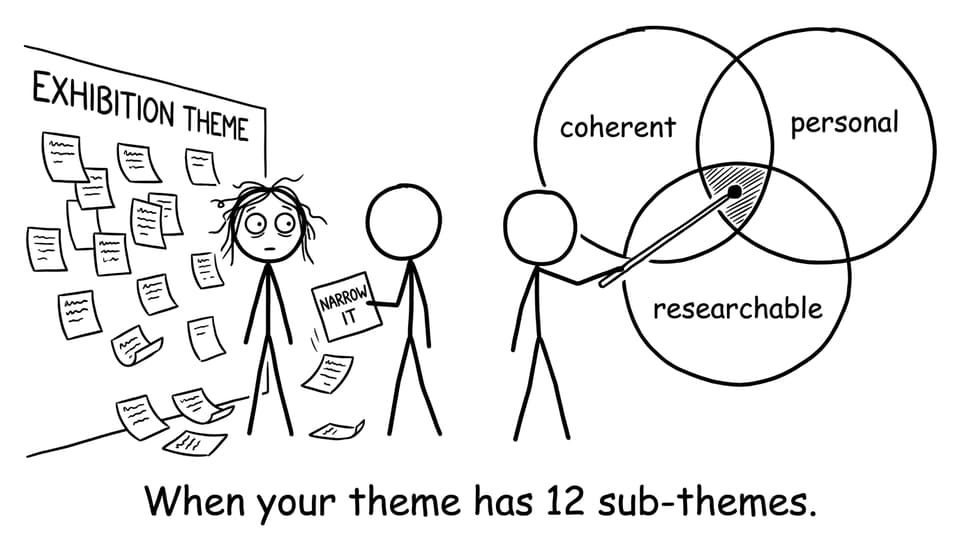
If you want the fastest way to feel calm, start here: pick a theme that is personal, researchable, and specific enough to curate.
The quick checklist for a strong IB Visual Arts theme
Use this checklist before you commit. A high-scoring IB Visual Arts exhibition theme usually:
-
Creates coherence without forcing every artwork to look the same
-
Produces variety in media, scale, and viewpoint (without turning random)
-
Supports artist research across cultures or time periods
-
Gives you clear language for your curatorial rationale
-
Helps you generate at least 8 different investigations (even if you only exhibit 4-11 works)
For the examiner-focused view, keep IB Visual Arts Assessment Criteria Explained Simply open while you plan.
Strong IB Visual Arts exhibition themes (and how to make them yours)
Below are theme families that work because they naturally create both unity and depth. The key is the “zoom-in”: take a big idea and give it a boundary.
Identity and self-expression (but with a boundary)
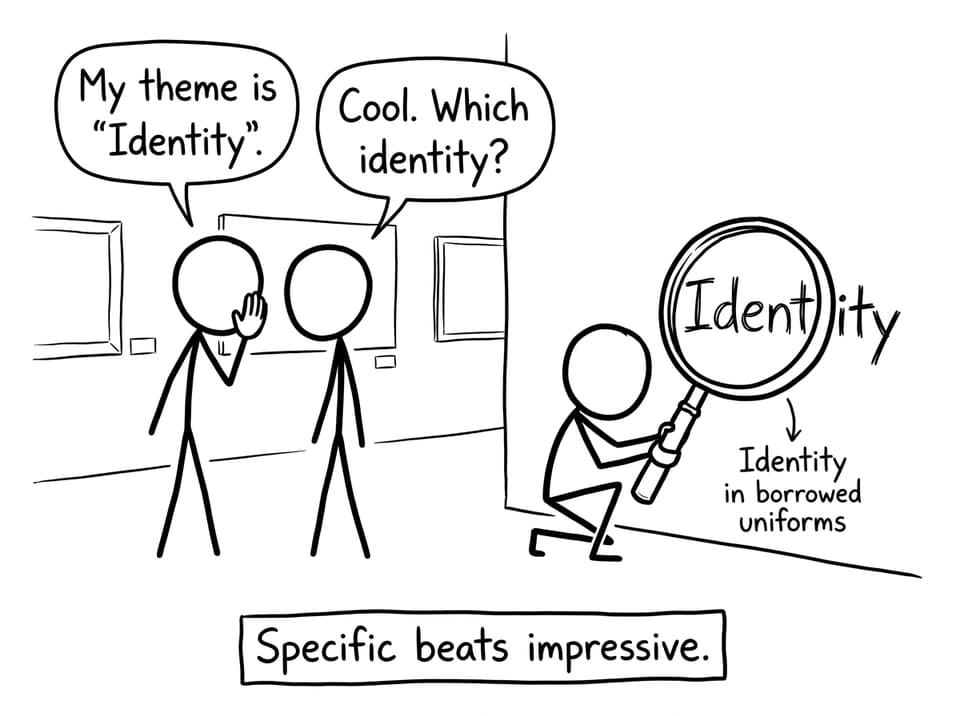
Identity is popular because it’s inexhaustible. It also becomes vague fast. In IB Visual Arts, the winning move is to anchor identity in something concrete: clothing, language, names, migration, archives, masks, rituals, or family objects.
Try narrowing prompts like:
-
Identity in borrowed uniforms (school, work, tradition)
-
Identity as translation (between languages, labels, expectations)
-
Self-portraiture without faces (hands, rooms, belongings)
If you want more ways to pressure-test themes, see Best Themes for IB Visual Arts Exhibition.
Memory and nostalgia (layers, erasure, evidence)
Memory themes work because they naturally invite process: layering, rewriting, distorting, stitching, reprinting, and re-photographing. That means your Process Portfolio gets stronger as your concept gets stronger.
Useful angles:
-
Family history vs public history
-
Objects that “store” memory (tickets, letters, fabrics)
-
Nostalgia as comfort vs nostalgia as manipulation
Pair this with smart documentation using How to Show Experimentation in Your IB Visual Arts Process Portfolio.
Technology and modern life (attention, surveillance, the algorithm)
This theme is relevant, but the best exhibitions don’t just say “phones are bad.” They show what technology does to seeing: how attention fragments, how bodies pose for cameras, how feeds shape identity.
Ways to sharpen it:
-
The aesthetics of screenshots and notifications
-
Surveillance and self-surveillance
-
AI as collaborator vs AI as threat (handled thoughtfully)
For course context and how the exhibition fits the bigger picture, read What is IB Visual Arts?.
Environment and nature (beauty, damage, responsibility)
Environment themes can be poetic or political. Either way, specificity wins.
Strong directions include:
-
Local environmental change (one coastline, one park, one street)
-
Nature as pattern language (repetition, growth, decay)
-
Human-made “nature” (gardens, zoos, urban plants)
This theme is perfect for varied media: prints, sculpture, photo series, found materials, and installation documentation.
Social justice and inequality (art as a careful argument)
Activist themes can be powerful in IB Visual Arts, but only if you avoid poster statements. The strongest bodies of work show nuance: conflict, complicity, and the limits of your own viewpoint.
To keep it rigorous, ask:
-
What is my relationship to this issue?
-
What visuals am I borrowing, and what ethics come with that?
-
Can I show complexity, not just outrage?
To avoid common traps, check Most Common Mistakes in IB Visual Arts, Pitfalls to Avoid.
How to develop your theme without getting stuck
A theme becomes “strong” when it produces a repeatable process.
Start with one sentence, then write three rules
Write your theme in one line. Then give yourself three rules that guide making.
Example:
-
Theme: “Memory as a fragile archive.”
-
Rule 1: Every piece includes a trace of erasure or damage.
-
Rule 2: I combine one personal source with one public source.
-
Rule 3: I repeat one visual motif across media.
Build your theme across the three IB Visual Arts components
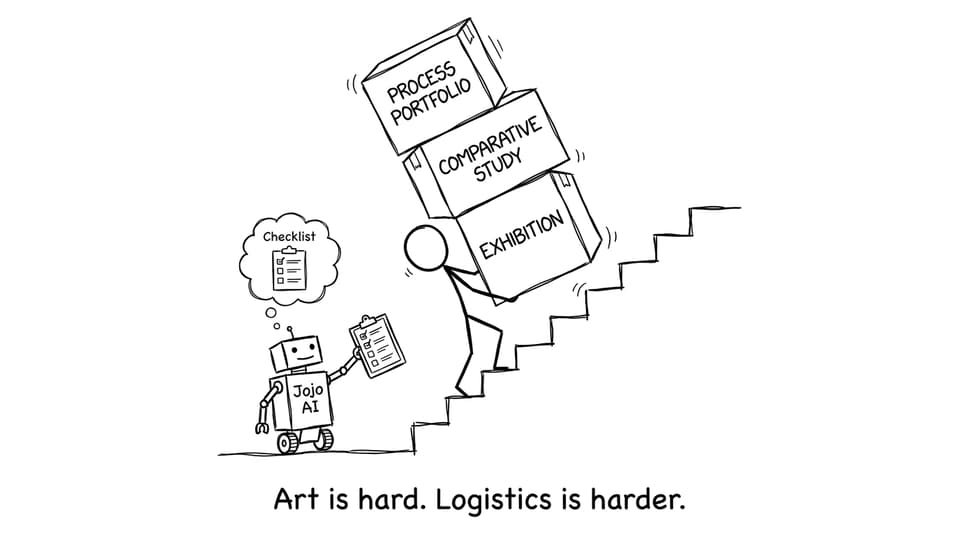
Your exhibition theme should quietly support everything:
-
The Process Portfolio shows experiments and development (see What to Include in an IB Visual Arts Portfolio).
-
The Comparative Study becomes easier when your theme creates meaningful comparisons (use IB Visual Arts Comparative Study Structure (Step-by-Step)).
-
The Exhibition becomes a curated argument, not a storage closet.
Write the rationale like a calm explanation, not a poem
A strong IB Visual Arts curatorial rationale is clear, specific, and grounded in decisions: why these works, why this order, why this spacing.
Use IB Visual Arts Curatorial Rationale: A Clear Guide as your structure, then practice layout thinking with IB Visual Arts Exhibition Setup Tips for High Marks.
Bring it home: make your IB Visual Arts theme do real work
A strong IB Visual Arts exhibition theme isn’t there to decorate your wall labels. It’s there to help you choose, refine, and explain. When the theme is focused, your experimentation becomes easier to document, your curatorial rationale becomes easier to write, and your exhibition reads like a deliberate body of work.
When you’re ready to turn that theme into a scoring plan, use RevisionDojo as your studio partner: build skill with Study Notes and Flashcards, pressure-test decisions with AI Chat, and get rubric-aligned feedback using the Grading tools. Then sharpen your selection with Mock Exams and Predicted Papers-style practice for your written components, and explore strong samples in the Coursework Library. If you want a human second set of eyes, RevisionDojo Tutors can help you make your IB Visual Arts theme tighter, clearer, and more curatable.


