
EE Assessment Criteria Explained (2027 Guide)
The first time many students truly respect the EE isn’t when they brainstorm a topic.
It’s when they open the criteria and realize the EE is not a “good writing” contest. It’s a matching game between what you think you’re doing and what examiners are trained to reward.
That’s why two students can spend the same 40-ish hours and end up with very different outcomes. One builds a calm, criteria-aligned project. The other writes a smart-sounding document that slowly drifts away from what the rubric measures.
This guide breaks down the EE assessment criteria for 2027 in a practical way: what each criterion is really asking, how to earn marks on purpose, and how RevisionDojo can shorten the gap between “draft” and “final.”
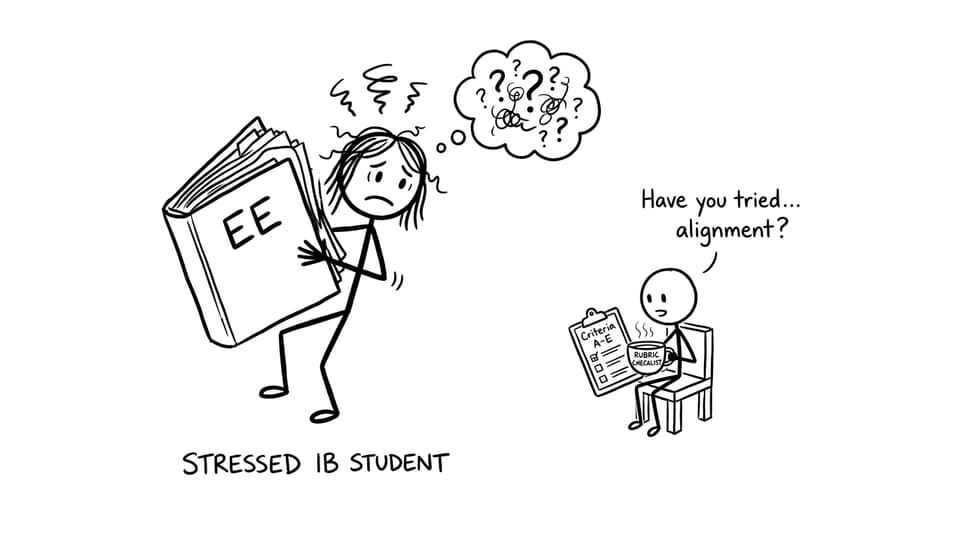
Quick checklist before you polish anything in your EE
Use this as a fast diagnostic. If you can’t answer a question confidently, you’ve found your next high-leverage edit.
-
Can you say your EE research question in one breath (no extra clauses)?
-
Does your method clearly fit your registered subject’s conventions?
-
Do your headings show an argument (not just a list of topics)?
-
Does each section earn its place by answering the research question?
-
Are you analyzing evidence more than summarizing sources?
-
Do you evaluate the strengths and limitations of your evidence?
-
Does your conclusion answer the question and acknowledge limits?
-
Do your reflections show decisions, changes, and learning (not vibes)?
If you want the big picture of the whole EE journey across subjects, start with RevisionDojo’s Extended Essay guides. Then return here to align your draft with the criteria.
What “new for 2027” usually means for the EE
When students hear “2027 criteria,” they often imagine the IB replaced the whole marking system.
In reality, the criteria themselves are stable, but what changes over time is how consistently examiners apply descriptors across subjects, and how strict they are about things students commonly get wrong (over-broad questions, descriptive writing, thin reflection, messy presentation).
The safest 2027 mindset is simple: treat the EE like five parallel projects (Criteria AtoE). If one thread is weak, it pulls down the whole result.
For a companion explanation in plain English, keep these open while you draft:
EE Criterion A: Focus and method (design your investigation)
Criterion A is the steering wheel of your EE. If it’s loose, everything wobbles later.
What examiners look for in EE Criterion A
Examiners are asking: did you design an investigation, or did you just start writing and hope structure appears?
High-scoring work shows:
-
A sharply focused research question
-
A method that clearly fits the subject you registered
-
A structure that follows logically from your question and method
This is especially important in Individuals and Societies EEs: you are expected to investigate through the lens of your chosen subject’s methodology (for example, economics, history, digital society). The method is not a decoration; it’s the discipline.
How to earn marks in EE Criterion A
-
Write a research question that forces analysis (often helped by command terms like “to what extent” or “how far”).
-
Add a short paragraph early that justifies why your method belongs in the subject.
-
Use headings that reflect “steps in reasoning,” not “chapters in a textbook.”
If you’re still choosing or validating a topic, use How do you know if your EE topic is good enough? to sanity-check feasibility.
For research-question precision, keep these open during edits:
EE Criterion B: Knowledge and understanding (show you’re inside the subject)
Students sometimes become vague because they’re trying to sound academic. Criterion B punishes vagueness.
What examiners look for in EE Criterion B
They want proof that you understand the subject you’re writing in:
-
Correct terminology and concepts
-
Accurate context
-
Knowledge that stays tightly relevant to the research question
In Individuals and Societies subjects, this often means using concepts meaningfully (not name-dropping them). For economics, terms like supply and demand must be used precisely. For history, concepts like causation and consequence must shape your argument. For social and cultural anthropology, concepts like marginalization need to do work in your analysis.
How to earn marks in EE Criterion B
-
Define key terms once, cleanly, and then use them consistently.
-
Treat “context” as only what the reader must know to understand your argument.
-
Choose concepts you can actually apply repeatedly across the essay.
If you want to see what “subject-specific expectations” feel like, browse a subject guide and notice how strict the boundaries are. For example: Essentials of the EE (English Lit).
EE Criterion C: Analysis and line of argument (turn sources into thinking)
A strong EE is not a tour of what other people wrote.
It’s a line of argument that you build from evidence.
What examiners look for in EE Criterion C
They’re watching for:
-
Analysis that directly answers the research question
-
Evidence used with purpose
-
A coherent argument that develops across the essay
The key phrase is “line of argument.” It means your paragraphs are connected, not just individually impressive.
How to earn marks in EE Criterion C
-
Build paragraphs around claims, not authors.
-
After every key quotation, statistic, or example, add a “so what?” sentence.
-
Show how each section moves your argument forward.
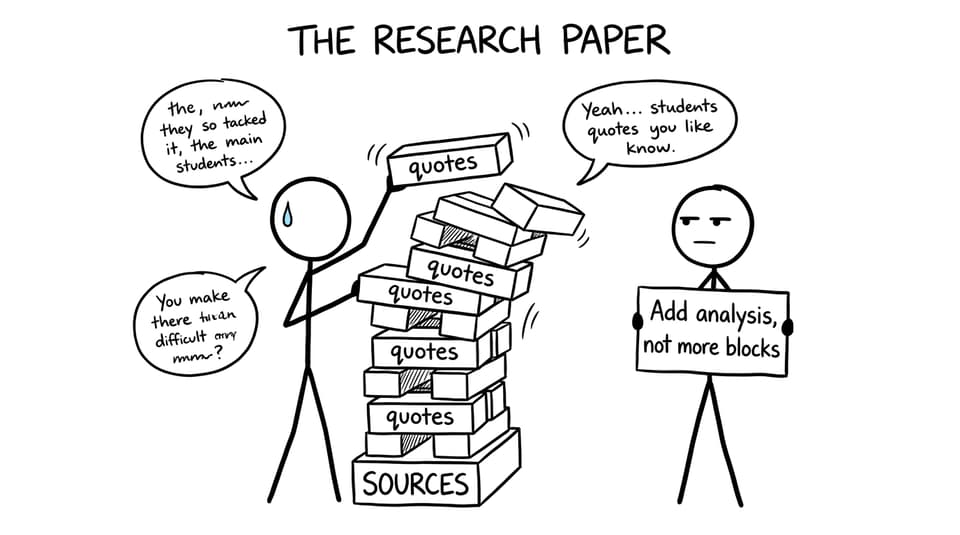
If your middle sections feel descriptive, this guide is a direct fix:
EE Criterion D: Discussion, evaluation, and presentation (make it readable and defensible)
Students often hear “presentation” and think “make it pretty.”
But the EE is assessed like academic work: clarity, consistency, and correct scholarly conventions.
What examiners look for in EE Criterion D
A high-scoring EE is easy to follow:
-
Clear organization and signposting
-
Consistent citations and references
-
Correct integration of tables, figures, diagrams, maps, and graphs
In Individuals and Societies EEs, structural conventions matter: diagrams and maps should be clearly labelled (scale, key/legend when appropriate), acknowledged if created by others, and actively discussed in the body of the essay rather than “dropped in.”
How to earn marks in EE Criterion D
-
Keep your structure predictable: introduction, focused body sections, conclusion.
-
Update your table of contents after major edits.
-
Decide your citation style early and stay consistent.
For a clean, IB-aligned layout, use:
EE Criterion E: Reflection and engagement (prove you learned like a researcher)
Many students postpone reflection until the end, then write something that sounds motivational.
Criterion E does not reward motivational writing. It rewards visible thinking.
What examiners look for in EE Criterion E
Examiners want evidence that you:
-
Made real research decisions
-
Changed direction for clear reasons
-
Learned about your method, your question, and your limitations
In other words: engagement is not emotion. Engagement is intellectual honesty over time.
How to earn marks in EE Criterion E
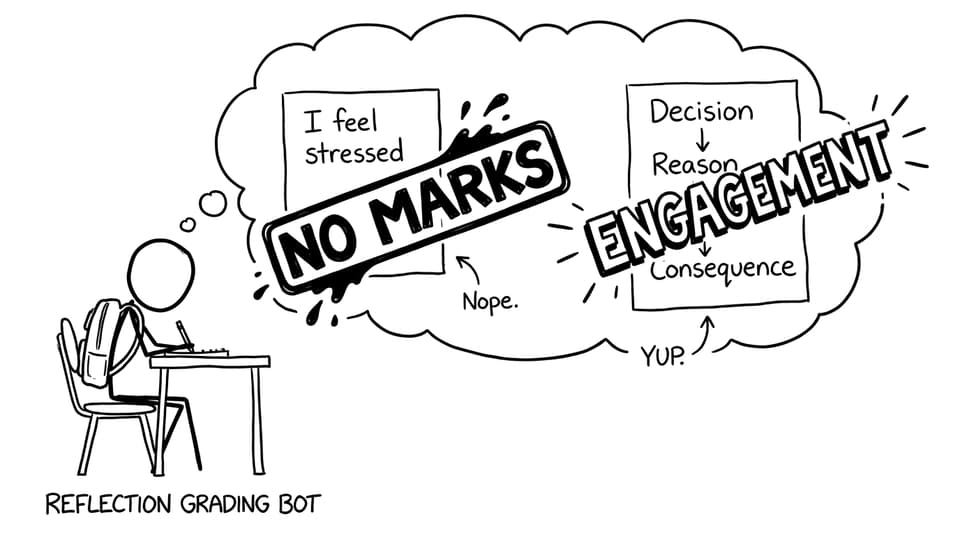
Use a simple reflection pattern:
-
Decision
-
Reason
-
Consequence
Example (strong): “I narrowed my case study from X to Y because my sources for X were repetitive; this allowed a clearer comparison and changed my argument by…”
Example (weak): “This was challenging but I learned a lot.”
Two strong reflection resources:
A calm EE workflow: align to criteria instead of rewriting blindly
Most EE stress comes from editing without a target. The criteria give you targets.
Plan first for EE Criteria A and B
-
Draft your research question and a one-paragraph method justification.
-
Build a small “concept bank” (key terms + definitions you will actually use).
-
Choose sources with a job description: one line on what each source contributes.
Need help crafting the opening? Use 7 key steps to write a strong extended essay introduction.
Draft with EE Criteria C and D in mind
-
Write headings as claims (the steps of your argument).
-
Use a repeatable paragraph pattern: claim -> evidence -> analysis -> mini-link back to the research question.
-
Cite as you go. Don’t “save citations for later.”
Reflect continuously for EE Criterion E
-
After each supervisor meeting, write what changed and why.
-
When a method fails, record the pivot.
-
When you spot a limitation, document how it affects your conclusions.
How RevisionDojo helps you improve your EE faster (without guesswork)
The fastest improvement isn’t heroic rewriting. It’s short feedback loops.
RevisionDojo is built to compress those loops while you still remember what you meant:
-
Use the Grading tools to get rubric-aligned feedback on your EE draft, then revise criterion by criterion: RevisionDojo Grader
-
Use AI Chat to ask targeted questions like: “Which sentences are descriptive?” and “How can I strengthen the line of argument without changing my claim?”
-
Use Study Notes and Flashcards to keep subject terminology sharp so your EE sounds like your subject, not like generic school writing
-
Use the Questionbank, Mock Exams, and Predicted Papers to protect exam prep time while the EE runs in the background
-
Use the Coursework Library and Coursework Examples to see what strong structure and depth look like: IB Coursework Exemplars
-
If you want human guidance, RevisionDojo Tutors can help you make high-leverage choices (topic scope, method fit, argument structure) rather than cosmetic edits
If you want a wider set of EE support posts in one place, browse: All IB Extended Essay posts.
Common EE mistakes that lose marks quietly
These don’t always look like “bad writing.” They look like normal student habits that clash with the criteria.
-
A research question that’s interesting but too broad to answer in 4,000 words (Criterion A)
-
A method that doesn’t match subject conventions (Criteria A/B)
-
Paragraphs that summarize sources without analysis (Criterion C)
-
A conclusion that introduces new ideas instead of answering the question (Criterion C)
-
Reflection that reports feelings but not decisions (Criterion E)
For a blunt, useful checklist, read: Mistakes to avoid in IB Extended Essays.
Closing: treat the EE criteria like a compass
A strong EE is rarely decided by one perfect paragraph.
It’s decided by alignment: research question aligned with method, evidence aligned with claims, and reflection aligned with real decisions.
When you treat the EE criteria like a compass, the project gets calmer. You stop guessing what “good” means and start building what the rubric can actually reward.
If you want to tighten that alignment quickly, use RevisionDojo’s full workflow: Questionbank, Study Notes, Flashcards, AI Chat, Grading tools, Predicted Papers, Mock Exams, Coursework Library, and Tutors. Start by checking your current EE draft with the RevisionDojo Grader, then revise one criterion at a time. That’s how a stressful EE becomes a finishable one.