
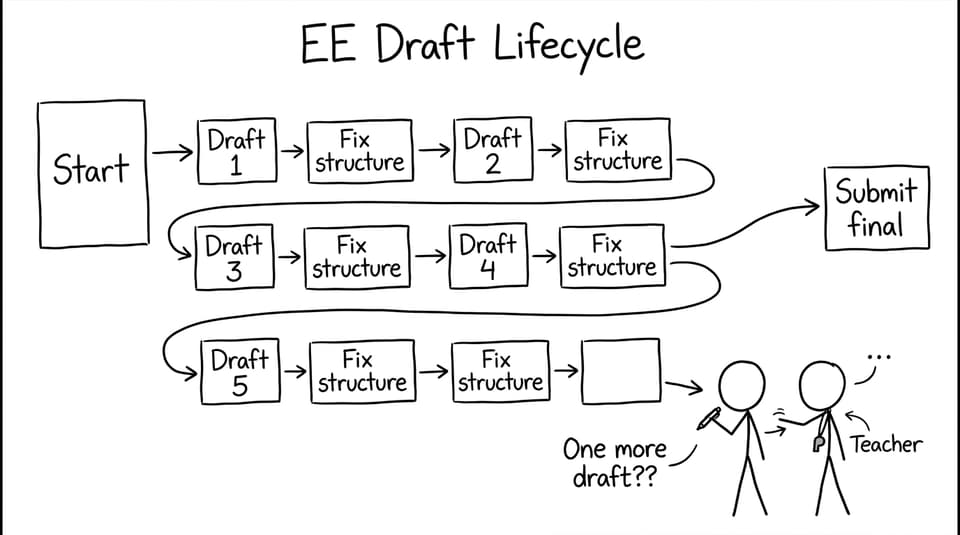
When you’re deep in the EE, you start to treat drafts like lottery tickets.
Draft 3 will be the one where the argument finally snaps into place. Draft 6 will fix the citations. Draft 9 will somehow make your analysis sound like you’ve been doing academic research since birth.
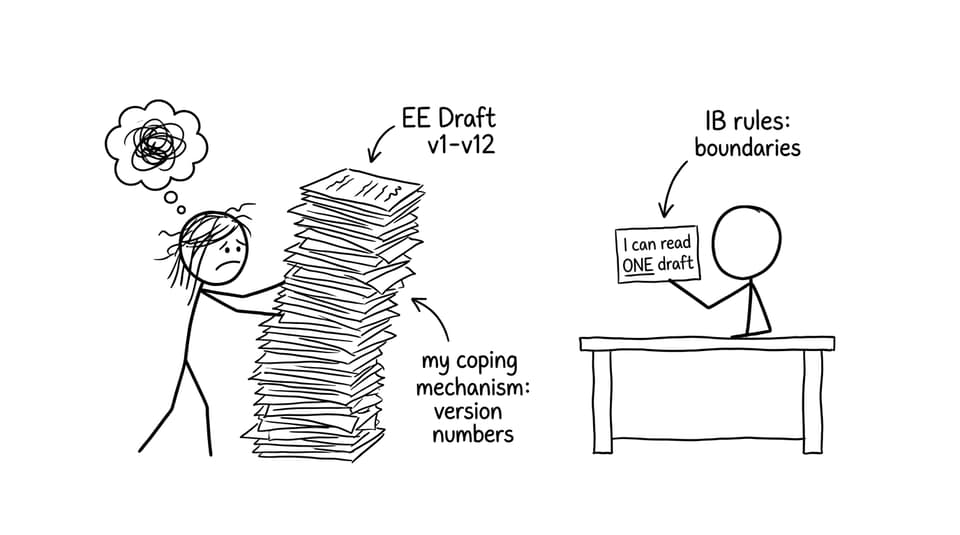
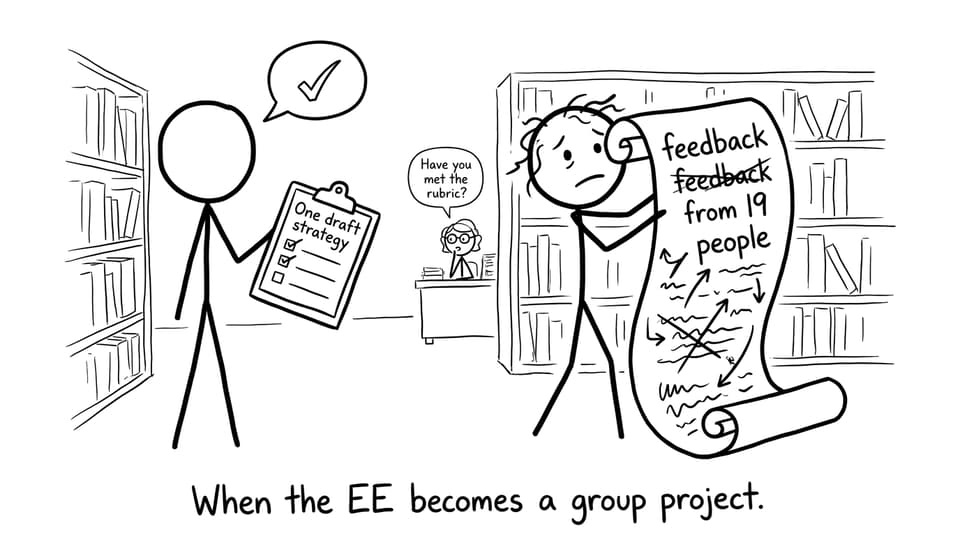
Then you meet the rule that feels like a cold splash of water: your supervisor may read and comment on one draft only.
Not one draft “per month.” Not “one draft per chapter.” One completed draft. After that, the next version your supervisor sees must be the final version submitted before the viva voce. And no changes may be made after that final submission.
So the real question behind “How many drafts can a supervisor read?” is this: How do you build a high-scoring EE when the most formal feedback you get is limited to one shot?
The rule, in plain language: how many EE drafts can your supervisor read?
For the EE, the supervisor may read and comment on one draft only.
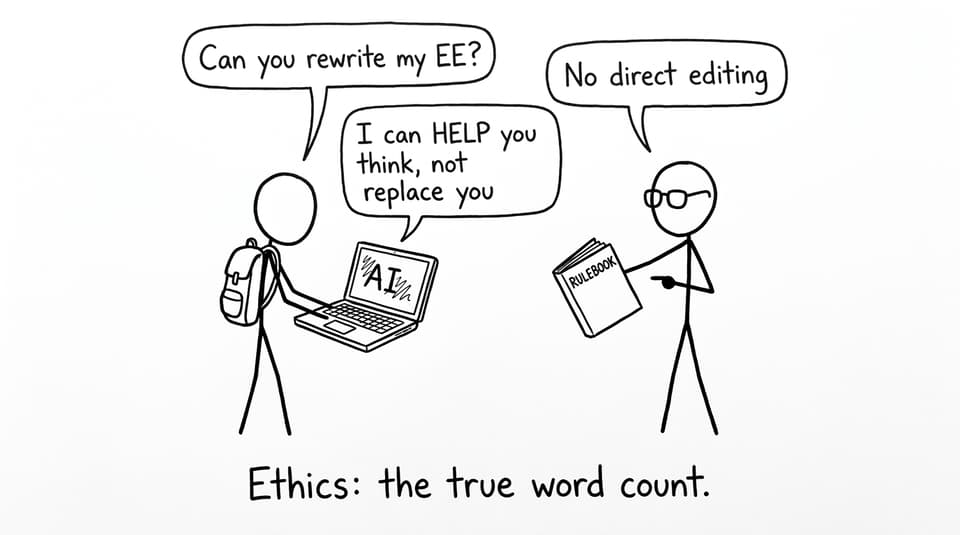
That comment can be written feedback, but it must stay within IB boundaries: no direct editing is permitted. Your supervisor can’t rewrite lines, fix your punctuation, restructure paragraphs for you, or proofread as if they’re your editor. They can guide you, ask questions, and point out issues in a general way.
After they’ve commented on that one draft:
- The next version your supervisor sees must be the final version submitted before the viva voce.
- No changes may be made after that final submission.
If you want a source you can return to when you’re planning your timeline, RevisionDojo’s EE guidance summarizes supervision expectations clearly in Essentials of the EE.
A quick checklist: how to make the “one-draft” EE rule work for you
Before you hand in your one official EE draft for supervisor comments, aim to have:
- A research question that is already focused and defendable
- A complete structure (intro, body sections, conclusion)
- Your evidence integrated (not just dumped in)
- Citations and bibliography mostly correct
- A clean table of contents and formatting pass
- A short list of the exact feedback you want (3 to 5 items)
If you’re unsure what “complete” looks like, use How to Format Your EE According to IB Guidelines as your final formatting checklist.
Why the IB limits EE supervisor feedback (and why it matters)
The IB’s restriction isn’t about making your life harder. It’s about authenticity.
The EE is meant to show independent research and writing. If supervisors could read unlimited drafts, some students would receive effectively unlimited coaching, and the line between “student work” and “teacher-edited work” would blur.
In practice, the rule changes how you should think:
- Your supervisor is a guide, not a co-writer.
- Your draft is an opportunity to receive strategic feedback, not line-by-line repair.
- Your best score comes from learning to revise like an examiner, not like a perfectionist.
To understand what examiners actually reward, keep RevisionDojo’s breakdown of criteria close: What Are the Assessment Criteria for the IB Extended Essay?.
What your supervisor CAN do for your EE (and what they can’t)
This is where many EE students lose time. They ask for the wrong kind of help.
What your supervisor can do
Your supervisor can:
- Confirm your topic and research question are appropriate
- Ask probing questions about your argument and method
- Flag gaps in logic, evidence, or focus
- Point you back to the rubric and subject conventions
- Help you plan the reflection sessions and viva voce
RevisionDojo explains the broader supervisory role in 10 Key Responsibilities of the Extended Essay Supervisor in IB.
What your supervisor can’t do
For the EE, your supervisor can’t:
- Directly edit your writing
- Rewrite paragraphs
- Proofread for grammar and punctuation
- Fix your citations for you
- Tell you exactly what to say to hit a markband
The key is to treat feedback like a compass, not a to-do list written by someone else.
The “one draft” strategy: how to use your supervisor’s single read wisely
Your supervisor’s one official read of your EE is most valuable when your draft is already “complete enough” to critique.
A common tragedy: students hand in a half-built draft hoping the supervisor will help them build it. The feedback becomes vague because the writing isn’t stable enough to diagnose.
Instead, aim for a draft that is:
- Coherent: every section clearly answers the research question
- Defendable: claims have evidence, evidence has analysis
- Readable: the structure is obvious without explanation
If you want a practical guide to tightening the draft you submit for supervisor feedback, follow How to Improve Your IB Extended Essay Draft.
The three questions to attach to your EE draft email
When you submit your one official EE draft, include 3 specific questions like:
- “Does my research question stay consistent from introduction to conclusion?”
- “Which section feels least analytical, and why?”
- “Where does my argument drift into description?”
Specific questions earn specific answers.
You can still draft many times: the supervisor limit is not a revision limit
Here’s the part most EE students miss: the rule limits supervisor feedback, not your drafting.
You can still do 10 drafts if you want. But the loop has to change:
- Self-assessment against the criteria
- Peer review using structured prompts
- Tool-based feedback for clarity and coherence
- Time-boxed rewrites that target one weakness at a time
This is where RevisionDojo quietly becomes the safety net.
You can use RevisionDojo’s Grading tools to get rubric-aligned feedback without breaking supervision boundaries, then use AI Chat to understand the “why” behind changes. You can store key structure reminders in Flashcards, and use Study Notes to rebuild subject knowledge when analysis feels thin. When exam pressure rises, the Questionbank, Mock Exams, and Predicted Papers keep your exam prep moving while the EE gets polished.
If you want the full system view, see RevisionDojo App: The Smarter Way to Prep for IB Exams.
A realistic EE workflow that fits the rule (and your exam schedule)
The mistake is trying to “finish” the EE during the same weeks your subjects demand heavy revision. The better approach is to separate phases.
Build phase (before the supervisor draft)
Goal: create a complete, messy-but-coherent EE.
- Use RevisionDojo Study Notes to refresh content you must accurately explain
- Use AI Chat to interrogate your reasoning (ask: “What counterclaim would an examiner raise?”)
- Use the Coursework Library to calibrate what strong structure and analysis look like
- Use a simple weekly deadline: “One section becomes stable by Sunday”
Feedback phase (the one supervisor draft)
Goal: turn supervisor feedback into a short revision plan.
- Translate comments into 5 to 8 prioritized actions
- Map each action to a criterion (A to E)
- Fix structure and argument first, language last
If you want criterion-specific guidance, RevisionDojo’s tools for interpreting markbands are introduced in IB EE Feedback Tool: Improve Your Extended Essay Score.
Finalization phase (the final version before viva voce)
Goal: produce the final EE your supervisor will see next.
- Run a final rubric check
- Confirm formatting
- Clean citations
- Cut anything that doesn’t answer the research question
- Export as your final submission (because no changes can be made after)
Don’t forget the viva voce: your EE ends with a conversation
The EE isn’t finished when you stop typing. It ends with the viva voce, the short final interview after submission.
You want your final version to feel stable in your mind so the viva voce becomes reflection, not panic.
Use RevisionDojo’s guide: How to Prepare for the IB Extended Essay Viva Voce.
And if you want to strengthen reflection quality (which students often leave too late), see How Reflection Strengthens Your IB Extended Essay.
Closing: treat the EE rule like a design constraint, not a punishment
The EE supervision rule feels strict because it forces a shift in identity.
You can’t be a student waiting to be corrected. You have to become a student who can revise.
Your supervisor gets one official draft to read and comment on. After that, the next version they see must be your final submission before the viva voce, and you can’t change anything after that final submission.
That sounds limiting. But it’s also clarifying.
Build a complete draft early. Use the one supervisor read for strategy. Then use RevisionDojo to run the revision loop with confidence: Study Notes to stay accurate, Flashcards to hold key frameworks in memory, AI Chat to challenge your reasoning, Grading tools to align with the rubric, and the Coursework Library to calibrate what “good” looks like. And when exams start to crowd your calendar, keep marks rising with the Questionbank, Mock Exams, and Predicted Papers.
The goal isn’t more drafts. It’s fewer, smarter decisions, and a final EE you can defend calmly when it matters.