

RevisionDojo logoRevisionDojo logo
PricingSchools
  1. Home
  2. /Blog
  3. /Score a 7 in IB Design Technology: A Calm Strategy

Score a 7 in IB Design Technology: A Calm Strategy

IB Design Technology
RevisionDojo Team
•Last updated: 19 Jul 2026•7 min read
Jojo holding a cookie

This site uses cookie tracking technologies. Learn more in our Cookie Policy.

Share on
Share on
Share on
4.1/5 from students worldwide
Share
Share on X

You can feel it in DT classrooms around the world: someone builds something impressive… and still doesn’t break into the top band.

That’s the first quiet lesson of IB Design Technology. A 7 isn’t a reward for complexity. It’s a reward for thinking that is easy to see.

If you want a 7, your job is not to look like an engineer. Your job is to make an examiner think, “This student understands the criteria, and every decision has a reason.” This guide shows how to do that for both the IA and the exams in IB Design Technology.
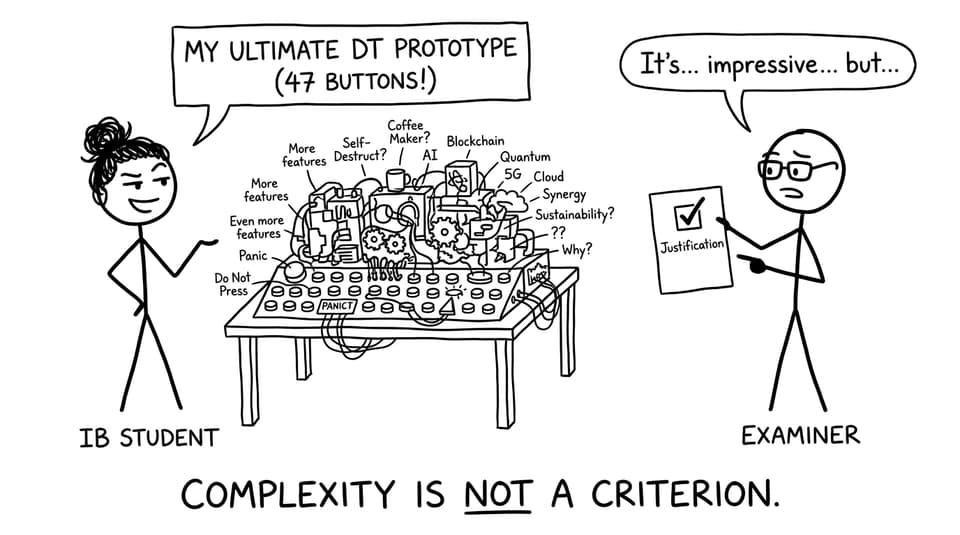
A too-complicated prototype meets the rubric

The Grade 7 checklist (print this mentally)

Before you add more work, check if you are doing these consistently:

  • Problem and user are specific, real, and evidence-based

  • Design requirements are testable (not vibes)

  • Iteration is documented as learning: test --> change --> justify

  • Evaluation uses data, feedback, and trade-offs

  • Exam answers follow command terms and apply theory to the scenario

When you need a single home base for the course, start with the IB Design Technology hub and the IB Design Technology posts tag.

What separates a 6 from a 7 in IB Design Technology

Most students who hover at 6 are working hard. The gap is usually structural:

Grade 7 work is easy to mark

A 7 makes the chain of reasoning obvious: research leads to requirements, requirements lead to tests, tests lead to iteration, iteration leads to evaluation.

Grade 7 work is honest

A 6 sometimes tries to hide weaknesses. A 7 uses weaknesses as evidence of insight: “Here’s what failed, here’s why, here’s what I changed.”

If you want the assessment logic made explicit, use How Is the IB Design Technology IA Graded? as your reference point.

How to build a 7-level IA in IB Design Technology

Start with the user, not the product

The simplest way to lose marks in IB Design Technology is starting with “I want to make X.” Examiners want “A specific user struggles with Y, and evidence shows Z causes it.”

If you’re choosing a direction, follow How Do You Choose a Good IB Design Technology IA Topic? and What Is the Best Way to Start the IB Design Technology IA?.

Write requirements that can actually be tested

Top-band requirements read like they were designed to be measured:

  • “Must be usable with one hand for 30 seconds without discomfort (self-reported user rating 4/5+)”

  • “Must withstand a 1 m drop test with no functional failure”

This matters because your testing and evaluation will reuse these exact statements.

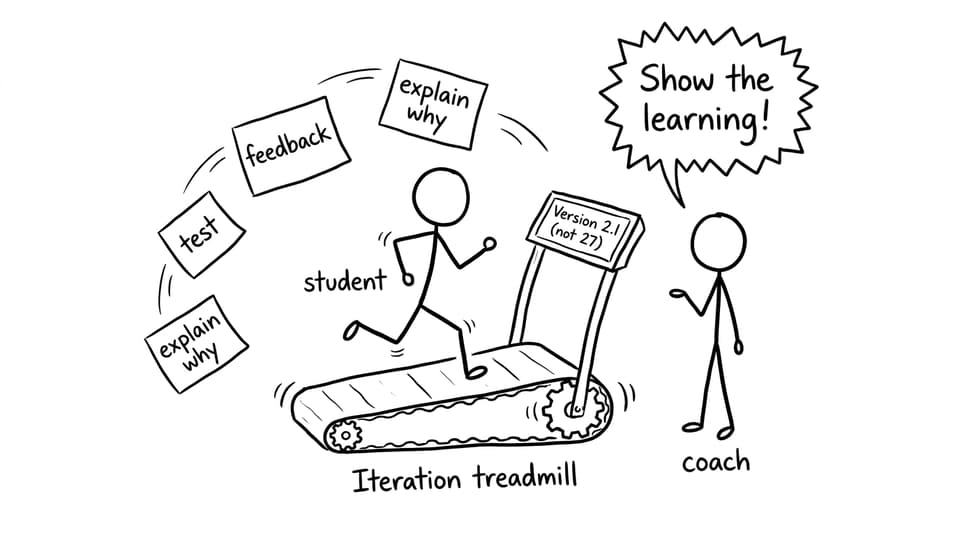
Show iteration as a loop, not a timeline

A lot of students write “I iterated” as if the word itself earns marks. In IB Design Technology, iteration is a visible loop:

  1. Test something early

  2. Find a specific limitation

  3. Change one variable

  4. Explain why that change is better

  5. Test again

Iteration treadmill: show the learning

To make iteration unmistakable, use How Do You Show Iteration in the IB Design Technology IA?.

Evaluate with evidence, not adjectives

“Successful,” “aesthetic,” “ergonomic” are not evaluation. Evidence is evaluation.

Your evaluation should be structured around requirements, then supported by:

  • Test results (tables, measurements, before/after)

  • User feedback (quotes tied to specific requirements)

  • Trade-offs (what improved, what got worse, and why you accepted it)

If your research section is bloated, read How Much Research Do You Need in the IB Design Technology IA? and cut until every paragraph informs a decision.

How to score a 7 on IB Design Technology exams

The exam side of IB Design Technology rewards the same mindset: apply, justify, evaluate.

Treat command terms like instructions

“Analyse” is not “describe with extra words.” “Evaluate” is not “say it’s good.” Your structure should match the command term, then stay loyal to it.

Apply theory to the scenario (that’s where marks live)

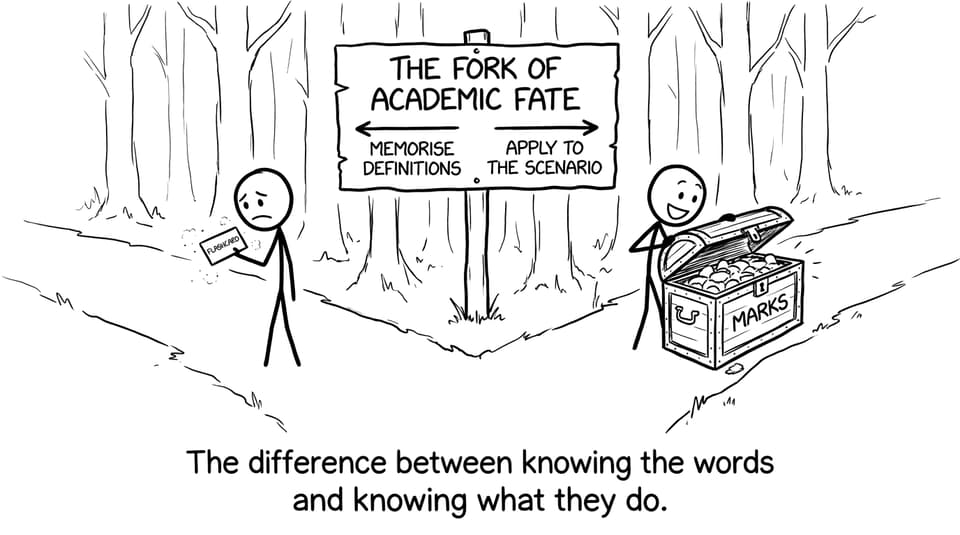
Memorising definitions helps, but definitions alone rarely finish the job. Aim to:

  • Use DT concepts in the context given

  • Compare options (materials, processes, sustainability impacts)

  • Justify decisions with constraints

Two paths: memorise vs apply

Practise under realistic conditions, then review like an examiner

RevisionDojo makes this practical: use Study Notes to patch understanding, Flashcards to keep concepts active, then the Questionbank to build exam patterns. When you want realism, add Predicted Papers and timed runs, then use AI Chat and Grading tools to see why marks were won or lost.

Start targeted practice from the DT Questionbank view and add exam rehearsal with Design Technology Predicted Papers.

A simple weekly routine for a 7

  • 3x per week: 25 minutes IB Design Technology Questionbank + error log

  • Daily: 10 minutes Flashcards (materials, processes, sustainability, design cycle)

  • 1x per week: one timed section from Predicted Papers, then review with AI Chat

  • 1 IA block: one improvement loop (test --> change --> justify)

If you’re juggling IA and exams, follow How Do You Balance the IA and Exams in IB Design Technology?.
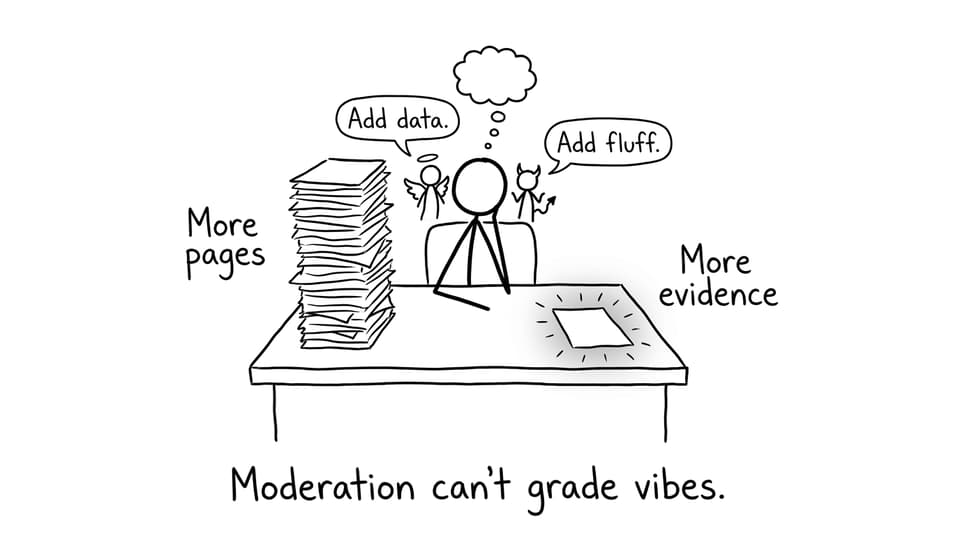
More pages vs more evidence

Conclusion: a 7 is a system, not a personality

A 7 in IB Design Technology is built from small decisions that compound: choosing a focused user, writing requirements you can test, iterating honestly, and answering exam questions with applied judgement.

If you want one place to run that whole system, RevisionDojo is designed for it: Questionbank, Study Notes, Flashcards, AI Chat, Grading tools, Predicted Papers, Mock Exams, Coursework Library, and Tutors. Start at the IB Design Technology hub, pick one weak area today, and make your thinking easier to mark tomorrow.
How helpful was this article?
Add as a preferred source on Google

Continue studying with RevisionDojo

  • IB Coursework GraderCheck an IA, EE, or TOK draft against IB assessment criteria.
  • IB Coursework ExamplesLearn from high-scoring coursework across IB subjects.
  • IB Grade CalculatorEstimate an IB grade using session-specific boundaries.
  • IB Grade BoundariesExplore historical grade boundaries by subject and session.

Join 650k+ students breezing through the IBReady to breeze through the IB?

Footer

General

  • For parents
  • For schools
  • Pricing
  • Gift RevisionDojo
  • Tutoring
  • IB syllabus
  • MYP syllabus
  • Blog
  • Research

Features

  • Jojo AI
  • Questionbank
  • Notes
  • Flashcards
  • Test builder
  • Exam mode
  • Coursework
  • Coursework grader
  • Coursework examples
  • Predicted papers
  • IB grade calculator
  • Grade boundaries

Research

  • State of learning survey
  • IB Moderation Analysis
  • Jojo AI vs ChatGPT
  • Jojo AI vs Gemini
  • Jojo AI vs Perplexity
  • Jojo AI vs Claude
  • Jojo AI vs Poe

Platform

  • RevisionDojo vs Others
  • Content philosophy
  • Trustpilot
  • Join usWe're hiring
  • Terms and conditions
  • Privacy policy
  • Cookie policy
  • Trust Center

MYP Subjects

  • MYP Biology
  • MYP Chemistry
  • MYP English Lang & Lit
  • MYP Extended Mathematics
  • MYP History
  • MYP Individuals & Societies
  • MYP Physics
  • MYP Standard Mathematics
  • MYP Biology
  • MYP Chemistry
  • MYP English Lang & Lit
RevisionDojo logo

© 2022 - 2026 RevisionDojo (MyDojo Inc)

RevisionDojo was developed independently of the IBO and as such is not endorsed by it in any way.

WhatsApp
LinkedIn
Facebook

Frequently Asked Questions

  • MYP Extended Mathematics
    • MYP History
    • MYP Individuals & Societies
    • MYP Physics
    • MYP Standard Mathematics

    IB Subjects

    • Arabic ab initio
    • Arabic B
    • Biology
    • Business Management
    • Chemistry
    • Chinese A Lang & Lit
    • Chinese B
    • Computer Science (CS)
    • Computer Science (First Exam 2027)
    • Design Technology (DT)
    • Design Technology (First Exam 2027)
    • Digital Society (DS)
    • Economics
    • English A Lang & Lit
    • English A Lit
    • English B
    • Environmental systems and societies (ESS)
    • French A
    • French ab initio
    • French B
    • Geography
    • German A
    • German ab initio
    • German B
    • Global Politics
    • History
    • Mathematics Analysis and Approaches (AA)
    • Mathematics Applications & Interpretation (AI)
    • Philosophy
    • Physics
    • Psychology
    • Psychology (First Exam 2027)
    • Arabic ab initio
    • Arabic B
    • Biology
    • Business Management
    • Chemistry
    • Chinese A Lang & Lit
    • Chinese B
    • Computer Science (CS)
    • Computer Science (First Exam 2027)
    • Design Technology (DT)
    • Design Technology (First Exam 2027)
    • Digital Society (DS)
    GDPR compliant
    Download on the App Store

    Related Articles

    IB Design Technology · 4 min read

    What Extra Topics Are Covered in IB Design Technology HL?

    Learn what extra topics IB Design Technology HL students study, how HL content is deeper than SL, and what this means for exams and coursework.

    IB Design Technology · 7 min read

    IB Design Technology IA: How to Show Real Iteration

    IB Design Technology iteration made simple: learn what counts, where to show it in your IA, and how to document changes for higher marks.

    IB Design Technology · 8

    IB Design Technology Problem Statement: Write It Strong

    IB Design Technology problem statement guide: learn the user-first formula, avoid solution language, add evidence, and set up high-scoring IA work.

    IB Design Technology · 8

    IB Design Technology IA Referencing: A Simple Guide

    IB Design Technology IA referencing made simple: what to cite, how to format in-text citations, and how to avoid plagiarism with consistent sources.

    IB Design Technology · 7

    IB Design Technology Without Creativity: Can You Still Excel?

    IB Design Technology success isn’t about being artistic. Learn what examiners reward, how to score higher, and how RevisionDojo helps.

    IB Design Technology · 7

    Common IB Design Technology Exam Mistakes (and Fixes)

    IB Design Technology exam mistakes are predictable. Learn the most common errors and quick fixes for command terms, evaluation, timing, and structure.

  • Spanish A
  • Spanish ab initio
  • Spanish B
  • Sports, exercise and health science (SEHS)
  • Theory of Knowledge (TOK)
  • Economics
  • English A Lang & Lit
  • English A Lit
  • English B
  • Environmental systems and societies (ESS)
  • French A
  • French ab initio
  • French B
    • Geography
    • German A
    • German ab initio
    • German B
    • Global Politics
    • History
    • Mathematics Analysis and Approaches (AA)
    • Mathematics Applications & Interpretation (AI)
    • Philosophy
    • Physics
    • Psychology
    • Psychology (First Exam 2027)
    • Spanish A
    • Spanish ab initio
    • Spanish B
    • Sports, exercise and health science (SEHS)
    • Theory of Knowledge (TOK)
    min read
    min read
    min read
    min read