
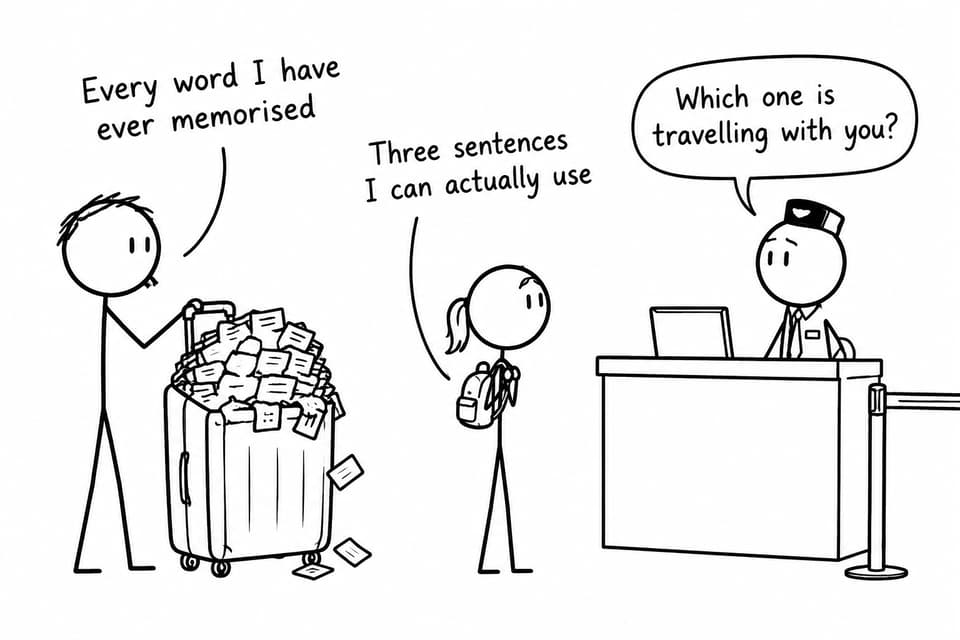
Starting IB Spanish can create a strange illusion: the more words you collect, the less prepared you sometimes feel. A list containing la familia, el instituto and el medio ambiente looks productive, but the examination does not reward vocabulary as a collection. It rewards language you can understand, adapt and use for a purpose.
The most effective way to learn Spanish ab initio vocabulary is therefore to organise it around the five prescribed IB themes and their 20 topics. For each topic, learn useful nouns, high-frequency verbs, descriptive language, connectors and one or two flexible sentence patterns. This guide gives new IB DP1 students that structure.
The current course for students assessed before 2029 follows the language ab initio guide introduced for first assessment in 2020. The IB has announced a revised language ab initio course for first assessment in 2029, so students expecting assessment in 2029 or later should confirm the applicable syllabus with their coordinator. The structure below is intended for the current pre-2029 course.
Your DP1 vocabulary checklist
Build each prescribed topic using five layers:
- Core nouns: the people, places, objects and issues central to the topic
- Useful verbs: especially verbs that let you narrate, describe and justify
- Adjectives and adverbs: language for detail rather than vague statements
- Connectors: phrases such as sin embargo, por eso and además
- Reusable chunks: complete patterns such as lo que más me gusta es...
A sensible starting point is the IB Spanish ab initio hub, where Questionbank practice, Study Notes, Flashcards and AI Chat can be used together rather than as separate activities.
Identidades: describing who people are
The four prescribed topics are personal attributes, personal relationships, eating and drinking, and physical well-being.
For personal attributes, begin with simpático, generoso, tímido, trabajador, paciente and seguro de sí mismo. Add verbs that explain identity: ser, tener, parecer, llevarse bien con and preferir. Remember that ser usually expresses an identifying characteristic, while estar commonly expresses a temporary state:
- Mi hermano es tranquilo, pero hoy está nervioso.
- Me considero una persona bastante independiente.
Personal relationships require more than family labels. Learn apoyar, confiar en, discutir, compartir and llevarse mal. These create richer answers: Me llevo bien con mi prima porque siempre me apoya.
For food, combine items with quantities and opinions: una ración de, demasiado, saludable, casero, picante and tener hambre. Avoid translating English literally. Spanish speakers normally say tengo hambre, not soy hambriento.
Physical well-being brings in hacer ejercicio, descansar, dormir lo suficiente, evitar and mantenerse en forma. A useful pattern is Para llevar una vida sana, hay que... The impersonal hay que makes advice sound natural and applies beyond a single person.
Experiencias: narrating life and memorable events
The prescribed topics are daily routine, leisure, holidays and tourism, and festivals and celebrations.
Daily routine is where reflexive verbs matter: despertarse, levantarse, ducharse, vestirse and acostarse. Keep the pronoun attached to the correct person: me levanto, not yo levanta. Add time markers such as primero, luego, normalmente and al final del día.
Leisure vocabulary should help you compare and justify preferences. Learn jugar a, tocar, salir con amigos, quedarse en casa and pasarlo bien. Notice the distinction between jugar al tenis and tocar la guitarra.
For holidays and tourism, useful words include el alojamiento, el billete, hacer una reserva, perderse, visitar lugares de interés and probar la comida local. Develop past-time control early:
- El verano pasado viajé a Chile con mi familia.
- El hotel era cómodo, pero estaba lejos del centro.
The preterite moves the trip forward, while the imperfect describes background or repeated conditions. That distinction is more valuable than memorising 30 types of accommodation without context.
Festivals introduce celebrar, tener lugar, disfrazarse, los fuegos artificiales and las costumbres. Cultural specificity matters. Instead of claiming that every Spanish-speaking country celebrates in the same way, identify a place and use cautious language: En algunas regiones... or Una tradición conocida en México es...
Ingenio humano: technology, media and movement
The four topics are transport, entertainment, media, and technology. RevisionDojo's Ingenio Humano topic resources can help you turn these broad labels into manageable subtopics.
For transport, learn el transporte público, el atasco, el carril bici, coger o tomar el autobús, and reducir el tráfico. Regional variation is normal. Coger el autobús is common in Spain, while tomar el autobús is widely used in Latin America.
Entertainment requires language for reaction: la trama, el personaje, entretenido, aburrido, recomendar and tratar de. For example, La película trata de una familia que se muda al extranjero. Do not write es sobre in every response when a more idiomatic option is available.
For media and technology, prioritise actions: subir una foto, descargar, compartir datos, proteger la privacidad, hacerse viral and pasar demasiado tiempo frente a una pantalla. Vocabulary varies here too. You may encounter el ordenador and la computadora, or el móvil and el celular. Consistent, contextually appropriate usage matters more than choosing one universal version.
Technology prompts often invite evaluation. Build paired phrases such as por un lado... por otro lado... and aunque es útil, puede... These let you move from naming technology to analysing its effect.
Organización social: school, work and community
The prescribed topics are neighbourhood, education, the workplace, and social issues. The Organización Social study area provides aligned practice for this theme.
For neighbourhood, learn el barrio, las afueras, los servicios públicos, seguro, ruidoso and estar bien comunicado. A strong comparison might be: Antes vivía en un pueblo tranquilo, mientras que ahora vivo en un barrio más animado.
Education vocabulary should reflect your real IB experience: la asignatura, el horario, entregar una tarea, sacar buenas notas, aprobar, suspender and tener dificultades con. Be careful with false friends. Asistir a clase means to attend class; it does not mean to help the class.
Workplace language includes solicitar un puesto, ganar un sueldo, trabajar a tiempo parcial, adquirir experiencia and hacer prácticas. When discussing future plans, use me gustaría, pienso plus an infinitive, or quiero. For example: Me gustaría trabajar en el extranjero porque quiero conocer otras culturas.
Social issues may involve la pobreza, el desempleo, la desigualdad, las personas sin hogar and el acceso a la educación. Avoid unsupported generalisations. Prefer En muchas comunidades, puede ser difícil... over declaring that an issue affects every place identically.
Compartir el planeta: discussing shared challenges
The four topics are climate, physical geography, the environment, and global issues.
Climate and physical geography require distinct vocabulary. Hace calor describes weather, while el clima es cálido describes a broader climatic pattern. Add la costa, la cordillera, el bosque, la sequía, las inundaciones and la temperatura media.
Environmental answers improve when nouns are connected to actions: reciclar los residuos, ahorrar agua, usar energías renovables, contaminar el aire and proteger las especies. A reusable recommendation structure is El gobierno debería invertir en... Another is Si usamos menos plástico, reduciremos..., which connects a present condition to a future consequence.
Global issues can overlap with social issues, but your language should remain specific: el cambio climático, los conflictos, la migración, la cooperación internacional and los derechos humanos. The Core Themes glossary is useful for checking definitions before turning them into active sentences.
How vocabulary appears in IB assessment
Under the current guide, Spanish ab initio is an SL course. Paper 1 assesses productive writing and contributes 25%. Students complete two required tasks, each requiring 70-150 words, and select an appropriate text type from the options given.
Paper 2 assesses receptive skills through listening and reading and contributes 50%. The remaining 25% comes from the internally assessed individual oral, which includes work with a visual stimulus, follow-up discussion and broader conversation connected to the prescribed themes.
This explains why translation cards alone are insufficient. Writing requires vocabulary that fits audience, purpose and text type. Reading and listening require recognition of paraphrase, while the oral requires rapid retrieval and interaction.
Three official command terms are especially useful when interpreting classroom and assessment prompts:
- Describe: give a detailed account, so supply concrete characteristics and examples.
- Explain: give reasons or causes, using phrases such as porque, ya que and debido a.
- Outline: give a brief account or summary, selecting the main points rather than every detail.
Text conventions matter too. An email may need a greeting and closing; an article usually needs an engaging title and reader-focused organisation; a diary entry adopts a private, reflective voice. The complete Spanish ab initio course guide explores these assessment demands in more depth.
Common DP1 vocabulary mistakes
The first mistake is learning nouns without gender. Store la oportunidad and el problema, not just oportunidad and problema. The second is learning verbs without their patterns. Record depender de, soñar con and ayudar a alguien as complete units.
The third is ignoring accents: sí and si, or qué and que, do different jobs. The fourth is forcing sophisticated language that you cannot control. A correct sentence with aunque is better than an elaborate structure copied without understanding.
Finally, do not study every topic once and then abandon it. Use spaced retrieval. The Spanish ab initio self-study guide and guide to working towards a 7 show how repeated practice can connect vocabulary, grammar and assessment technique.
A practical weekly system
Choose one topic each week. On day one, learn 12-15 words as phrases. On day two, retrieve them with Flashcards. On day three, write 70-100 words in a plausible text type. On day four, answer listening or reading questions. On day five, speak for two minutes from an image without reading a script.
Then use grading tools or AI Chat to identify recurring errors, not merely to obtain a score. RevisionDojo also brings together Predicted Papers, Mock Exams, a Coursework Library and Tutors for wider IB support, but for a new Spanish student the best sequence is simpler: Study Notes, retrieval, Questionbank practice, feedback and repetition.
Vocabulary becomes useful when it survives contact with a real question. Visit the IB Spanish ab initio Questionbank and study hub and try 10 free questions. Ten carefully reviewed answers will teach you more about your usable vocabulary than another untested list of 100 words.