

A funny thing happens in an IB Chemistry IA when you finally get numbers on the page.
At first, data feels like proof. A neat table, a clean graph, a trend that agrees with what you expected. Relief.
Then you notice the uncomfortable parts: one trial that refuses to behave, a temperature reading that drifts, a burette that seems to hate you personally. And suddenly the IA stops being only about chemistry. It becomes a small test of something bigger: whether you can tell the truth when the truth is slightly inconvenient.
Scientific integrity is what keeps your IB Chemistry IA credible. Not because examiners are looking for perfect results, but because they are looking for honest science: transparent methods, accurate measurements, and ethical decisions you can defend.
A quick integrity checklist (save this before you write)
Use this as your pre-submission scan for any IB Chemistry IA:
-
Record all trials, including the awkward ones.
-
Keep raw data readable: units, uncertainties, consistent decimal places.
-
Do not delete outliers just because they are annoying.
-
Use significant figures that match your apparatus.
-
Cite every dataset, definition, method influence, and image that is not yours.
-
Disclose tools and support (software, AI help, peer feedback) clearly.
-
Evaluate limitations with evidence, not excuses.
If you want the rubric translated into practical actions, keep the IB Chemistry Internal Assessment Guide open as you draft.
What scientific integrity means in an IB Chemistry IA
In an IB Chemistry IA, integrity is not a motivational slogan. It is a set of habits that make your investigation reproducible and fair.
It shows up in small choices:
-
You log what happened, not what you hoped would happen.
-
You treat uncertainty as information, not as a flaw to hide.
-
You separate observation from interpretation.
-
You respect safety, environmental impact, and the boundaries of individual work.
A practical way to remember it: your examiner should be able to follow your decisions like footprints. If a number changed, why? If a method changed, when? If you used a tool, how? That clarity is integrity in a form the IB can assess.
For a step-by-step overview of the whole journey, the guide Navigating the IB Chemistry IA: From Planning to Execution pairs well with what follows here.
Ethical experiment design: integrity starts before you collect data
Most integrity problems begin long before the results table. They begin in design.
Choose a question you can test without corner-cutting
A strong IB Chemistry IA question is narrow enough to measure carefully. When questions are too broad, students feel forced to “make it work” by trimming trials, skipping controls, or over-claiming conclusions.
If you are still choosing a topic, use IB Chemistry IA Ideas in 2025 (Sorted by Major + Topic) to find questions that are realistic in time, equipment, and risk.
Respect safety and environmental impact
Ethics in chemistry includes what you expose people and the environment to.
-
Minimize hazardous reagents.
-
Use small-scale methods where possible.
-
Dispose of waste properly.
-
Avoid experiments that require unsafe temperatures, pressures, or concentrations.
In other words: integrity is also what you choose not to do.
Honest data collection: how to record results the IB can trust
Your IB Chemistry IA does not need pretty data. It needs believable data.
That means your raw data must look like it came from an actual lab: consistent precision, appropriate uncertainties, and a clear record of trials.
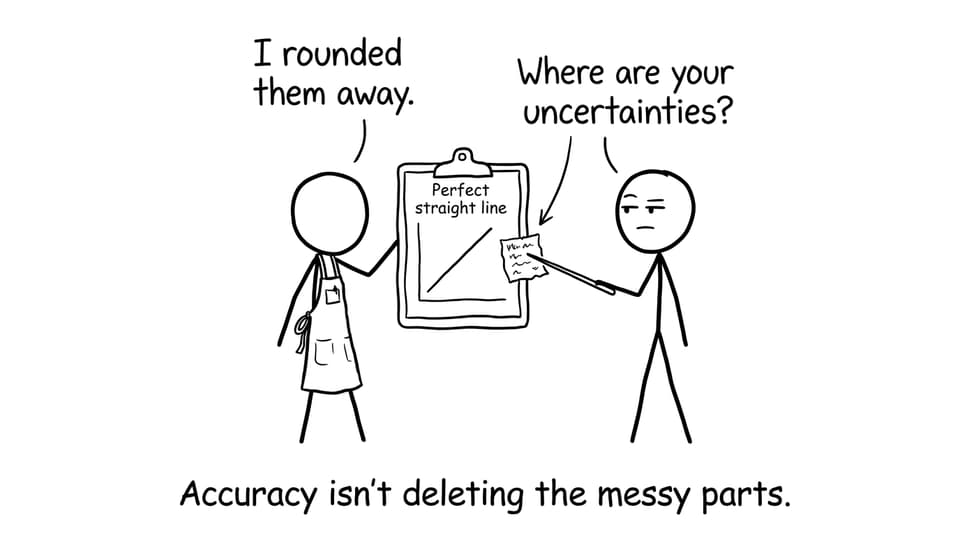
Uncertainties are not optional details
Uncertainty communicates what your apparatus can genuinely support. Without it, your numbers may look “precise” but become scientifically empty.
If uncertainty is a weak point for you, build it from the syllabus side as well as the IA side:
And for IA-specific expectations (tables, error bars, handling outliers), the rubric guidance in 2.2 Data analysis is the most direct reference point.
Significant figures are an honesty tool
Students often treat significant figures as formatting. In reality, they are an ethics filter. Too many digits suggest false precision.
A simple check: if your balance reads to 0.01 g, your mass cannot suddenly become meaningful to 0.0001 g because a calculator produced extra digits.
If you want the reasoning explained clearly (with examples that feel like exam questions), read Why Do Chemists Use Significant Figures To Report Measurements.
Data manipulation vs data processing: the line you must not cross
Every IB Chemistry IA requires processing: averaging trials, calculating gradients, propagating uncertainties, and converting units.
Integrity is what keeps processing from turning into manipulation.
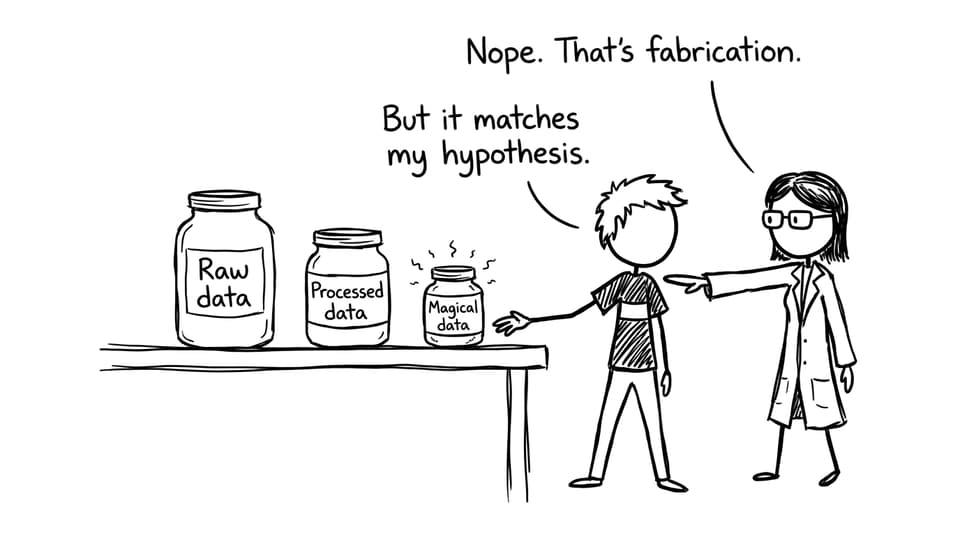
What counts as manipulation?
-
Removing results without explanation.
-
Editing raw values to “look right.”
-
Rounding strategically so patterns appear stronger.
-
Repeating trials silently until you get the trend you wanted.
The truth is: most students do not plan to fabricate. They drift into it when they feel judged by the messiness of real science.
What to do instead (the examiner-friendly approach)
-
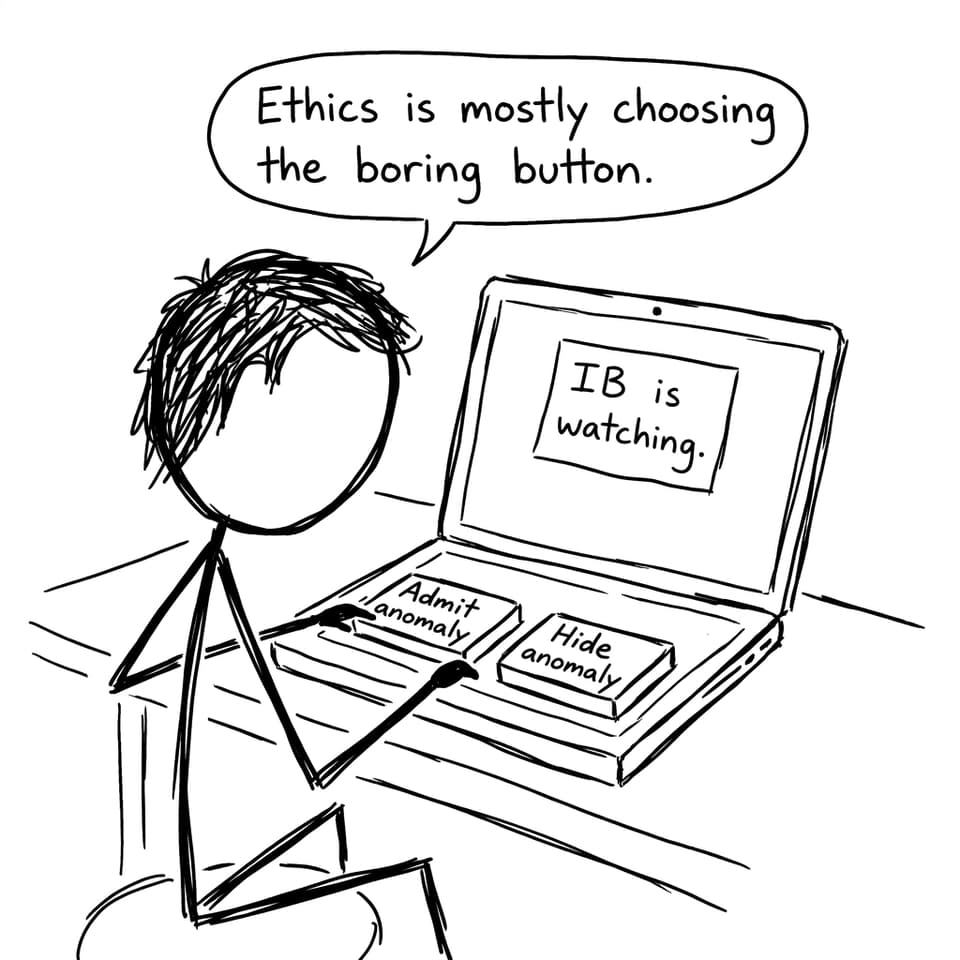
Keep the outlier in the dataset.
-
Comment on it explicitly.
-
Offer evidence-based causes (instrument limitations, reaction conditions, human reading error).
-
Propose a realistic improvement (calibration, tighter control of temperature, more trials, better technique).
That approach does not weaken your IB Chemistry IA. It makes it look like science.
For practical technique habits that reduce messy data in the first place, IB Chemistry Lab Skills: Practical Tips That Add Marks is a strong companion.
Using sources responsibly: citations are part of accuracy
Scientific integrity is also intellectual honesty.
In an IB Chemistry IA, you should cite:
-
definitions and theories you rely on
-
literature values you compare against
-
datasets from databases
-
diagrams or images you didn’t create
-
method ideas that shaped your design
If you want a clean system, follow IA Citations: 10 Best Practices for IB EE and IA and keep it simple: one style, used consistently, with enough detail to find the source again.
And if you are worried you may have copied too closely without meaning to, use the checklist in How to Avoid Plagiarism in Your IA.
Technology and AI: how to use tools without losing ownership
The modern IB student has powerful tools: spreadsheets, graphing software, coding notebooks, and AI.
Used well, they improve accuracy. Used carelessly, they blur who did the thinking.
A safe integrity rule:
-
Use tools to calculate, visualize, check, and learn.
-
Do not outsource your scientific reasoning, evaluation, or final wording.
If you used AI to clarify an idea, troubleshoot a calculation, or sanity-check your uncertainty propagation, record that in your process notes and keep your explanations clearly yours.
For the broader student-facing standards, How to Uphold Academic Integrity in IB Assessments helps you draw the boundaries before you get stressed and make a rushed decision.
How RevisionDojo supports integrity (and exam performance)
Integrity is easier when your workflow is organized.
RevisionDojo is built for that kind of calm structure:
-
The Coursework Library helps you see what transparent reporting looks like.
-
The Grading tools keep you aligned to criteria so you do not invent “fake improvements” that sound clever but are not evidence-based.
-
The Study Notes and Flashcards make sure your explanation sections reflect real understanding.
-
The AI Chat helps you get unstuck on concepts (like uncertainty propagation) without copying someone else’s write-up.
-
The Questionbank, Mock Exams, and Predicted Papers keep exam prep honest: you practise, you get feedback, you fix the gap.
If you are polishing your draft, the rubric-aligned IB Chemistry IA Grader is the fastest way to check whether your integrity habits are actually visible on the page.
Closing: in IB science, truth beats polish
In the pressure of the IB, it is tempting to treat the Chemistry IA like a performance. Smooth graphs, clean lines, perfect conclusions.
But science is not a performance. It is a record.
When you choose to show uncertainties, keep anomalies, cite sources, and write conclusions that match the evidence, you are doing more than avoiding misconduct. You are practising the kind of honesty that makes results worth reading.
If you want that integrity to feel simpler and more structured, build your workflow in RevisionDojo: use the Study Notes to understand the theory, drill exam-style accuracy with the Questionbank, test yourself with Mock Exams and Predicted Papers, and refine your IA with the Grading tools and AI Chat. That combination keeps your IB Chemistry IA truthful, and it keeps your exam prep sharp.