



Introduction: the moment your “cool idea” meets reality
There’s a specific kind of silence that happens when you open a fresh document titled Chemistry IA and realize your idea is still basically a mood. You can picture the experiment. You can almost hear the bubbles. But you cannot yet explain, in one clean sentence, what you are testing, why it matters, and how you’ll prove it.
That gap (between excitement and evidence) is where most IB Chemistry IAs either become calm, controlled investigations… or chaotic weeks of redoing trials while your word count grows and your confidence shrinks.
This guide walks you through the IB Chemistry IA from planning to execution to writing, with practical checkpoints and a simple aim: make your investigation feel inevitable. Like the result could only have been reached by your choices, your method, and your thinking.
The IB Chemistry IA in one page: a quick checklist
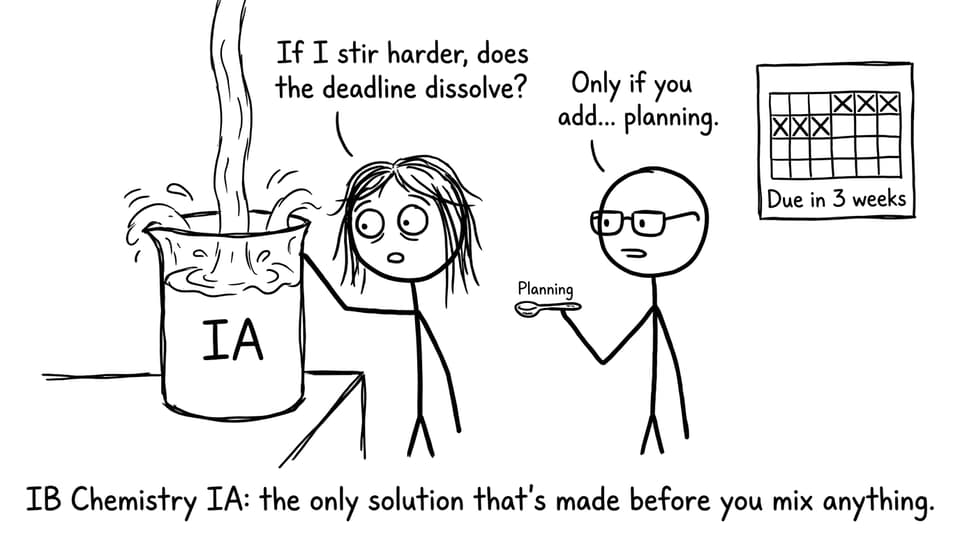
Use this as your “I’m not panicking, I’m prioritizing” list:
-
Read the rubric and translate it into actions you can show on the page.
-
Choose a focused topic that is measurable, safe, and genuinely interesting.
-
Do preliminary research: find literature values, expected trends, and the chemistry that explains them.
-
Write a research question that is specific, testable, and syllabus-connected.
-
Define variables and controls, then build a method that can be replicated.
-
Pilot first, then run proper trials with a plan for uncertainties.
-
Process data clearly: tables, graphs, sample calculations, and error bars.
-
Evaluate honestly: strengths, limitations, impact, and realistic improvements.
-
Edit for communication: tight structure, consistent units, clean citations.
If you want examples to calibrate what “good” looks like, start with the IB Chemistry IA Examples library and compare how different students handle analysis and evaluation.
Planning your IB Chemistry IA: start with the rubric, not the aesthetic
Students often plan their IB Chemistry IA like they’re planning a science fair: pick an experiment that looks impressive, then hope the writing will catch up. The IB marks the opposite way. It rewards clarity, control, and thinking.
A smart first step is to read a rubric breakdown in plain English, then keep it beside you while planning. RevisionDojo’s IB Chemistry IA Guide is built for this: it spells out what examiners look for and what evidence earns marks.
Even better: when you have a draft, run it through the IB Chemistry IA Grader to see where your investigation is strong and where it’s quietly losing marks.
The criteria, translated into what you must show
-
Personal engagement: a clear reason you chose the topic, plus decisions you made (not just enthusiasm).
-
Exploration: a method that is detailed, controlled, safe, and replicable.
-
Analysis: processed data, uncertainties, patterns, and chemistry-based interpretation.
-
Evaluation: meaningful limitations with impact, and improvements that are actually doable.
-
Communication: a report that reads like a scientific argument, not a lab diary.
(And yes, some versions of the documentation describe criteria slightly differently. The practical takeaway stays the same: you need evidence of thinking, not just steps.)
Choosing a topic for IB Chemistry: pick “measurable” before “interesting”
The best IB Chemistry IA topics feel personal, but they also behave. They produce numbers you can trust and trends you can interpret.
A useful way to choose is to filter ideas through feasibility:
-
Can you measure the dependent variable precisely?
-
Can you control the major variables?
-
Can you run enough trials without living in the lab?
-
Can you explain the chemistry with syllabus-level theory?
If you’re still hunting for direction, use curated idea lists like IB Chemistry IA Ideas in 2025 (Sorted by Major + Topic) or the simpler starting points in IB Chemistry IA Ideas (2024): Simple, Strong Topics. The goal isn’t to copy an idea. The goal is to see what a controllable, syllabus-friendly investigation looks like.
Narrowing: the skill that saves your IA
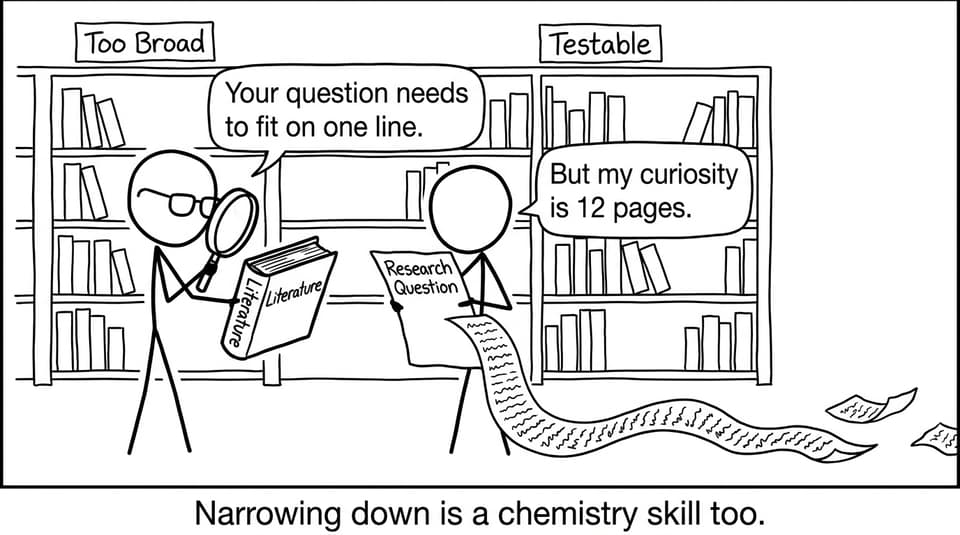
Most topic problems are actually scope problems.
A broad idea like “catalysts affect reaction rate” becomes strong only when you specify:
-
the reaction system
-
the catalyst type and range
-
how rate is measured
-
the controlled conditions
In IB Chemistry, narrow often means “one independent variable, at least five values, enough repeats to see a trend.”
Preliminary research: build the story before you collect data
Preliminary research in IB Chemistry isn’t there to decorate the introduction. It does three practical jobs:
-
predicts what trend you should expect
-
helps you justify variable ranges
-
gives you literature values to compare against later
As you read, keep a “method decisions” list. Example: if literature suggests temperature strongly affects your system, you must control it (water bath, insulation, timed equilibration). That list becomes your exploration marks.
When you’re revising the theory behind your experiment, it helps to keep your core content solid. RevisionDojo’s IB Chemistry Revision Notes (SL/HL) make it easy to refresh the exact chemistry you’ll need to explain your rationale and trend.
Research question and hypothesis: make them do real work
A good research question in IB Chemistry is a contract. It promises the examiner:
-
what you changed
-
what you measured
-
how you measured it
-
under what conditions
It should be specific enough that a stranger could run the experiment.
Hypothesis and null hypothesis: how to write them like a scientist
Your hypothesis should not be a vibe (“I think it will increase”). It should be a chemistry claim with a reason tied to the curriculum.
Include:
-
direction of change
-
mechanism or theory (collision theory, Le Chatelier, intermolecular forces, etc.)
-
link to variables
Then add a null hypothesis: no statistically significant change. This gives your analysis a serious tone, especially if you use uncertainty and basic statistics.
Planning the experiment: control is kindness (to your future self)
The method section of an IB Chemistry IA is where students accidentally lose marks while thinking they’re being efficient.
Plan for these before you step into the lab:
Variables and controls
-
Independent variable: choose ranges that are wide enough to show a trend, but not so wide that the system breaks.
-
Dependent variable: pick a measurement with precision you can defend (balance, burette, colorimeter, pH probe).
-
Controlled variables: write how you control them, not just that you do.
Replicates and trials
A single run is a rehearsal. Your final dataset needs repeats so you can calculate means and uncertainties that feel credible.
Safety and ethics
List hazards that are real for your chemicals and equipment, then explain mitigation (PPE, ventilation, proper disposal). Safety isn’t filler. It shows competence.
Pilot experiment
Do a small pilot to test:
-
whether the effect size is measurable
-
whether your method is too slow or too fast
-
whether your chosen range makes sense
Pilot data doesn’t need to appear in full, but the decisions you make because of it often strengthen personal engagement and exploration.
Execution day: treat it like a performance with a script
On the day you collect data, your goal is to reduce improvisation.
Bring:
-
pre-made raw data tables with units and uncertainty columns
-
a timer plan (when to start, stop, and record)
-
a consistency ritual (same swirling, same equilibration time, same endpoint judgement)
And if something goes wrong, record it. In IB Chemistry, honest anomalies often become strong evaluation points later.
Data processing and analysis: where your IB Chemistry IA becomes convincing
Processing is not “make a graph.” It is transforming raw numbers into evidence that answers your question.
For detailed expectations, use RevisionDojo’s IA guide section on Data analysis. It covers the practical details examiners look for: units, decimal places, error bars, sample calculations, and appropriate handling of outliers.
What strong analysis usually includes
-
raw data table with units and absolute uncertainties
-
processed table (means, derived values, percent change, rates)
-
at least one clear sample calculation
-
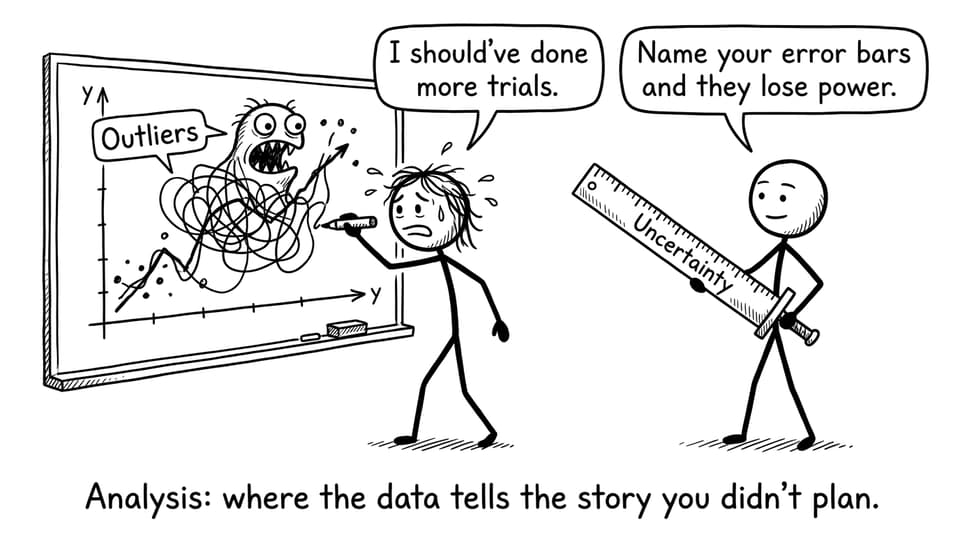
graphs with labelled axes, sensible scales, best-fit line/curve, error bars
-
interpretation that uses chemistry language, not just “it increased”
If you want extra practice explaining trends clearly (the same skill you need in Paper 2), use the Questionbank and pull questions from topics related to your IA. Explaining markscheme-style trends trains you to write tighter IA discussion paragraphs.
Writing the report: structure is your hidden advantage
A clean IB Chemistry IA report usually reads like this:
Introduction
Start broad (topic area), then narrow to your exact research question. Include the chemical theory that predicts the trend and justify your chosen range.
Methodology
Materials and procedure with enough detail for replication. Include controls, safety, and how you measured uncertainty.
Results
Raw and processed data presented clearly. Tables first, then graphs. Keep it readable.
Discussion
This is where you earn analysis marks: explain trends using chemistry, compare to literature, and comment on reliability.
Conclusion
Answer the research question directly, referencing the trend and data.
Evaluation
If you struggle here, read How to Write a Compelling IA Evaluation Section. It shows how to move beyond generic weaknesses into limitations that actually affect your conclusion.
References
Cite everything you used for theory, literature values, and method inspiration.
If you want a reality-check on what examiners reward, What IB Examiners Look for in a Strong IA is a helpful lens before you submit.
How your IA supports exam prep (and not the other way around)
A quiet benefit of doing an IB Chemistry IA well is that it upgrades your exam thinking.
You start noticing that exam questions reward the same habits:
-
controlling variables (validity)
-
stating assumptions
-
justifying conclusions with evidence
-
discussing uncertainty and limitations
After your IA, your revision becomes more grounded. And when you’re ready to consolidate content fast, the IB Chemistry Resources hub ties everything together: Study Notes, Flashcards, AI Chat, Grading tools, Predicted Papers, Mock Exams, and even Tutors if you need a human to sanity-check your plan.
Closing: make your IB Chemistry IA feel inevitable
A strong IB Chemistry IA doesn’t feel like a lucky experiment. It feels like a sequence of thoughtful decisions: a focused question, a controlled method, data you can defend, and writing that tells the truth about what happened.
If you want that sense of calm control, use RevisionDojo as your home base: explore the IB Chemistry IA Guide, check your draft with the IB Chemistry IA Grader, and study smart with the Questionbank, Study Notes, Flashcards, AI Chat, Mock Exams, Predicted Papers, Coursework Library, and Tutors.
Your IA is not separate from exam success. Done well, it’s practice for the exact thinking IB Chemistry rewards.