
Chemistry has a quiet way of punishing confidence.
You do a titration. The colour change looks perfect. Your calculator spits out 0.1428571429 mol dm⁻³. It feels like certainty.
Then your teacher asks one question: “How many significant figures?”
In IB Chemistry, significant figures are not a picky formatting rule. They’re a promise. They tell the examiner (and your future self) how much trust your measurement deserves.
What significant figures actually communicate in IB Chemistry
Significant figures exist because every measurement is limited. Your balance, burette, thermometer, and stopwatch can only resolve so much detail.
So when chemists report results, significant figures communicate:
-
Precision (how finely you could measure)
-
Reliability (how much of the number is supported by the method)
-
Honesty (no invented digits)
This matters constantly in IB Chemistry data questions and practical write-ups, especially in uncertainty-focused topics.
If you want structured practice on exactly that, start with Uncertainties and Errors (Topic 11.1) and the matching 11.1 Questionbank.
A quick checklist to stop losing easy marks
Use this whenever you’re doing calculations in IB Chemistry:
-
Record raw data to the instrument’s resolution (and no further).
-
Keep extra digits during working, round only at the end.
-
Match your final answer’s significant figures to the least precise measurement.
-
Add units every time you write a value.
-
If your answer seems “too exact,” it probably is.
For broader exam habits beyond rounding, common IB Chemistry exam mistakes are worth reviewing.
Significant figures prevent “false precision”
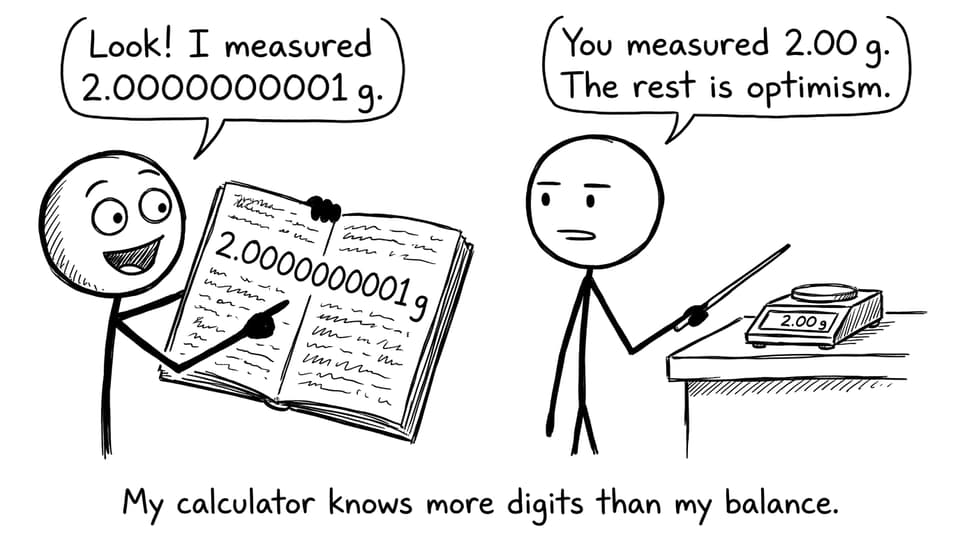
Imagine a balance that reads to 0.01 g. If you report 2.012357 g, you’re claiming knowledge the instrument never gave you.
Significant figures stop that. They force your reported value to match the real-world resolution of the equipment.
This links directly to uncertainty: if you haven’t met uncertainty requirements, the digits are basically decoration. A helpful companion concept is explained in Why uncertainties accompany experimental measurements.
Significant figures keep calculations realistic in IB Chemistry
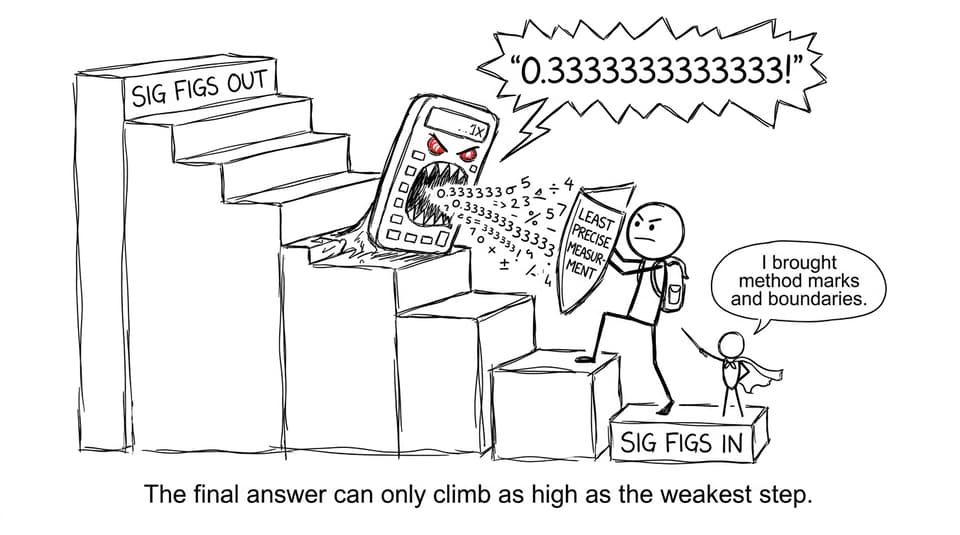
The trap in IB Chemistry is that calculation steps can create the illusion of increasing accuracy.
You might multiply two values, divide by a constant, and suddenly your calculator prints ten decimal places. But those digits didn’t come from better measurement; they came from arithmetic.
Significant figure rules prevent you from reporting a final value that appears more precise than your weakest measurement.
This shows up everywhere: enthalpy calculations, concentration calculations, rate data, spectroscopy processing. It’s especially relevant for modern assessment styles like Paper 1B, where careful interpretation matters more than speed. See IB Chemistry Paper 1B preparation tips.
Significant figures help you judge whether differences are meaningful
Two results can look different while still being effectively the same once you consider uncertainty and rounding.
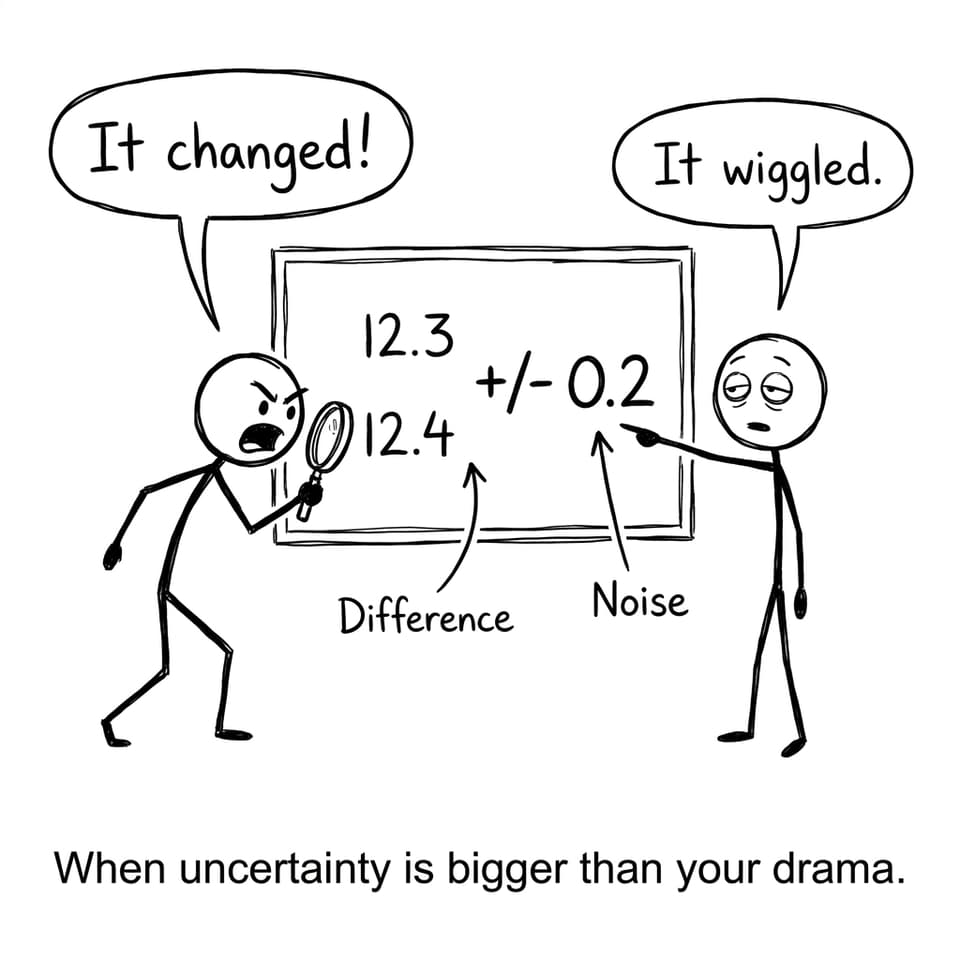
For example, 12.3 and 12.4 might not represent a real change if both values carry an uncertainty of +/- 0.2.
In IB Chemistry, that’s the difference between good analysis and overconfident storytelling. It’s also part of scientific integrity: reporting what the data supports, not what you wish it supported. RevisionDojo connects that mindset to assessment expectations in Integrity in IB Chemistry.
How RevisionDojo helps you master significant figures fast
Significant figures improve fastest with feedback.
On RevisionDojo, you can drill uncertainty and data-processing skills using the IB Chemistry Resources hub and the free Questionbank. Pair that with Study Notes, Flashcards, AI Chat for quick “does this round to 3 s.f.?” checks, plus Grading tools to see what examiners reward. When you’re ready to pressure-test, Predicted Papers and Mock Exams make the habit automatic.
Conclusion: significant figures are scientific humility
Significant figures exist because measurement is never perfect, and chemistry is honest about that.
If you treat significant figures as a communication tool, IB Chemistry gets calmer: your calculations look more professional, your data analysis becomes more credible, and you stop donating marks to rounding mistakes.
Build the habit with RevisionDojo’s IB Chemistry Questionbank, Study Notes, Flashcards, AI Chat, and Grading tools, then lock it in with Mock Exams and Predicted Papers. In a subject built on precision, learning to report precision is one of the smartest wins you can take.