


A wrong answer can feel like the end of a practice question. In reality, it is the beginning of the most useful part.
The best method for reviewing mistakes in MYP Individuals and Societies practice is to reconstruct your thinking, find the first weakness, classify its cause, connect it to an assessment criterion, rewrite the answer, and complete a delayed retest. You can begin today with three incorrect or uncertain responses and a simple error log.
This matters because MYP Individuals and Societies does not reward knowledge alone. Its four criteria cover knowing and understanding, investigating, communicating, and thinking critically. An answer may contain accurate facts yet remain weak because it misses the command term, evaluates a source poorly, overlooks a perspective, or leaves its conclusion unsupported.
A score tells you something went wrong. Careful review tells you what to do next.
Your same-day mistake review checklist
After completing a short set from the MYP Individuals and Societies Questionbank:
- Preserve your original answer.
- Reconstruct what you were trying to do.
- Find the first meaningful weakness.
- Classify the cause and relevant criterion.
- Write a specific next-time rule.
- Correct the answer without copying.
- Schedule a related question for later.
Start with three responses, including answers that were correct only because you guessed. Focused diagnosis is usually more useful than rapidly rereading every question.
A six-step method for reviewing your mistakes
Reconstruct your original thinking
Before reading the explanation, write one honest sentence about your approach:
- “I listed causes because I treated evaluate as describe.”
- “I trusted the source because it contained statistics.”
- “I knew the definition but could not apply it.”
- “I stated two perspectives without explaining their implications.”
Do not rewrite history to make your reasoning sound better. Your original decision is the evidence you need. If you cannot remember your reasoning, you may have guessed or followed a memorized pattern without understanding when it applied.
Find the first point of weakness
Compare your work with the explanation, teacher feedback, or task-specific clarification. Look for the earliest important difference rather than highlighting everything.
Perhaps your definition was inaccurate, your evidence irrelevant, or your source evaluation descriptive rather than judgmental. In an extended response, you may have summarized information when the question required a supported argument.
Finding the first weakness prevents you from rewriting an entire response when only one thinking habit needs repair.
Classify the cause
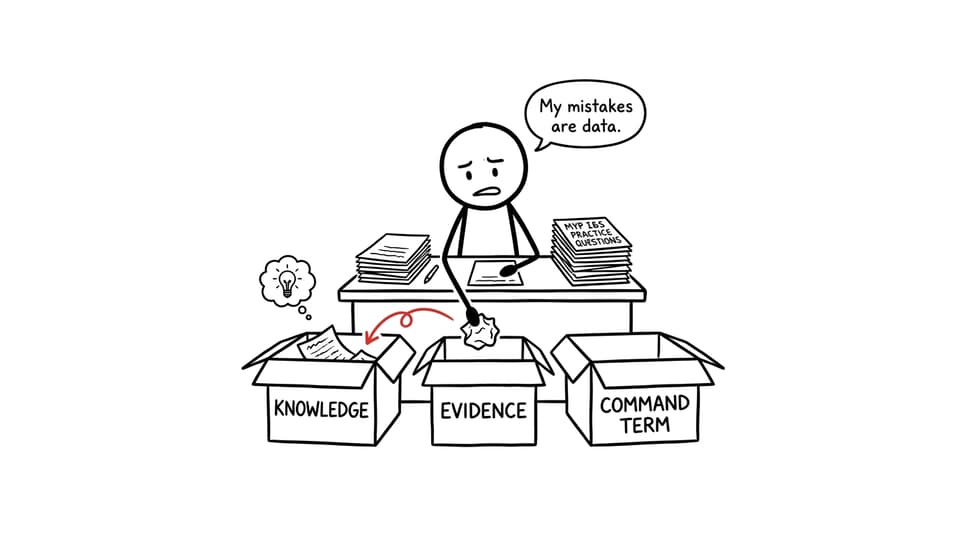
“Wrong” is not a useful category. Choose a label that points toward an action.
| Mistake type | Diagnostic question | Immediate repair |
|---|---|---|
| Knowledge | Was a fact, concept, example, or term missing? | Review a small section and retrieve it from memory. |
| Command term | Did I answer a different task? | Translate the command term into actions. |
| Evidence | Did I make an unsupported claim? | Add precise data, source material, or an example. |
| Source evaluation | Did I describe rather than judge? | Link origin and purpose to value or limitation. |
| Perspective | Did I overlook another viewpoint? | Compare a credible alternative perspective. |
| Communication | Was the reasoning unclear? | Rebuild the weakest paragraph. |
| Timing | Did rushing change my answer? | Use a short reading and checking routine. |
Avoid calling everything “careless.” Repeatedly missing the command term is a reading process that can be changed, not random carelessness.
Connect the error to the MYP criteria
The official MYP framework organizes Individuals and Societies assessment around four equally weighted criteria. Exact descriptors depend on your MYP year, so use your teacher's criterion sheet and task-specific clarification.
- Criterion A, Knowing and understanding: terminology, factual and conceptual knowledge, explanations, and examples.
- Criterion B, Investigating: research questions, plans, methods, information, and evaluation of the investigation.
- Criterion C, Communicating: organization, audience, purpose, format, and source documentation.
- Criterion D, Thinking critically: analysis, arguments, source evaluation, perspectives, and implications.
A response may reveal several weaknesses, but select the main criterion first. This keeps your next session focused. The MYP Individuals and Societies resource hub lets you move between questions, summaries, flashcards, lessons, and definitions without turning one gap into hours of unfocused revision.
Write a next-time rule
Turn each diagnosis into one observable instruction beginning with “Next time, I will...”
“Revise harder” and “be more critical” express hope, not behavior. Better rules include:
- “When asked to evaluate, I will weigh strengths and limitations before judging.”
- “After using a statistic, I will explain how it supports my claim.”
- “For each source limitation, I will connect origin or purpose to the investigation.”
- “Before writing, I will underline the command term, topic, and context.”
Keep the rule short enough to read before your next practice set.
Correct the answer without copying
Read the feedback, close it, and rewrite only the damaged part. If your source evaluation lacked a limitation, rebuild that section. If your paragraph included evidence but no reasoning, repair the paragraph rather than writing a new essay.
A useful analytical paragraph makes a claim, supplies relevant evidence, explains its significance, considers a qualification or alternative perspective when required, and links the reasoning back to the question.
Use the MYP Study Guide and lessons for conceptual problems. If terminology is weak, active recall with MYP Individuals and Societies cheatsheets or flashcards is more useful than repeatedly copying definitions.
For example, confusion about development indicators requires concept review rather than general essay practice. Test your recall with the development indicators flashcards, then return to the response.
Retest the skill after a delay
Correcting an answer while feedback is nearby only proves that you can follow feedback. Attempt a related question after one or two days to test independent application.
If the original mistake concerned demographic transition, choose another task from the demographic transition practice collection. For identity and social influences, use the identity formation Questionbank.
Mark the result as fixed, improving, or repeated. A repeated error means the repair was too shallow, the rule was unclear, or the underlying knowledge needs more work.
Build an error log you will use
An error log should be a control panel, not a storage cupboard.
| Topic | First weakness | Criterion | Next-time rule | Retest |
|---|---|---|---|---|
| Migration | Described data without explaining the trend | A/D | Explain the pattern and a plausible cause | Thursday |
| Empire source | Named the author's role but gave no value | D | Connect position to what the source reveals | Friday |
| Urban planning | Used the wrong format | C | Identify audience, purpose, and format first | Monday |
Review the log weekly and count repeated causes rather than total errors. Several mistakes across different topics may come from one habit, such as unsupported claims or misread command terms.
Match the repair to the mistake
Effective MYP Individuals and Societies revision techniques are selective. Knowledge gaps need Study Notes or Flashcards. Source-evaluation weaknesses need model analysis and unfamiliar sources. Communication problems need paragraph reconstruction. Timing problems need controlled practice.
RevisionDojo connects those stages. Use the Questionbank to diagnose weaknesses, Study Notes and Flashcards to repair knowledge, AI Chat to question unclear explanations, and Grading tools to examine complete responses. Mock Exams test whether new habits survive demanding conditions, while Tutors can help distinguish content gaps from reasoning or communication problems.
Choose three incorrect or uncertain answers today. Reconstruct your reasoning, locate the first weakness, classify it, connect it to a criterion, write a next-time rule, and repair the response from memory. Then schedule one related question.
That is how reviewing becomes learning. With RevisionDojo's connected resources, each mistake can become a clearer decision and, eventually, a stronger habit.