
Trade is easy to talk about when it’s abstract. Two countries exchange goods, everyone wins, the world spins on.
Then your phone breaks.
Suddenly you’re staring at a supply chain that starts in one country, gets assembled in another, shipped across oceans, and priced in a currency you don’t use. You’re also staring at the exact kind of reality IB examiners love: messy, real, full of trade-offs.
For Group 3 students preparing for IB exams, real-world examples of economic trade aren’t just “nice context.” They are the difference between an answer that sounds like a textbook summary and an answer that feels like economics happening in front of you.
Along the way, keep a revision home base open: Understanding IB Economics: A Comprehensive Guide. It’s the quickest way to reconnect trade examples to the syllabus language.
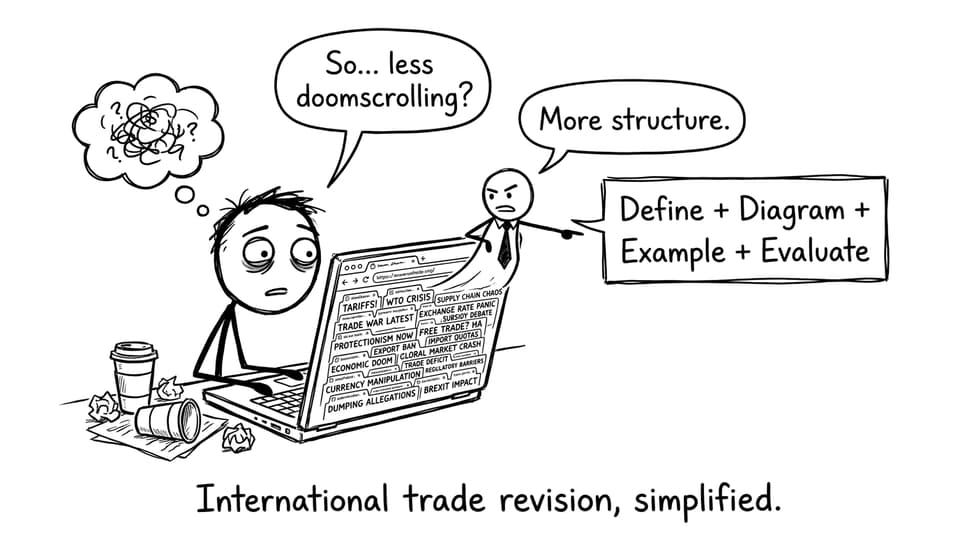
Group 3 quick checklist: how to use trade examples in exams
Before you memorise another headline, make your examples do exam work. This checklist is a reliable Group 3 routine:
-
Name the trade relationship (countries/region + what’s traded).
-
Identify the policy or structure (tariffs, free trade agreement, quota, single market, cartel).
-
Link to a model (comparative advantage, demand and supply, terms of trade, balance of payments).
-
State a likely impact (consumers, producers, government revenue, employment, inflation, growth).
-
Evaluate (short vs long run, winners vs losers, assumptions, unintended consequences).
To sharpen exam technique and example selection, pair this article with Methods for Effective IB Economics Revision.
Real-world examples of economic trade for Group 3 students
The goal is not to collect a hundred examples. It’s to own six to eight examples so well that you can bend them to fit any exam prompt.
US-China trade relations: interdependence with friction
This is one of the most tested modern examples because it contains everything: consumer goods, technology, politics, and policy conflict.
-
What it looks like in the real world: The US imports large volumes of manufactured goods from China, including electronics, machinery, and textiles.
-
Why it matters economically: Persistent trade imbalances can trigger political pressure for protectionism.
-
Where the exam marks are: Tariffs change domestic prices, shift consumption patterns, and can disrupt global supply chains.
Strong Group 3 evaluation here sounds like: tariffs may protect certain domestic producers in the short run, but they can raise costs for firms using imported components and reduce consumer welfare. Retaliation risk matters too.
If you want more practice turning headlines into analysis, build on Real-Life Examples in Economics: Bringing Theory to Life.
European Union trade agreements: integration as a policy choice
The EU is an exam-friendly example because it’s not just “trade” but a whole framework for reducing barriers.
-
Single Market logic: freer movement of goods and services among member states.
-
External deals: the EU signs trade agreements with non-members, including CETA with Canada, reducing many tariffs and encouraging cooperation.
-
Brexit as disruption: the UK leaving the EU changed trade rules and increased friction in previously smoother trade flows.
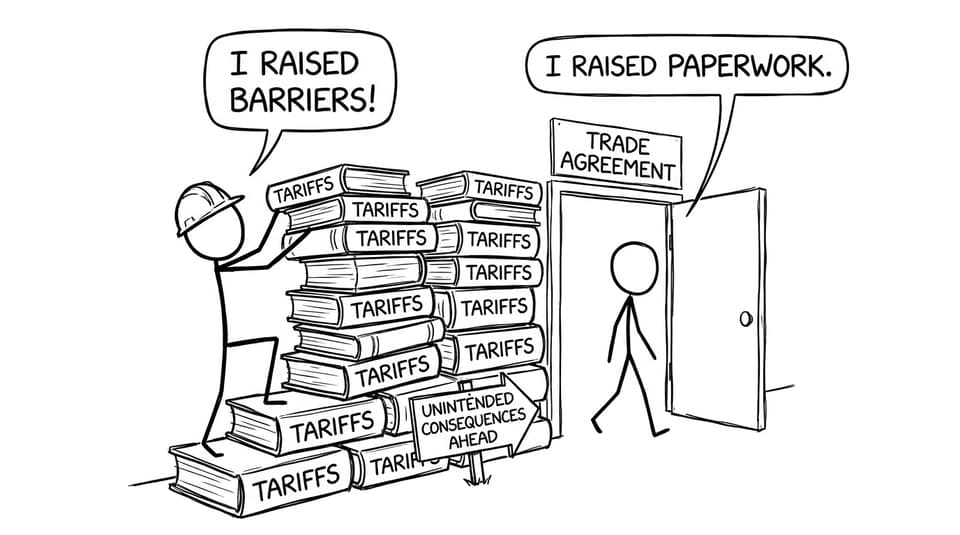
For Group 3 students, the deeper insight is that trade agreements often replace price barriers with rule barriers: standards, paperwork, and border procedures. Those “invisible” costs show up in firms’ time, inventory management, and final prices.
NAFTA to USMCA: trade agreements evolve with the economy
NAFTA (1994) and its replacement, the USMCA (2020), are useful because they show trade policy updating to match modern production.
-
Core idea: reduce tariffs and deepen trade links across the US, Canada, and Mexico.
-
What changed with USMCA: more emphasis on modern rules, including digital trade and labour-related provisions.
-
Exam-ready angle: agreements can increase trade volumes and efficiency, but also create adjustment costs for workers in industries facing more competition.
A good Group 3 conclusion here is balanced: trade creation can raise overall welfare, but distributional effects can be politically and socially significant.
Belt and Road Initiative (BRI): infrastructure as a trade strategy
BRI is useful when exam questions hint at development, long-run growth, or geopolitical trade routes.
-
What it is: China-backed infrastructure development and investment across many countries.
-
Trade mechanism: new ports, rail, and roads can reduce transport costs, making trade more viable.
-
Challenges to evaluate: debt sustainability concerns, dependence, and strategic influence.
In Group 3 essays, BRI can support a sophisticated point: lowering trade costs can expand productive capacity and market access, but financing structure and governance quality shape whether benefits are broad-based.
OPEC and oil trade: when a cartel shapes the whole world
OPEC is a clean example of how market structure affects trade outcomes.
-
What it does: coordinates policies among major oil-exporting countries to influence output and prices.
-
Why it’s global: oil is a key input for transport and production, so price changes spill into inflation and growth.
-
Trade angle: oil price shocks can shift a country’s balance of payments, especially for net importers.
For Group 3, the strong evaluation is about vulnerability and time horizons: short-run demand for oil can be inelastic, so price changes hit consumers quickly. Over the long run, substitution and new technology can reduce dependence.
ASEAN trade agreements: regional growth through lower barriers
ASEAN illustrates how trade blocs can support development and integration.
-
What it is: a regional grouping promoting economic cooperation among ten Southeast Asian countries.
-
How it works: free trade agreements with major economies (including China, Japan, and South Korea) reduce barriers.
-
Economic impact: greater export opportunities, regional supply chains, and stronger incentives for investment.
A Group 3 exam response can evaluate whether gains are evenly distributed: trade may accelerate growth in more industrialised members faster than in less diversified economies.
How RevisionDojo helps Group 3 students turn examples into marks
Knowing examples is only half the job. Under exam time pressure, you need retrieval, structure, and feedback.
RevisionDojo is built for that loop:
-
Use Study Notes to lock in the models behind each trade story.
-
Use Flashcards to memorise example triggers (country + policy + effect).
-
Use the Questionbank to practise applying examples to unfamiliar prompts.
-
Use AI Chat to pressure-test your evaluation and command-term focus.
-
Use Grading tools to spot why a “good explanation” still drops marks.
-
Use Mock Exams to train timing and stamina.
-
Use Predicted Papers to practise likely angles while staying flexible.
-
Use the Coursework Library and Tutors if you need guided feedback and targeted help.
If you’re unsure how much depth you need, this pairing is useful for Group 3 decision-making: Understanding the Differences Between IB Economics SL and HL.
Bringing it home: trade is the story, Group 3 is the skill
Economic trade is never just containers crossing oceans. It’s incentives, constraints, and consequences you can map with models and evaluate like a grown-up.
If you’re revising for Group 3, treat these real-world examples of economic trade as tools: pick a few, learn them deeply, and practise attaching them to the right diagrams and evaluation.
When you’re ready to make that practice systematic, use RevisionDojo to run the loop: Study Notes for clarity, Flashcards for recall, Questionbank for application, AI Chat for feedback, and Mock Exams for timing. That’s how Group 3 trade examples turn into marks on exam day.
For more connected reading, these are strong next steps: