


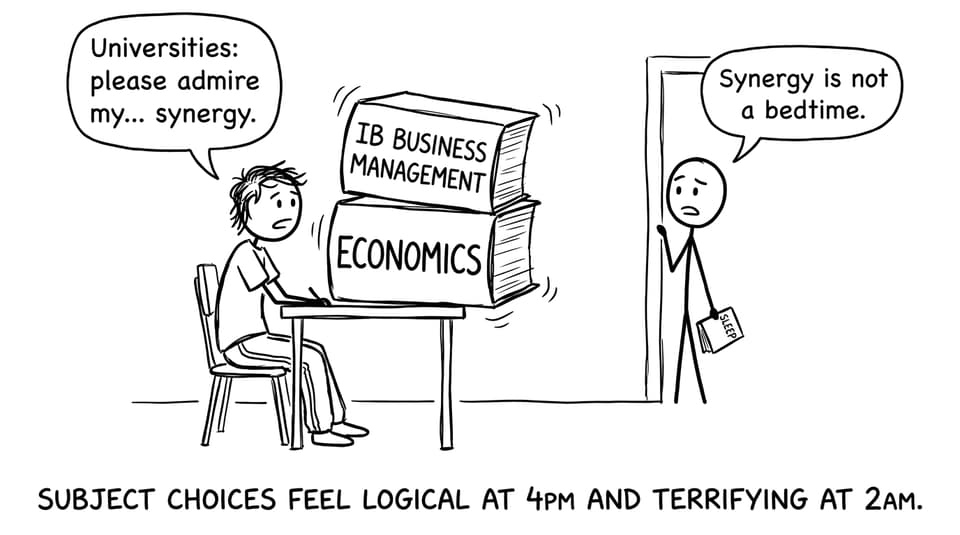
If you’ve ever stared at your subject choices at 2am and wondered if universities will judge you for picking both Economics and IB Business Management, you’re not overthinking. You’re doing what ambitious IB students do: trying to make the future legible.
The fear is specific: “Will this look like I played it safe?” But universities rarely read your timetable like a personality test. They read it like evidence. Evidence of readiness, balance, and the ability to perform under pressure.
The fast answer universities actually use
Here’s the checklist most admissions thinking boils down to when you take Economics plus IB Business Management:
-
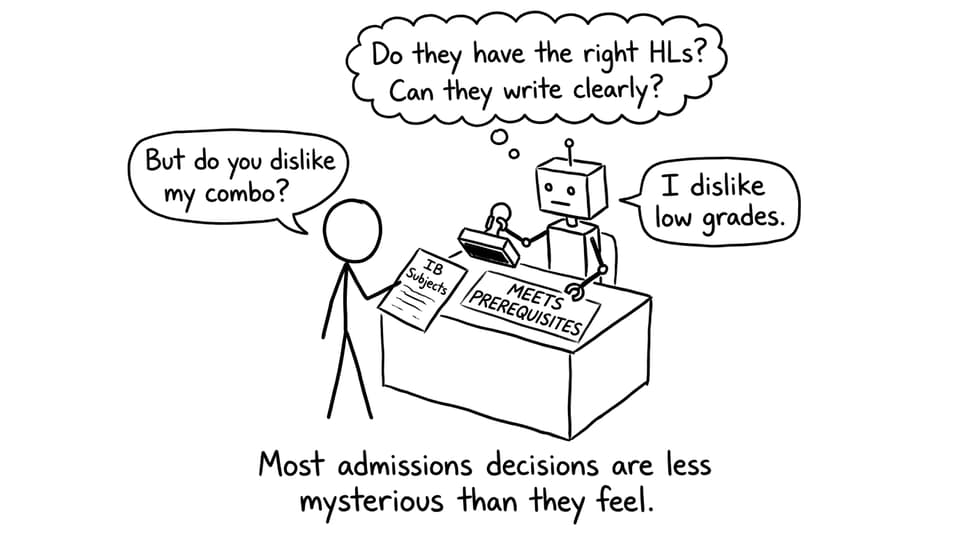
Do you meet prerequisites for the course (especially HL requirements)?
-
Does your overall subject set look balanced (quant + writing + breadth)?
-
Are your grades strong across the set, not just in one area?
-
Can you explain the choice clearly in your personal statement or interview?
-
Did you use the IB core well (TOK/EE) to show thinking beyond one lane?
If you want the longer, calmer version, keep reading.
Why students worry about overlap (and why unis worry about something else)
Economics and IB Business Management both live in Group 3. So yes, there’s overlap: markets appear in Business; firms appear in Econ. That similarity is exactly why the combination can feel “too close.”
But universities are not tallying your subjects like they’re trying to maximize variety. They’re asking: will you cope with the degree?
Economics shows comfort with models, causal reasoning, and structured evaluation. IB Business Management shows you can apply frameworks to messy real organizations and defend a recommendation. Together, they can signal coherence: you like decisions, incentives, trade-offs, and real-world outcomes.
If you want a clearer comparison of the two thinking styles, see Business vs. Economics: Choosing the Right Path in IB and How to Choose Between IB Business Management and IB Economics.
What universities tend to like about IB Business Management + Economics
The synergy is real (when you use it)
The best applications don’t just “have both.” They connect both.
In Economics, you learn why inflation, interest rates, or trade policy can squeeze households and firms. In IB Business Management, you learn how a specific firm reacts: pricing strategy, operations, HR, finance, ethics.
This is why the combo can look sharp for business, management, finance, marketing, and entrepreneurship paths, as long as the rest of your diploma isn’t lopsided.
Depth can beat variety
Some courses reward a focused narrative. If you’re aiming for business-related degrees, taking IB Business Management plus Economics can look like purposeful preparation.
If you’re unsure whether schools even allow both subjects, start with Is It Possible To Take Both IB Business Management And IB Economics?.
When the combo can raise eyebrows
When it crowds out quantitative strength
For some economics, finance, and data-heavy courses, the bigger signal is your maths level. If your schedule has Economics + IB Business Management but your maths choice doesn’t match the degree, that’s where doubts can appear.
A useful guide here is Best IB Math for Business and Economics: AA vs AI.
When it looks like you avoided academic stretch
Universities don’t dislike IB Business Management. They dislike mismatches: “This course is mathematically demanding but the applicant didn’t choose subjects that prepare them.”
If you’re choosing between the two subjects because of difficulty, read Is IB Business Management Easier Than IB Economics? with a practical lens: “Which exam style will I actually execute well?”
When grades drop because workload wins
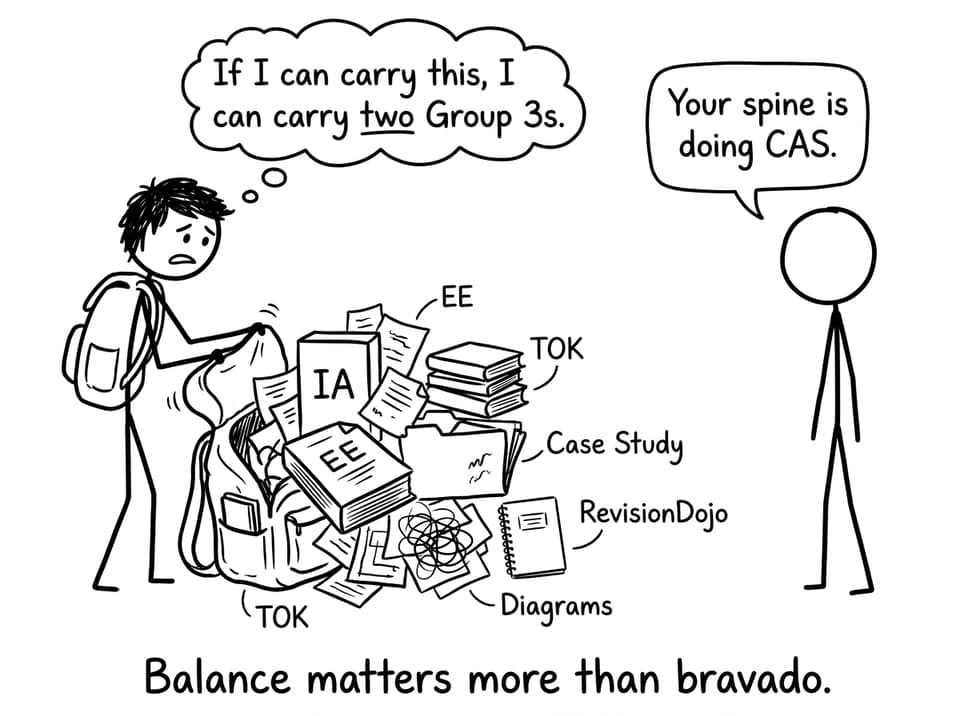
Two Group 3 subjects can be very doable. But the workload becomes real when IAs, EE, TOK, and multiple essay-based exams collide.
Universities will almost always prefer a slightly “broader” combination with strong grades over a “perfectly aligned” combo with inconsistent performance.
How to make the combination look strong in your application
Use your writing to explain your logic
In your personal statement/interview, don’t defend the combo. Frame it.
Try something like:
-
Economics trained me to analyse incentives and policy constraints.
-
IB Business Management trained me to recommend decisions in real organizational contexts.
-
Together, they shaped how I evaluate trade-offs: not just what works in theory, but what’s feasible.
Use TOK and the EE as proof of range
If you write your EE in a business or economics-adjacent topic, aim for depth and method, not buzzwords. Show research skill, not just interest.
Build evidence with exam-style practice
If you’re an IB student preparing for exams, the quickest way to make this combo pay off is to convert “interest” into marks.
RevisionDojo is built for that loop:
-
Use the Business Management - IB Resources hub for syllabus-aligned Study Notes
-
Drill weak areas with the IB Business Management Questionbank
-
Lock definitions and frameworks with Flashcards
-
Use AI Chat to unblock confusion fast
-
Build stamina with Mock Exams and Predicted Papers
-
Get feedback via Grading tools, and deeper support from the Coursework Library and Tutors
For broader strategy, RevisionDojo App: The Smarter Way to Prep for IB Exams is a solid starting point.
The quiet truth: universities care less about the combo than you think
Taking both Economics and IB Business Management is not automatically a red flag. It’s a signal. And like any signal, it only works if the rest of your application supports it: balanced subjects, the right HLs, and grades that prove you can handle the pace.
If you want that signal to translate into exam performance, build a repeatable routine with RevisionDojo’s Questionbank, Study Notes, Flashcards, AI Chat, Grading tools, Predicted Papers, Mock Exams, Coursework Library, and Tutors. When IB Business Management turns from “a subject I chose” into “a subject I can score in,” universities tend to stop worrying and start nodding.