
Choosing the IB Diploma can feel like choosing a route before the map is fully visible. Parents hear about six subjects, Higher Level courses, internal assessments, university cut-offs, UNEDasiss and entrance tests. The vocabulary arrives faster than the reassurance.
Here is the clear answer: the IB Diploma is widely available in Spain and provides a recognized route into Spanish and international universities. The qualification itself is consistent across countries, but university admission in Spain depends on the institution, degree, autonomous community and the way a student's IB results are converted and weighted.
This parent guide to the IB Diploma in Spain explains what families need to understand before selecting a school, choosing subjects or preparing for university. The goal is not to make parents manage the programme. It is to help them ask better questions while leaving students enough ownership to succeed.
The IB Diploma in Spain at a glance
Before getting lost in details, focus on seven practical questions:
- Is the school officially authorized to offer the Diploma Programme?
- Which IB subjects and languages does it actually teach?
- Can the timetable support the student's intended combination?
- Which three subjects should be taken at Higher Level?
- Do prospective university degrees require or reward particular subjects?
- How does the school guide families through UNEDasiss and regional admission procedures?
- What academic and wellbeing support is available during the two-year programme?
That checklist matters because schools do not all offer the same IB experience. Authorization creates a common framework, but subject availability, language of instruction, university counselling and academic support remain local.
What is the IB Diploma?
The Diploma Programme is a two-year curriculum generally studied by students aged 16 to 19. Students complete six subjects alongside three core components: Theory of Knowledge, the Extended Essay and Creativity, Activity, Service.
Students normally take three subjects at Higher Level and three at Standard Level, although the official framework permits four Higher Level subjects in some circumstances. Higher Level courses involve greater teaching time and depth. The six subjects are selected across languages, individuals and societies, sciences, mathematics and the arts, with permitted substitutions in certain groups.
Each subject receives a grade from 1 to 7. Theory of Knowledge and the Extended Essay can contribute up to three additional points, producing a maximum Diploma score of 45. Students generally need at least 24 points, while also satisfying the programme's other passing conditions and completing CAS.
Parents should understand one subtle distinction: earning the Diploma and obtaining admission to a chosen degree are different goals. A student may meet the Diploma requirements but still need a higher score, specific Higher Level grades or strategically weighted subjects for a competitive university course.
Families can explore the current structure through RevisionDojo's IB syllabus and assessment hub, which organizes subjects, assessment resources and core guidance in one place.
Choosing an IB school in Spain
Spain has public, state-subsidized private, independent Spanish and international schools offering IB programmes. Some schools teach the Diploma primarily in Spanish, some in English and others through bilingual combinations. A school may also combine the IB with elements of the Spanish Bachillerato, creating a demanding but potentially useful dual pathway.
Always confirm a school's current authorization through the official IB school directory. Then look beyond the badge.
Questions worth asking each school
Ask which subjects ran during the previous two academic years, not simply which ones appear in a brochure. A course advertised by a school may depend on sufficient enrolment, teacher availability or timetable compatibility.
Also ask:
- How many students are usually in each subject class?
- Which languages can be used for instruction and assessment?
- How are Extended Essay supervisors assigned?
- How does the school schedule internal assessment deadlines?
- Does university counselling cover Spanish public universities, private universities and destinations abroad?
- Who handles UNEDasiss guidance?
- What happens when two desired subjects occupy the same timetable block?
The best school is not automatically the one with the longest subject list. It is the one able to deliver the combination, guidance and learning environment your child actually needs.
Subject choices and university plans in Spain
There is no single authoritative national dataset showing one definitive ranking of IB subject popularity across Spanish schools. Availability also differs substantially between institutions. It is more useful to think in terms of common degree-oriented combinations.
Students considering medicine, biosciences or health-related degrees often investigate Biology and Chemistry. Engineering applicants commonly look closely at Mathematics: Analysis and Approaches and Physics. Economics, business and social-science pathways may combine Mathematics with Economics, Business Management, History or a language.
These are patterns, not universal admission rules. A university may care about the overall admission score, specified subjects, Higher Level grades, subject equivalencies or a combination of them. Requirements can also change by degree and admissions cycle.
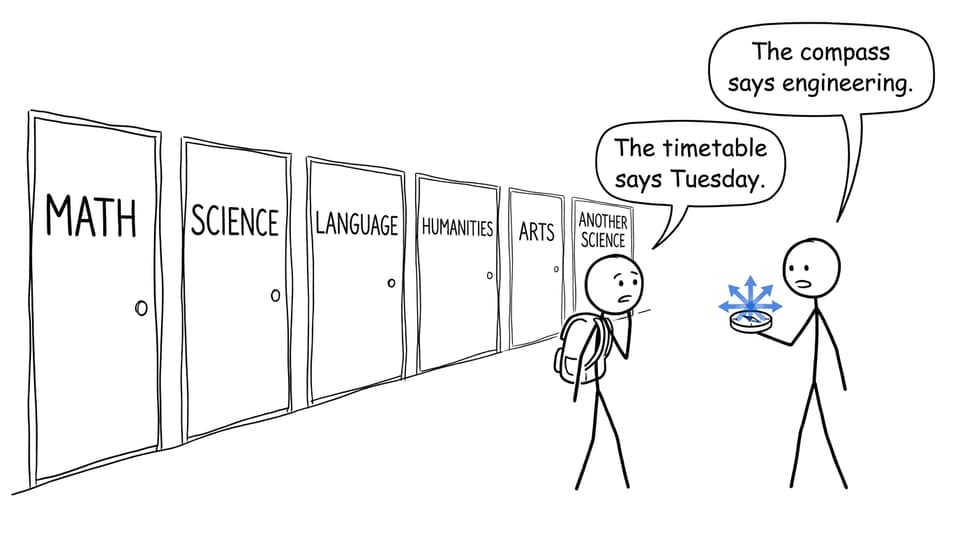
Work backwards from several plausible degrees rather than one dream course. Check each university's current requirements and weighting tables before finalizing Higher Level choices. RevisionDojo's global IB university application guide can help families organize that research.
Once choices are made, subject-specific resources become valuable. Students can use the IB Biology resource collection, IB History resources and IB Business Management resources to see how course content and assessment demands differ.
How the IB leads to Spanish universities
Students holding the full IB Diploma can access Spanish universities without completing the ordinary Spanish Bachillerato route. For many applications, particularly to public universities, the central administrative step is obtaining UNEDasiss accreditation.
UNEDasiss evaluates international academic records and provides the admission information Spanish universities use. For IB students, it can convert the Diploma result into the Spanish university access scale. Families should not assume, however, that one procedure covers every institution.
Public university admission
Spanish public-university admission commonly distinguishes between an access score and an admission score. The converted IB result can provide the base access score on a scale up to 10. Relevant weighted subjects may then contribute additional points, potentially producing an admission score up to 14.
Those additional points can be important for degrees with high previous cut-off marks. Depending on the university and region, students may seek direct recognition of eligible IB subjects, take UNED Specific Competency Tests known as PCEs, or use another accepted route to strengthen the admission score.
The crucial phrase is depending on the university. Subject recognition and weighting arrangements are not perfectly uniform across Spain. Families should check the target university's current rules and ask whether specific IB subjects will be recognized for additional points. RevisionDojo's guide to IB grade conversion in Spain provides useful context, but the university and UNEDasiss instructions for the relevant cycle remain decisive.
A published cut-off is normally the result of the previous admissions process, not a guaranteed threshold for the next one. Treat it as planning evidence rather than a promise.
Private university admission
Private universities may apply their own procedures, including academic review, interviews, aptitude assessments, language evidence or programme-specific requirements. Some use UNEDasiss accreditation, while others place greater emphasis on their internal admissions process.
Contact each institution directly and ask for requirements in writing. A broad statement that a university "accepts the IB" does not explain the required total, subject grades, language level or application stages.
A practical timeline for IB parents
During the first Diploma year, clarify likely countries, degrees and subject requirements. Build a shortlist wide enough to include ambitious, realistic and safer options. Confirm whether Spanish applications will require weighted subjects or PCE preparation.
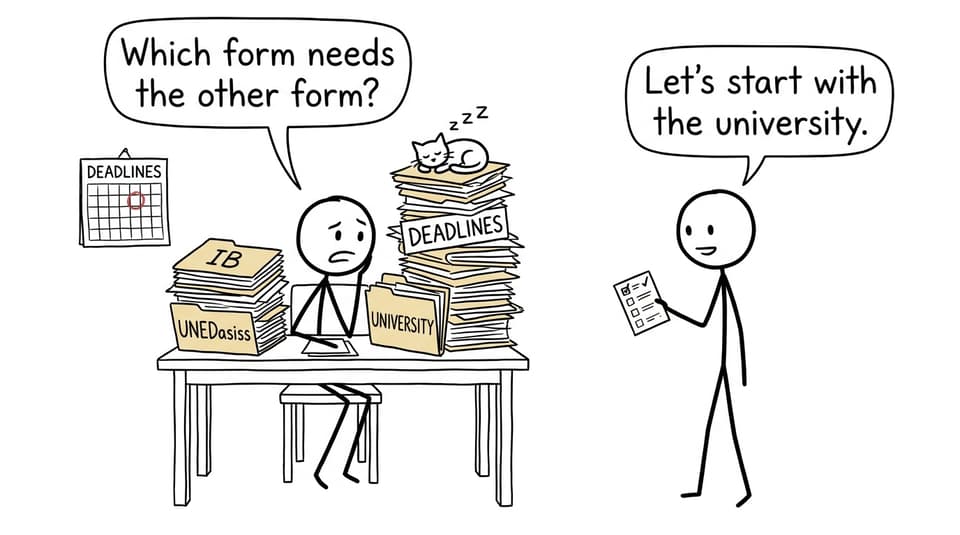
By the beginning of the second year, create a shared deadline document covering university applications, UNEDasiss, result transmission, supporting documents and any separate assessments. Check current official dates rather than copying the previous year's calendar.
During the final revision period, reduce administrative surprises. Confirm identity documents, application accounts and the process for sending official IB results. The student should know which outcomes matter: total points, relevant Higher Level grades and any degree-specific subject conditions.
RevisionDojo's minimum IB score guide helps explain why a single headline score rarely tells the whole admissions story.
How parents can support exam preparation
The most useful parental role is usually environmental rather than instructional. Protect sleep, help preserve a workable schedule and ask questions that encourage reflection: "Which topic is costing you marks?" is more useful than "Have you revised enough?"
A strong weekly cycle is simple:
- Review concise Study Notes for one weak area.
- Retrieve key ideas with Flashcards.
- Apply them through Questionbank practice.
- Use AI Chat to examine misconceptions and unclear feedback.
- Review errors with Grading tools rather than merely recording a score.
- Build stamina using Mock Exams and Predicted Papers.
Students can begin with RevisionDojo's IB subject notes and IB Questionbank guide. The Coursework Library and IA guides can support understanding of assessment structure, while Tutors provide human guidance when a persistent difficulty needs more than another hour alone.

The point is not to add more resources. It is to shorten the feedback loop between attempting a task, understanding the error and trying again.
A calmer way to make the decision
The IB Diploma in Spain offers a credible route to universities at home and abroad, but good outcomes rarely come from choosing the programme in the abstract. They come from aligning the school, subject combination, university route and student's working habits.
Start with possible destinations. Verify requirements. Ask schools specific questions. Then give the student room to own the work.
RevisionDojo brings the academic side of that plan together through its Questionbank, Study Notes, Flashcards, AI Chat, Grading tools, Predicted Papers, Mock Exams, Coursework Library and Tutors. For a family managing both IB assessments and Spanish university procedures, one organized source of support can turn a crowded map into a sequence of manageable next steps.