
For IB students sitting exams in May 2028 (started DP1 in August 2026).
The best May 2028 IB computer science study advice is to revise by syllabus point, write and trace programs every week, and practise explaining computing decisions in precise exam language. Your cohort follows the course first assessed in 2027, so use resources explicitly aligned with that syllabus rather than material built around the previous course.
Computer science creates a peculiar illusion. Reading an algorithm can feel like understanding it, just as watching someone play the piano can feel simpler than touching the keys yourself. The difference appears when the page is blank and you must decide what happens next.
That is why effective revision alternates between retrieval, application and explanation. The RevisionDojo resources for the new IB Computer Science course bring those stages together through Study Notes, Flashcards, Questionbank practice and AI-supported feedback.
Your May 2028 study checklist
Use this as the foundation of your two-year plan:
- Organize notes around the official syllabus statements, not textbook chapters alone.
- Schedule one programming session and one theory-retrieval session each week in DP1.
- Trace algorithms by hand before checking them with a computer.
- Learn definitions, but also practise applying them to unfamiliar situations.
- Treat the pre-seen case study as applied Theme A revision, not a separate vocabulary test.
- Start the computational solution early enough to test, evaluate and improve it honestly.
- Increase timed Paper 1 and Paper 2 practice gradually during DP2.
- Keep separate error logs for knowledge, programming, command terms and timing.
Confirmed syllabus and assessment for IB Computer Science 2028
The current official IB guide and subject brief identify this as the course first assessed in May 2027. The published structure therefore applies to students preparing for May 2028 unless the IB subsequently issues an amendment.
Theme A, Concepts of computer science, covers computer fundamentals, networks, databases and machine learning. Theme B, Computational thinking and problem-solving, covers computational thinking, programming and object-oriented programming, with abstract data types as an HL-only topic. The course supports Python and Java in relevant Paper 2 programming questions.
Paper 1 assesses Theme A and includes questions connected to a pre-seen case study. Paper 2 assesses Theme B, including programming and algorithmic problem-solving. At SL, each paper lasts 1 hour 15 minutes and contributes 35%, while the computational solution contributes 30%. At HL, each paper lasts 2 hours and contributes 40%, while the computational solution contributes 20%.
The internal assessment is called the computational solution. Both SL and HL receive 35 recommended teaching hours for it, and students create a solution to a real-world problem of their choosing.
What is not yet published
As of 21 October 2026, the official May 2028 examination timetable was not publicly available on the IB examination schedule page. A session-specific 2028 Computer Science case study was not located on the public IB pages either. Final May 2028 grade boundaries are inherently unavailable before assessment and standard-setting take place.
Do not build a revision calendar around guessed examination dates or study an earlier case study as though it will be reused. Your coordinator and teacher should provide session documents when the IB releases them. The stable material you can study now is the first-assessment-2027 syllabus, assessment model and official command-term expectations.
How to make Computer Science notes that remain useful
A good note is not a transcript. It is a tool that helps you reconstruct an idea after some of it has faded.
Create one page or digital card for each syllabus statement. Use five fields:
- Core idea: a definition written in accurate technical language.
- Mechanism: how the system, process or algorithm works.
- Example: a concrete computing context.
- Trade-off: an advantage, limitation or ethical implication.
- Exam prompt: one question requiring application or evaluation.
For networks, for example, do not stop after defining a protocol. Explain what the protocol controls, place it in a realistic communication scenario, and compare its consequences with another approach. For databases, include small schemas, keys and normalization decisions. For machine learning, connect processes to data quality, model behavior and ethical consequences rather than collecting isolated buzzwords.
Programming notes should be shorter. Keep patterns for selection, iteration, functions, collections, classes and common algorithms, but annotate what each part accomplishes. The new-course Computer Science Questionbank is then useful for testing whether those patterns transfer to unfamiliar questions.
Case-study notes need a different structure. Build a glossary, map technical processes, identify stakeholders, collect credible examples and prepare arguments around the challenge questions once your 2028 document is released. The method in this guide to concise IB Computer Science case-study notes remains useful, but its 2027 case-study content should not be mistaken for May 2028 examinable material.
What to practise and how often
Consistency matters more than heroic revision weekends. During DP1, aim for two focused sessions each week outside lessons.
Weekly DP1 rhythm
Spend 30-45 minutes retrieving one Theme A topic without notes. Then spend 45-60 minutes writing, tracing or debugging algorithms from Theme B. Finish each session by recording one specific error and its correction.
Every two weeks, answer one longer response under a time limit. Every month, complete a mixed set that forces you to switch between concepts. This exposes whether your knowledge is flexible or merely familiar.
DP2 progression
In early DP2, add regular case-study work after the correct 2028 document becomes available. Around three to four months before the examination, move toward timed paper sections each week. Full Mock Exams are most valuable after you have repaired topic-level weaknesses, because a mock diagnoses performance but does not teach missing content by itself.
Use Study Notes when you genuinely lack understanding, Flashcards for terminology and retrieval, and the Questionbank for application. Jojo AI Chat can challenge an explanation or help identify an unclear step, while AI Grading tools can provide formative feedback. Always compare automated feedback with your teacher's guidance and the published assessment expectations.
Choose practice materials that match the syllabus
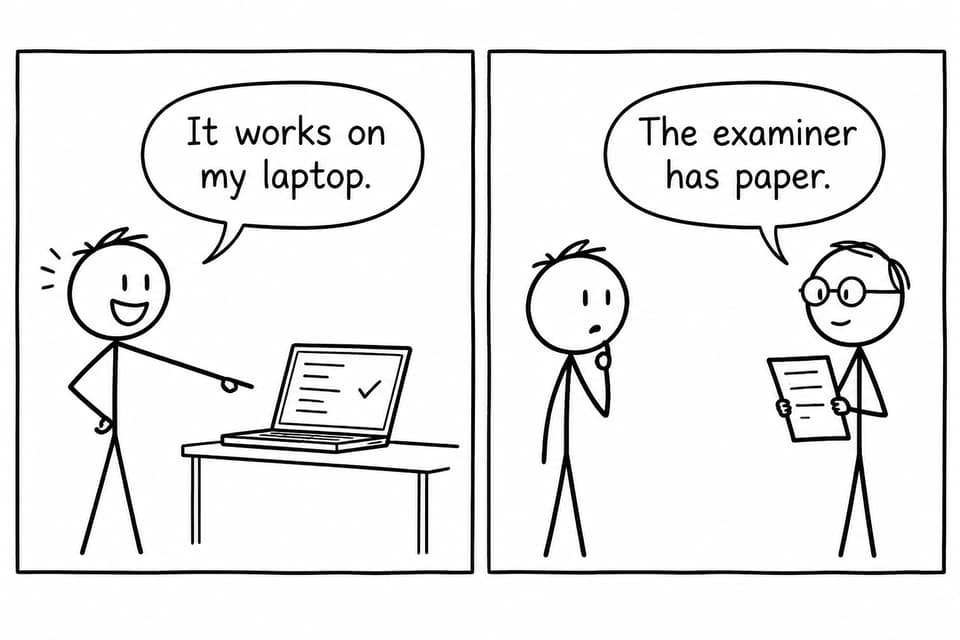
The date on a resource matters less than its syllabus alignment. Begin with the official guide for first assessment 2027, your teacher's course materials and official specimen assessment material supplied for this course. Then use resources clearly organized around Themes A and B, the pre-seen case study, and the computational solution.
Older questions can still help with durable concepts such as logic, networks, databases and algorithm tracing. However, they may use a discontinued structure, different option content or expectations that do not map neatly onto the current assessment. Tag every reused question with the current syllabus statement it practises. If you cannot make that connection, it should not lead your revision.
RevisionDojo lets you move from a syllabus area to targeted practice. You might review database normalization for the new syllabus, then solve related questions without looking back. HL students can similarly target sets as an abstract data type.
Predicted Papers can provide additional simulation once they are available for the correct session, but they are practice materials, not forecasts of exact questions or boundaries. The Coursework Library can clarify how strong computational thinking is communicated, while Tutors can help when repeated mistakes reveal a conceptual gap rather than a memory problem.
Common mark-losing habits
Answering the topic instead of the command term
A student may know everything relevant and still answer the wrong intellectual task. Describe requires characteristics or an account. Explain requires reasons or mechanisms. Evaluate requires a supported judgment that weighs relevant considerations.
Underline the command term and subject before writing. For extended responses, sketch a two-line plan so the answer develops rather than circles.
Writing code without tracing edge cases
Test ordinary, boundary and invalid inputs where relevant. Trace variable values line by line. Check loop termination, indexes, returned values and whether a condition covers every intended branch.
Giving generic case-study answers
Naming the case study is not application. Use its technologies, stakeholders, constraints and consequences. The case-study exam pitfalls guide explains transferable habits, although you must apply them to the eventual 2028 document.
Treating the internal assessment as a coding showcase
Complexity is not automatically quality. A manageable solution with defensible requirements, purposeful design, systematic testing and honest evaluation is usually easier to communicate than an oversized project. Follow your teacher's deadlines and preserve evidence as you work.
Memorizing code visually
If you can recognize a loop but cannot construct or adapt one, the knowledge is fragile. Close the example, rewrite it, change the problem and explain why it terminates.
HL versus SL study priorities
SL students should not interpret the smaller course as a vocabulary exercise. Paper 2 still requires computational thinking and programming, and Paper 1 still rewards applied understanding. Since the computational solution contributes 30% at SL, sustained project management is especially important.
HL students cover greater depth across the course and study B4 abstract data types. Paper 2 can demand more sophisticated object-oriented programming and choices involving structures such as stacks, queues, linked lists, trees or sets, according to the detailed syllabus. Practise selecting a suitable structure, applying its operations and justifying why it fits the problem.
The case-study allocation is also larger at HL, and HL Paper 1 contains more case-study marks and challenge questions than SL. That calls for deeper research and stronger synthesis, not simply longer notes. Compare the strengths of different techniques using the case-study study methods guide, then retain only methods that make recall and application measurably easier.
Both levels benefit from the same cycle: learn, retrieve, apply, receive feedback and revisit. The amount differs. The logic does not.
Build a system that survives until May 2028
The danger of a two-year course is not that there is too little time. It is that abundant time makes delay feel inexpensive.
RevisionDojo works best as one connected revision system. Study Notes establish clarity, Flashcards strengthen retrieval, the Questionbank tests transfer, AI Chat probes explanations, and Grading tools expose weak answers. Predicted Papers and Mock Exams later develop timing, while the Coursework Library and Tutors support work that needs deeper guidance.
Your specific next step is simple: open the IB Computer Science Questionbank for the new course, choose the topic most recently taught, and complete five questions without consulting your notes.