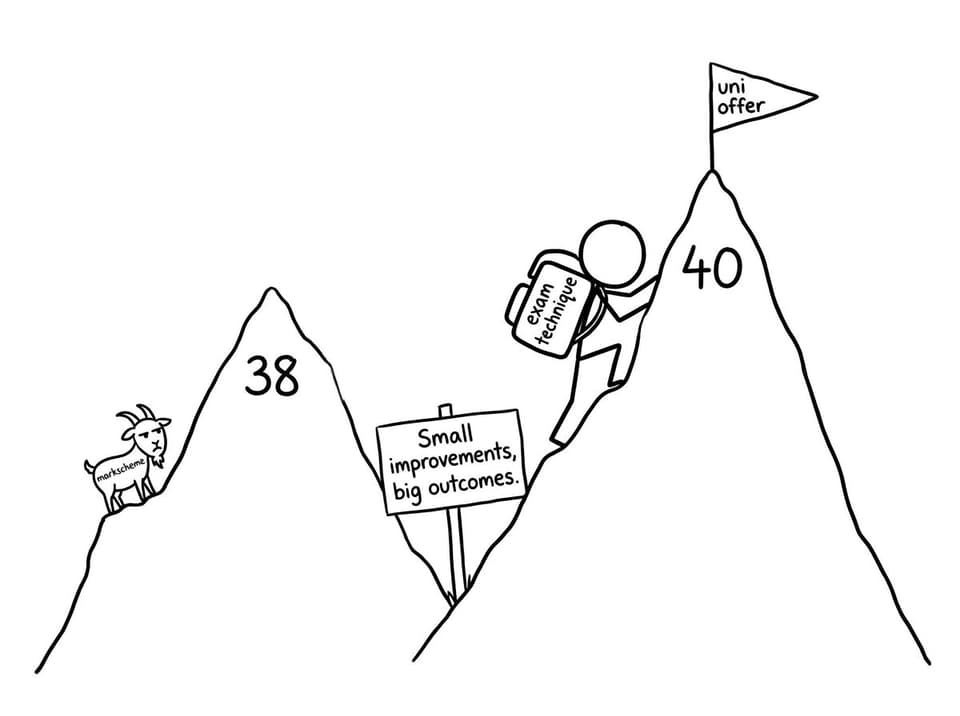

When you hear someone say they got a 40 in the IB, it can land in your chest in two different ways.
One way is awe: That's incredible. That's the number people whisper about.
The other way is quieter and more personal: If 40 is "good," what does that make my 33? My 36? My 39?
The truth is that IB scores don't just measure knowledge. They measure timing. Calm. Pattern-recognition. The ability to keep doing the basics when you're tired and the stakes feel bigger than you.
So, is 40 a good IB score?
Yes. It's outstanding. But what matters more is what a 40 actually represents and how you can build a realistic path toward it, one mark at a time.

Quick answer: yes, 40 is a great IB score
A 40 in the IB Diploma Programme is an elite result on a 45-point scale. It usually places you among the top-performing students worldwide, well above the global average.
But the more useful question is: What does 40 say about your performance profile? In IB, high totals are rarely built from perfection. They're built from consistent 6s and 7s, plus sensible handling of the core.
If you want context and comparisons, these posts give helpful reference points:
The IB 40 checklist: what you typically need
Here's the simplest way to "see" a 40 in the IB without turning it into mythology:
- Subject points: usually something like 36-38 points across six subjects
- Core points (TOK + EE): usually 2-3 points (sometimes 1, but that forces higher subject scores)
- Profile reality: more "solid across everything" than "perfect in one area"
A typical 40 profile might look like:
- 7, 6, 6 at HL
- 6, 6, 5 at SL
- 2 core points
Not magical. Just relentlessly consistent.
If you're aiming higher, this guide is a strong roadmap:
Why a 40 in IB feels different than "an A"
In many systems, a top grade can come from being naturally fast, or good at memorizing, or strong in one subject.
The IB is less forgiving. It's broad by design. You don't just need knowledge. You need endurance across languages, sciences, humanities, math, and the core.
A 40 signals three things:
You learned the syllabus and the game
The syllabus is content. The "game" is how marks are awarded.
In IB, two students can know the same material and score very differently because one writes in a way that matches command terms, markband logic, and examiner expectations.
This is why high scorers tend to do a lot of structured practice and feedback loops, not just rereading.
You minimized unforced errors
Most students don't lose marks on the hardest ideas. They lose marks on:
- forgetting to label a diagram,
- missing units,
- not addressing the "evaluate" part,
- running out of time because they over-wrote earlier questions.
A 40 is often the score of someone who made fewer avoidable mistakes.
You handled pressure repeatedly, not perfectly
A high IB total is rarely a single heroic exam day. It's usually a year of small habits that made exam day feel familiar.
That's where timed practice and feedback matter.
How rare is an IB 40, really?
It's easy to think "everyone online gets a 40" because the people who post are usually the people who are proud.
In reality, scoring 40+ is uncommon in the IB and sits far above the global average.
For a deeper dive into the numbers and why your perception gets skewed, read:
The takeaway isn't to intimidate you. It's to reassure you: if you're at 34-38 right now, you're closer than you feel. And if you're at 28-33, you're not "bad at IB." You're simply early in the process of converting effort into marks.
What a 40 means for university admissions
Universities don't all read the IB the same way, but a 40 is widely understood as a very strong academic signal.
In many competitive contexts, a 40:
- clears typical conditional thresholds,
- supports scholarship consideration,
- shows you can handle breadth and sustained workload.
If you're thinking specifically about predicted totals and how universities treat them, see:
The hidden math of getting from 38 to 40 in IB
The jump from 38 to 40 in IB sounds small. It's two points.
But emotionally, it can feel massive. Because those last two points usually come from:
- turning a 5 into a 6,
- turning a low 6 into a safe 6,
- getting the last mark in 8-mark questions more reliably,
- earning 2-3 core points instead of 1.
That kind of improvement isn't about learning more. It's about learning more precisely.
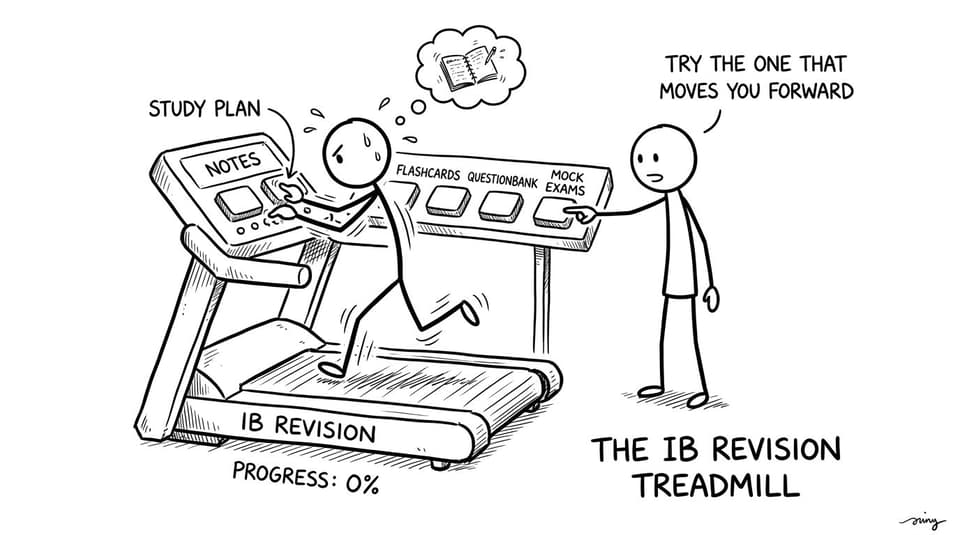
This is where RevisionDojo helps because it's designed around the exact loop that creates those tiny gains: Study Notes to clarify, Flashcards to retain, Questionbank to apply, AI Chat to unblock, then Mock Exams and Predicted Papers to pressure-test.
Start here if you want the platform overview:
A practical IB strategy if you want a 40 (without burning out)
Aiming for 40 in IB doesn't mean studying all day. It means studying in a way that produces marks.
Build a tight weekly loop
Use a weekly rhythm you can repeat:
- 2-3 short sessions: learn and clarify with RevisionDojo Study tools for IB
- 3-5 practice sessions: drill weak topics using the Questionbank
- 1 timed session: simulate pressure using Mock Exams and Predicted Papers (when available)
If you want a clean system for this, the workflow is laid out in:
Stop treating revision as rereading
High IB scores come from active recall and application.
That's why students who improve fastest usually live on:
- Flashcards for daily memory upkeep
- Questionbank sets for exam logic
- Feedback that tells them what an examiner wanted
If your memory keeps "resetting," build a flashcard routine:
Use feedback like a compass
Aiming for 40 means you don't have time for vague effort. You need feedback that's specific:
- Where did I drop marks?
- Which command terms am I missing?
- Which topics repeatedly cost me points?
RevisionDojo's AI Chat and Grading tools are built for this style of iteration, so you don't wait days to learn what went wrong.
If you want to understand what "mark-scheme-aligned feedback" really means, see:
Closing: the quiet truth about a 40 in the IB
A 40 in the IB is a brilliant score. But it's not a personality trait, and it's not proof that someone else is "built differently."
It's usually proof of something less dramatic: they practiced the right things, got feedback quickly, and kept showing up.
If your goal is a 40, don't chase the number by adding stress. Chase it by building a system that makes marks predictable: learn with Study Notes, retain with Flashcards, improve with the Questionbank, ask questions with AI Chat, pressure-test with Mock Exams and Predicted Papers, refine coursework with Grading tools and the Coursework Library, and get personal support from Tutors when you need a human voice.
Start your loop here: RevisionDojo for IB