
Scoring 40+ points in the IB can start to feel like a normal destination. You see the screenshots. The “acceptance + 44” captions. The school hallway posters with gold stars.
But here’s the quiet truth most students only learn after results day: 40+ is real, but it’s rare. And if you want the best shot at your own best score, the story usually begins earlier than revision season.
It begins with Subject Selection.

Quick checklist: what this article will help you do
-
Understand how common (and uncommon) 40+ scores are in reality
-
Spot the reasons 40+ looks more common than it is
-
Use Subject Selection to avoid “silent” score killers
-
Build a strategy that protects your consistency across six subjects
-
Use RevisionDojo to turn effort into marks, not just hours
How many students actually score 40+ points in the IB?
Across a typical IB session, fewer than 10% of students score 40 points or above worldwide. In many cohorts, it’s lower.
That single statistic reframes everything:
-
Most students who work hard and are genuinely “good at school” will still finish below 40.
-
A 40+ total usually requires strength across nearly every component: subjects and core.
-
The “my friend group all got 40+” stories are usually about unusual environments (selective schools, scholarship cohorts, or self-selecting social circles), not the global norm.
So if you feel pressure because 40+ seems everywhere, it’s not that you’re falling behind. It’s that you’re looking at the loudest 5-10%.
Why 40+ feels more common than it is
There’s a simple bias at work: high scores travel further.
A student who gets 41 is more likely to post it. A school is more likely to celebrate it. Friends are more likely to remember it. Meanwhile, a strong 34-38 (which universities regularly respect) often disappears into normal life.
This is why students start planning their entire IB experience around an outcome they’ve mostly seen through highlights.
And that’s where Subject Selection becomes either your quiet advantage or your quiet trap.
Subject Selection: the hidden reason 40+ is smaller than you think
Most people talk about 40+ like it’s just “work harder.” But in practice, a 40+ score is often a systems result: fewer weak links, fewer accidental mismatches, fewer subjects that drain time without giving marks back.
The IB is six subjects plus the core. If even one subject becomes a constant rescue mission, it pulls time away from everything else. That’s how capable students end up with totals that don’t reflect their potential.
Here are three Subject Selection mistakes that quietly shrink the 40+ group.
Picking for prestige instead of scoring reality
Some students choose subjects because they sound impressive, not because they fit how the IB assesses.
Ask yourself:
-
Do you score best in problem-solving or writing?
-
Do you sustain effort in subjects that require weekly practice (math, sciences), or do you spike last-minute?
-
Are you choosing a subject you’ll actually practice?
If you need help understanding the full structure of the Diploma (and what you’re really committing to), read How Many Subjects Do You Take in the IB?
Choosing subjects without a workload balance
A “perfect” combo on paper can become a messy reality when deadlines collide. The students most likely to reach 40+ aren’t necessarily the smartest; they’re often the ones whose choices allow consistent performance.
A practical way to sanity-check Subject Selection is to map:
-
reading-heavy subjects (and how many essays you’ll write)
-
calculation-heavy subjects (and how much weekly practice they need)
-
coursework load and stress profile
If you want a broader, end-to-end view of the journey from choices to final exams, use The Complete IB Revision Guide: From Subject Selection to Final Exams

Ignoring “assessment fit” (the most underrated factor)
Two students can love the same subject and still perform very differently because the assessment rewards different habits.
For example, if you’re deciding in Group 3, don’t just ask “which is easiest?” Ask which assessment style matches you: essays, data response, case studies, or arguments.
This is exactly the lens used in Choosing the Right IB Group 3 Subject for Your Career Goals
When Subject Selection matches your strengths and the markscheme logic, your revision time starts compounding instead of leaking.
What actually separates most 40+ scorers (it’s not superhuman study)
Most 40+ students share a boring, powerful trait: they lose fewer “cheap marks.”
Not because they’re perfect, but because they train the repeatable skills:
-
answering command terms precisely
-
structuring responses to match criteria
-
practicing under time limits
-
reviewing mistakes in a loop instead of “moving on”
That’s why the best prep isn’t endless notes; it’s the cycle of understand, practice, feedback, and repeat.
On RevisionDojo, that loop is built into one place:
-
Study Notes for fast clarity
-
Flashcards for daily recall
-
Questionbank for targeted exam-style practice
-
AI Chat when you’re stuck and need explanations that match your level
-
Grading tools to learn how marks are awarded
-
Predicted Papers to rehearse realistic full-paper timing (see IB Predicted Papers by IB Examiners and IB Predicted vs Specimen Papers: What They Mean)
-
Mock Exams to simulate pressure and pacing
-
Coursework Library to reduce uncertainty around IAs, EE, and TOK (start with IB Coursework Examples: IA, EE and TOK Exemplars)
-
Tutors when you need human diagnosis, not generic advice
Why chasing 40+ can backfire (and what to aim for instead)
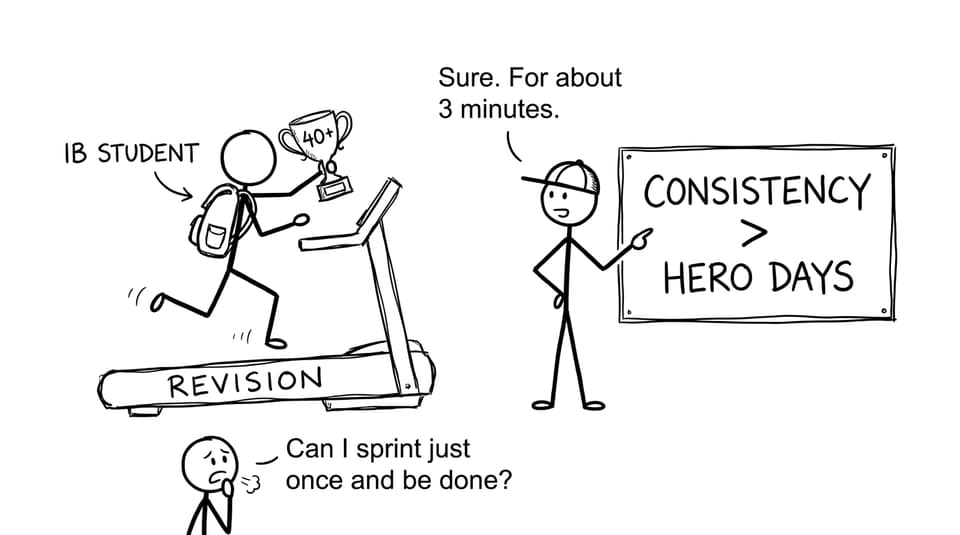
There’s a paradox: the students who obsess over 40+ can become less likely to reach it.
Because obsession nudges you toward:
-
perfectionism instead of repetition
-
constant comparison instead of consistent habits
-
“all-or-nothing” days that lead to burnout
A better target is: raise your floor.
That means turning 4s into reliable 5s, and 5s into reliable 6s, across all subjects. Totals climb when weak links stop snapping.
If you want a realistic plan for the final stretch, IB: How to Study in the Last 24 Hours (No Panic) is a good reset.
Conclusion: the smaller number is the point
40+ is rare not because students don’t care, but because the IB punishes weak links. Six subjects, core points, deadlines, and timing add up. A small mismatch in Subject Selection, repeated across months, becomes a big gap in May.
If you want the most realistic path to the highest score you can earn, start with smart Subject Selection, then build consistency with the right practice loop. RevisionDojo gives you that loop in one place: Questionbank, Study Notes, Flashcards, AI Chat, Grading tools, Predicted Papers, Mock Exams, Coursework Library, and Tutors.
Your job isn’t to join a mythical club. It’s to make your score predictable, stable, and deserved. And that’s how totals rise.


