

A predicted 40 in the IB can feel like someone quietly opened a door you have been pushing on for two years.
For a moment, the noise drops. Your calendar looks less hostile. Your university list stops feeling like fantasy.
Then the second thought arrives: Is a predicted 40 actually “good”… or just “good on paper”? In the IB, that question matters, because predicted scores sit in the strange space between real performance and future proof.
Below is the calm, practical truth about what a predicted 40 means in the IB, what opportunities it tends to unlock, and how to make sure it becomes your final result rather than your best moment.
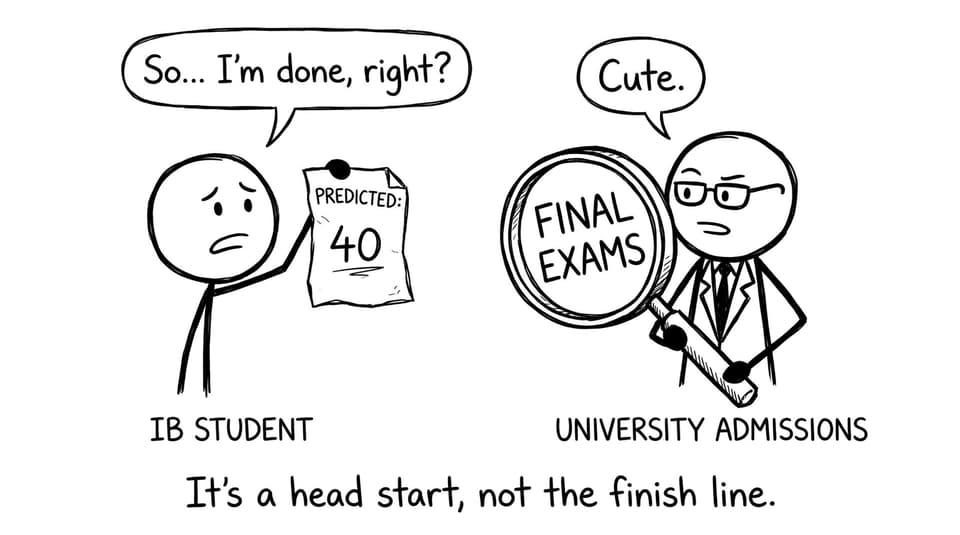
What a predicted score means in the IB (and why it exists)
In the IB, a predicted score is a teacher-generated estimate of what you are likely to achieve in the final exams and core components. It is usually built from your class performance, the quality of your Internal Assessments, and evidence from mocks and timed practice.
Predictions matter because they are often the most credible data universities receive before final IB results are released. In many systems, they influence conditional offers, scholarship consideration, and sometimes early acceptance decisions.
If you want to track how your component scores might translate into a diploma total, tools like the IB Exam Prediction guide can help you sanity-check where your points are coming from.
The IB points context: why 40 is objectively strong
The IB diploma totals 45 points:
-
6 subjects (up to 7 each) = 42
-
TOK + EE core points = 3
A predicted 40 typically implies a profile packed with 6s and 7s, plus solid core points. In a world where the global IB average is around the low 30s, a 40 signals that you are performing well above the center of the distribution.
Practically, it also tells universities something they care about more than raw intelligence: you can sustain effort across six subjects, meet multiple rubrics, and still keep your head.
Is a predicted 40 “enough” for top universities?
A predicted 40 is competitive for many selective programs, especially when it aligns with subject requirements at HL. In the UK context, many highly ranked courses sit around the high-30s to low-40s for typical offers, and a predicted 40 places you right in that conversation.
In the US and Canada, a predicted 40 can strengthen an application because it reads as sustained academic excellence across breadth. But in those systems, the IB score is only one signal among several: essays, recommendations, activities, interviews, and course fit still matter.
The most useful way to think about it is this:
-
A predicted 40 can open the door.
-
Your application materials decide whether you walk through it.
-
Your final exams decide whether the door stays open.
If you are building your prep around realistic exam practice, start with IB Predicted Papers as a structured rehearsal tool rather than a crystal ball.
Opportunities a predicted 40 can unlock (if you play it well)
A predicted 40 in the IB often increases access to:
-
Conditional offers from competitive universities (because your predicted score matches their risk tolerance)
-
Merit scholarships with score thresholds
-
Honors pathways or accelerated entry tracks in some regions
-
The confidence to apply to programs you would otherwise self-reject from
But the hidden opportunity is simpler: it gives you leverage over time. You can stop revising randomly and begin revising like a strategist.
That strategy is much easier when your resources are unified. Many students use RevisionDojo’s Questionbank to find exactly which topics are leaking marks, then reinforce weak areas with Study Notes and lock recall with IB Flashcards.
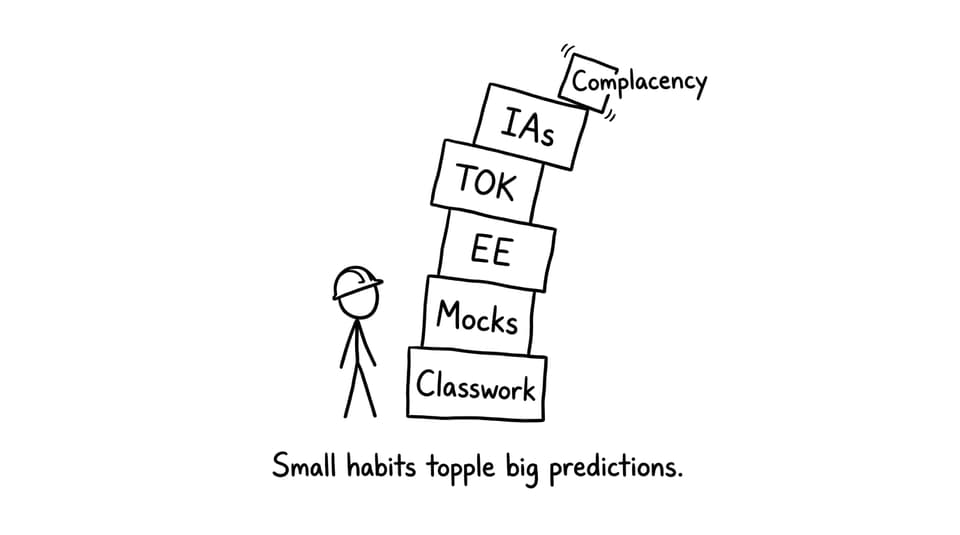
The main risk: treating a predicted 40 like a finish line
In the IB, the most common failure mode for high predictions is not lack of ability. It is a subtle change in behavior.
You start protecting the predicted number instead of building the final performance. You do fewer timed papers. You avoid hard feedback. You “maintain” instead of improve.
The fix is mechanical: keep the loop tight.
A simple checklist to protect (or raise) a predicted 40
-
Do at least one timed sitting per week in your highest-stakes IB subjects
-
Review mistakes for patterns, not just “what I got wrong”
-
Convert recurring errors into daily recall (flashcards or short drills)
-
Use examiner-style materials that resemble the real papers
-
Get fast feedback so you do not repeat the same mistake for two weeks
RevisionDojo is built for that loop: Mock Exams and Predicted Papers for stamina, the Questionbank for targeted volume, AI Chat when you are stuck, and Grading tools to show how marks are actually awarded.
For deeper coursework confidence, the IB Coursework Grade Prediction tool overview is useful when your IA/EE/TOK anxiety starts eating revision time.
How to turn a predicted 40 into a final 40 (the practical workflow)
Here is an approach that fits real student schedules:
-
One full-length timed paper every 7 days (rotate your HLs)
-
Two focused drills midweek using the RevisionDojo Questionbank
-
One short flashcard session daily (7--12 minutes) via Flashcards
-
One “reflection block”: write the three mistakes you keep making, and what you will do differently next time
If you are unsure how predicted papers should fit into that, read IB Predicted vs Specimen Papers: What They Mean. It helps you use predicted sets as training rather than superstition.
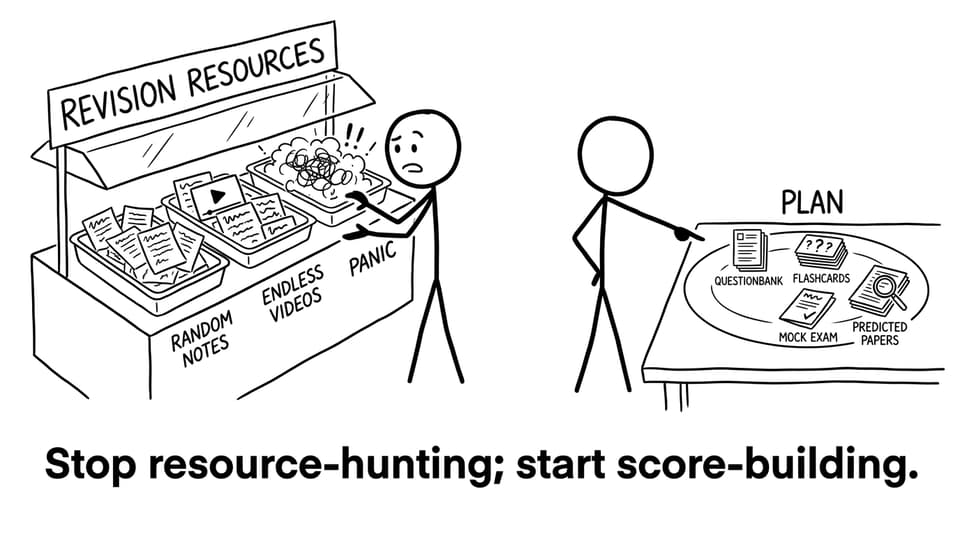
Conclusion: a predicted 40 in IB is leverage--use it
A predicted 40 in the IB is excellent. It is also fragile in the way all good things are: it lasts only if you keep showing up.
Use the prediction as leverage. Let it sharpen your choices. Spend less time collecting resources and more time running the loop that raises real scores: timed practice, fast feedback, targeted drills, and daily recall.
If you want that system in one place, RevisionDojo brings it together with Study Notes, Flashcards, a free Questionbank, AI Chat, Grading tools, Predicted Papers, Mock Exams, a Coursework Library, and Tutors for the moments you need a human diagnosis. Your predicted 40 is a strong signal. Now make it a final result.