RevisionDojo was developed independently of the IBO and as such is not endorsed by it in any way.
If you are an IB student, there is a particular kind of silence that arrives when you see a predicted grade that is lower than the story you have been telling yourself.
Not the dramatic silence of a movie. The practical kind. The one where you start doing mental arithmetic about university offers, time left, and whether "maybe I can just work harder" is a plan or a hope wearing a plan's clothing.
Here is the part most people skip: missing your predicted grades does not automatically mean you are "behind." In the IB, predicted grades are a snapshot of evidence a teacher has today, not a prophecy about who you are when it matters. A snapshot can be blurry. It can be early. It can be missing context.
This guide is for the next 48 hours and the next 8 weeks: what to do, what not to do, and how to turn a disappointing IB prediction into a structured comeback.
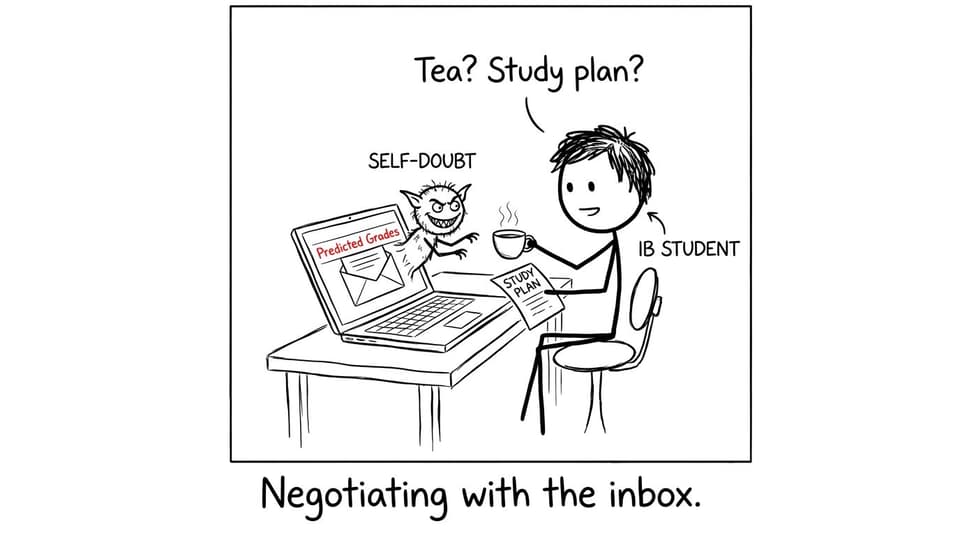
Negotiating with the inbox
The calm checklist (do this before you change anything)
Before you rewrite your whole life, run this short IB checklist. You are trying to replace panic with information.
Write down your predicted grades by subject (HL and SL), plus TOK and EE.
Ask: is the gap one subject or many?
Identify what evidence your teachers used (mock exams, in-class tests, IA progress, participation).
Check deadlines: when are predicted grades finalized at your school?
Decide your priority: raise predictions, raise final performance, or both.
Build a 2-week plan you can actually repeat.
If you want a clean way to translate where you are into points and priorities, use the IB Grade Calculator to see how changes in one subject can shift your overall IB total.
Why you missed your predicted grades (without making it personal)
The IB has a sneaky feature: it rewards consistency more than intensity. Many students revise hardest when fear arrives, but predictions are often based on months of smaller signals.
Here are the most common reasons IB students miss predicted grades:
Your evidence set is smaller than your potential
A teacher can only predict what they can defend. If you had one rough mock, one missed unit test, or an IA draft that was late, that becomes the story.
Your strengths are not "exam-shaped" yet
You might understand content, but lose marks on command terms, structure, or timing. The IB is strict about how knowledge is presented.
You are studying a lot, but not closing loops
If revision is mostly rereading notes, it can feel productive while producing little improvement. In the IB, improvement usually comes from feedback loops: attempt, mark, diagnose, redo.
RevisionDojo is built around that loop: Study Notes for clarity, Flashcards for recall, Questionbank for application, then AI Chat and grading tools to diagnose what went wrong.
What to do in the next 48 hours (the "stabilize" phase)
The fastest way to recover in the IB is to stop trying to recover emotionally first. Start operationally.
Ask for the marking rationale in writing
Send a short, respectful message to each teacher:
What evidence did you use for my predicted grade?
What are the next two assessments that could change it?
What would a "grade higher" performance look like, specifically?
This turns a vague disappointment into a measurable target.
Run a mistake audit, not a motivation speech
Pick one subject where you missed your IB predicted grade. Do:
30-45 minutes of timed questions (not open-book)
Review with a mark scheme mindset
Categorize errors into: knowledge gap, method gap, or exam technique gap
If you want the most efficient way to do this daily, the Comprehensive IB Question Bank breakdown shows exactly how targeted practice is supposed to work.
Protect your sleep like it is part of the syllabus
Sleep is not a reward for finishing work. In the IB, it is the infrastructure that lets you learn from work. If you reduce sleep, you often reduce the very gains you are chasing.
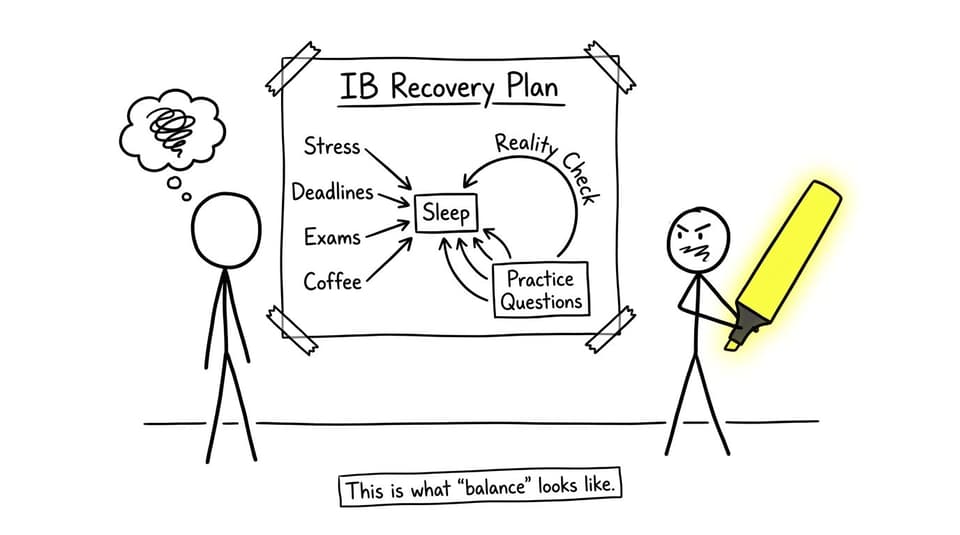
IB Recovery Plan flowchart
How to raise your IB performance quickly (the "leverage" phase)
Not every hour of study moves your grade equally. The goal is leverage: changes that produce visible marks.
Use "mark-heavy topics" to rebuild confidence
In most IB subjects, a few topic clusters account for a lot of marks. Do not avoid them because they feel hard. Start there because they are efficient.
Get feedback that is specific enough to change behavior
"Revise more" is not feedback. "Explain the assumption before substituting values" is.
Use RevisionDojo's AI Chat to interrogate your errors: ask why a mark scheme awards a point, what alternative phrasing works, or which step you skipped. Then use the Grading tools to check whether your revised answer would earn marks.
Train stamina with realistic simulations
A common reason IB students miss predicted grades is not knowledge. It is running out of time, misreading, or losing structure under pressure.
The goal is not to negotiate your IB predicted grade like it is a price tag. The goal is to show new evidence.
Bring a one-page "evidence update"
After two weeks, bring:
A list of timed practice sets you completed
Your error categories and what changed
One improved response with annotations
Teachers respond well to students who reduce their workload. When you bring organized evidence, you make it easier for them to justify a change.
Ask for a conditional pathway
Try:
"If I score X on the next timed essay/mock, would you consider updating my prediction?"
This gives you control. It also turns the situation into a fair test.
Use a tutor strategically, not emotionally
If you are stuck in one subject, a few focused sessions can break a plateau.
RevisionDojo's Tutors are most useful when you arrive with your error audit and a clear goal (for example: improve Paper 2 structure, fix data-based questions, or tighten evaluation). That is how you turn help into points.
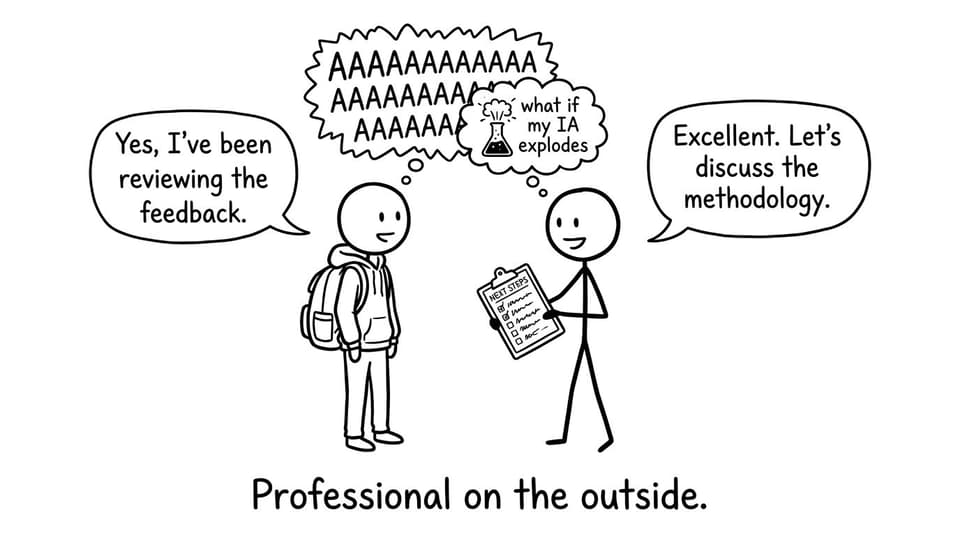
Professional on the outside
A practical 14-day IB recovery plan
This is a simple cycle many IB students can sustain without burning out.
Days 1-3: Diagnose
One timed set per day in your weakest subject
Review errors and tag them by type
Read the relevant RevisionDojo Study Notes sections
Days 4-10: Rebuild
Daily Flashcards (10-15 min)
4 practice blocks in the Questionbank (45-60 min)
1 writing session (essay, lab analysis, or structured response)
Closing: the IB is a long game, but your next step is small
Missing your predicted grades can feel like a verdict. In reality, it is information: a teacher's best estimate based on the evidence available at that moment.
Your job now is to create new evidence. Calm evidence. Timed evidence. Repeatable evidence. That is how IB students turn a disappointing prediction into a different ending.
If you want one place to run the whole turnaround, RevisionDojo is built for it: Study Notes to clarify content, Flashcards to make recall automatic, Questionbank to build exam skill, Mock Exams and Predicted Papers to train stamina, AI Chat and Grading tools to tighten feedback, a Coursework Library to learn from strong examples, and Tutors when you need a human to unlock a specific problem.
Start with one subject today. Run the 14-day plan. Then check your trajectory with the IB Grade Calculator. In the IB, momentum is not a personality trait. It is a system.