


The night before IB results day, your brain will try to time travel
There's a particular kind of quiet that shows up the evening before IB results day. It isn't peace. It's suspense.
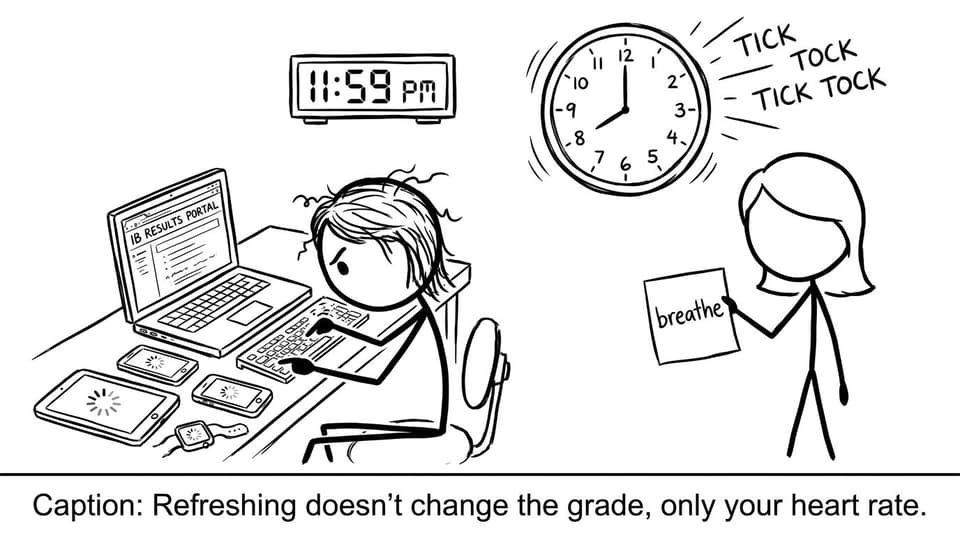
Students often say they feel "weirdly calm," which usually means their brain is saving its energy for a sprint at 11:59. Parents often say they "don't want to say the wrong thing," which usually means they're rehearsing lines that sound supportive but land like pressure.
The truth is: IB results day is not only about numbers. It's about interpretation, communication, and what happens in the next 24 hours. The point is not to feel nothing. The point is to make good decisions while feeling a lot.
To do that, you need a plan that is boring enough to work.
The IB results day checklist (print this mentally)
Here's a short checklist for IB students preparing for exams (and the parents supporting them) to keep results day clean and calm:
- Confirm you can access the IB candidate portal login details before the day.
- Agree on where you'll check results (and who will be present).
- Decide one sentence you'll say no matter what (a "neutral opener").
- When results appear: write them down accurately before reacting.
- Check diploma status, subject grades, and TOK/EE core points.
- If results affect university offers: draft one short email the same day.
- If results disappoint: request component marks and ask about remark options via your coordinator.
- Within 48 hours: make a simple next-step study plan using RevisionDojo tools.
If you want a student-focused walkthrough alongside this parents' guide, keep this tab open: What Should I Do on the IB Results Day? A Step-by-Step Guide.
What parents should actually do on IB results day
Most parents have the same hidden goal: reduce stress without reducing ambition. That's harder than it sounds, because IB results day compresses months of effort into a single screen.
Here are three roles that help.
Be the "tempo"
On IB results day, the student's nervous system sets the tone. But parents can set the tempo. Tempo means slowing the moment down enough to think.
A practical script:
- "Let's read it carefully first."
- "Let's write down the numbers."
- "Then we'll decide what to do next."
This matters because many students misread under stress. A 6 becomes a 5. A total becomes a subject grade. A core point gets missed. The IB interface is not designed for emotional clarity.
Be the "translator," not the judge
Students don't need instant judgement. They need interpretation.
Parents can help translate:
- What the total score means for the diploma
- Which specific subjects are near a boundary
- What options exist (remark, retake, alternative entry, gap year)
RevisionDojo has a calm, practical article for worst-case feelings: IB Results Day: What If Everything Goes Wrong?. It's written like a checklist, not a lecture.
Be the "boundary keeper"
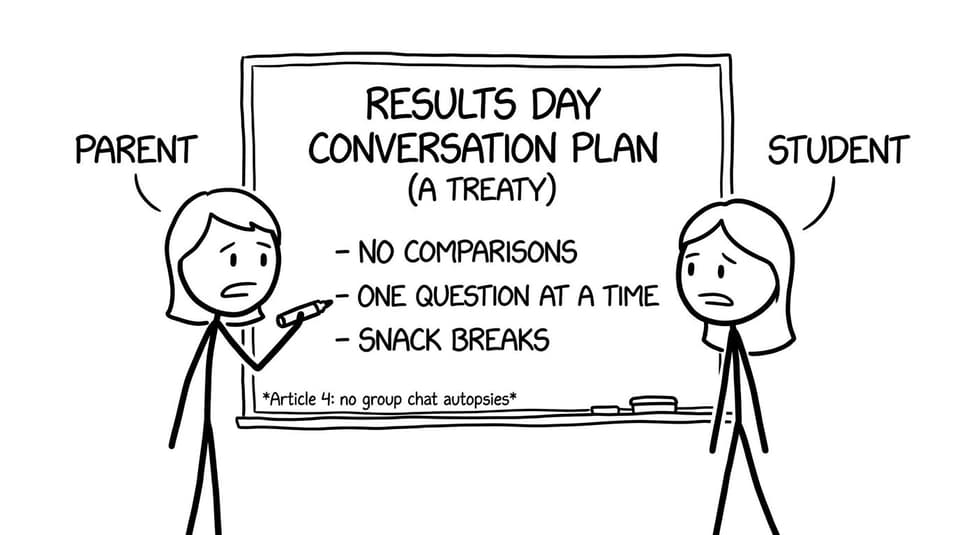
The most dangerous part of IB results day is the social layer: group chats, comparison totals, and the temptation to turn a personal outcome into a public performance.
A parent who gently enforces boundaries is doing real work.
Try:
- "Let's pause before posting anything."
- "Mute chats for an hour."
- "We can tell people later, on purpose."
What students should do on IB results day (even though this is "for parents")
Because you're the one living it.
Read the whole statement, not just the headline number
On IB results day, your attention will want to snap to the total points out of 45. But the useful information is spread out:
- Six subject grades (1-7)
- HL/SL distribution
- TOK and EE grades and core points
- Diploma awarded status
If you want the timing and what-to-expect details, use: IB Results Day 2025: Exact Date, Key Timings, and What to Expect.
Take a screenshot, then take a breath
Evidence first. Emotion second.
Write your results in a notes app or on paper too. It prevents the "did I imagine that?" loop that happens when adrenaline is high.
Then do a 10-minute pause. No calls, no group chat autopsies, no doom scrolling.
Decide which story you're telling yourself
This is where Morgan Housel's idea shows up: the story is often louder than the facts.
Two students can get the same IB score and experience it completely differently depending on expectations, offers, family context, and what they think it "means."
Your job is to separate:
- Facts (grades, totals, requirements)
- Meaning (what you think it says about you)
- Next steps (what creates options)
Meaning can wait. Next steps can't.
If the IB results are better than expected
Celebrate, but stay smart.
- Confirm university steps (some institutions receive results automatically, some require action).
- Save the statement of results.
- Thank the people who helped you.
- Then rest. Your brain has been sprinting for months.
If you want to reflect without spiraling, RevisionDojo has broader exam-season guidance that still applies after results: What No One Tells You Until After IB Exams.
If the IB results are disappointing (the calm, effective path)
Disappointment is not the problem. Confusion is.
Step one: get the facts from your coordinator
Ask for:
- Component marks
- How close you are to the next grade boundary
- Deadlines and costs for an enquiry upon results
- Whether a retake session is feasible for your goals
A parent can help here by keeping the questions specific. Vague panic burns time.
Step two: protect optionality
Optionality is a finance word that matters on IB results day. It means: keep doors open.
If university offers are involved, draft a short email that is factual, polite, and proactive. If you need a template-like process, start with: What Should I Do on the IB Results Day? Survival Guide.
Step three: rebuild confidence with evidence, not motivation
If you're retaking or re-entering exams, the fastest way to stop feeling helpless is to do one small session that proves you can improve.
This is where RevisionDojo becomes practical, not inspirational:
- Use the Questionbank to drill the exact topics that lost you marks: Comprehensive IB Question Bank: Thousands of Practice Questions.
- Use Study Notes to rebuild understanding without rewriting your life: Digital IB Study Notes: Access Anywhere, Anytime.
- Use Flashcards for daily recall so you don't reset to zero.
- Use AI Chat to fix misconceptions fast, while the question is still alive in your mind.
- Use Grading tools to learn what the markscheme rewards in your written responses.
- Use Mock Exams and Predicted Papers to make timing feel normal again: Online IB Mock Exams: Practice Anywhere, Anytime and IB Predicted vs Specimen Papers: What They Mean.
- Use the Coursework Library when coursework uncertainty is feeding your stress.
- Use Tutors when you need a human diagnosis and a steady plan.
A simple "results day to next week" plan (for parents and students)
The best IB results day plan is the one that avoids drama and creates traction.
Same day (0-6 hours)
- Write down results and save evidence.
- If needed, contact coordinator for component marks and deadlines.
- If needed, email universities with a short factual update.
Next 48 hours
- Decide: enquiry upon results vs retake vs accept-and-move-on.
- Choose the smallest set of actions that creates the biggest change.
Next 7 days
Run one loop per subject you might revisit:
- 20 minutes of RevisionDojo Study Notes on a weak area
- 25 minutes of Questionbank practice on that same area
- 10 minutes turning mistakes into Flashcards
- 1 short timed block using Mock Exams (even a section)
If you want a structured revision system that works whether you're celebrating or rebuilding, this guide is worth bookmarking: How to Study for IB Exams: Step-by-Step Guide.
Closing: IB results day is a snapshot, not a sentence
A snapshot can be useful. It can show you what worked, what didn't, and what you might do differently. But a snapshot is not a full biography.
On IB results day, the healthiest families do something simple: they keep the moment small and the future wide. They read carefully, they talk calmly, and they focus on actions that create options.
If you're an IB student preparing for exams (or preparing for a retake, or just preparing to feel normal again), RevisionDojo is built for the next chapter: Questionbank, Study Notes, Flashcards, AI Chat, Grading tools, Predicted Papers, Mock Exams, Coursework Library, and Tutors in one place.
Start with the hub and build your plan from there: RevisionDojo for IB.