The night before IB results day feels louder than it should
If you have ever watched a student "rest" the night before IB results day, you know the kind of quiet that isn't actually quiet.
There's the phone face-down, then face-up. The laptop "just to check the login," again. The group chat that keeps turning into a scoreboard. The casual joke that lands like a warning: "If it's bad, I'm literally moving to the woods."
On results day, students aren't only waiting for numbers. They're waiting for what those numbers will mean in a family, in a friend group, and sometimes in a university offer. Your job as a parent is not to manufacture confidence or say the perfect line. Your job is simpler and harder: reduce chaos, create safety, and help your student make one good decision at a time.
This guide is written for IB students preparing for exams, but it's also for the parents who love them. It's a way to turn results day into something manageable.

A quick IB results day support checklist (parents can screenshot)
Keep this small. Results day is not the day for a "family strategy retreat."
- Confirm your student can access the IB candidate portal login details in advance.
- Agree on where they'll open results (private, calm, no audience).
- Decide whether they want you in the room, nearby, or not present.
- Prepare two scripts: one for "I'm proud of you," and one for "We'll figure it out."
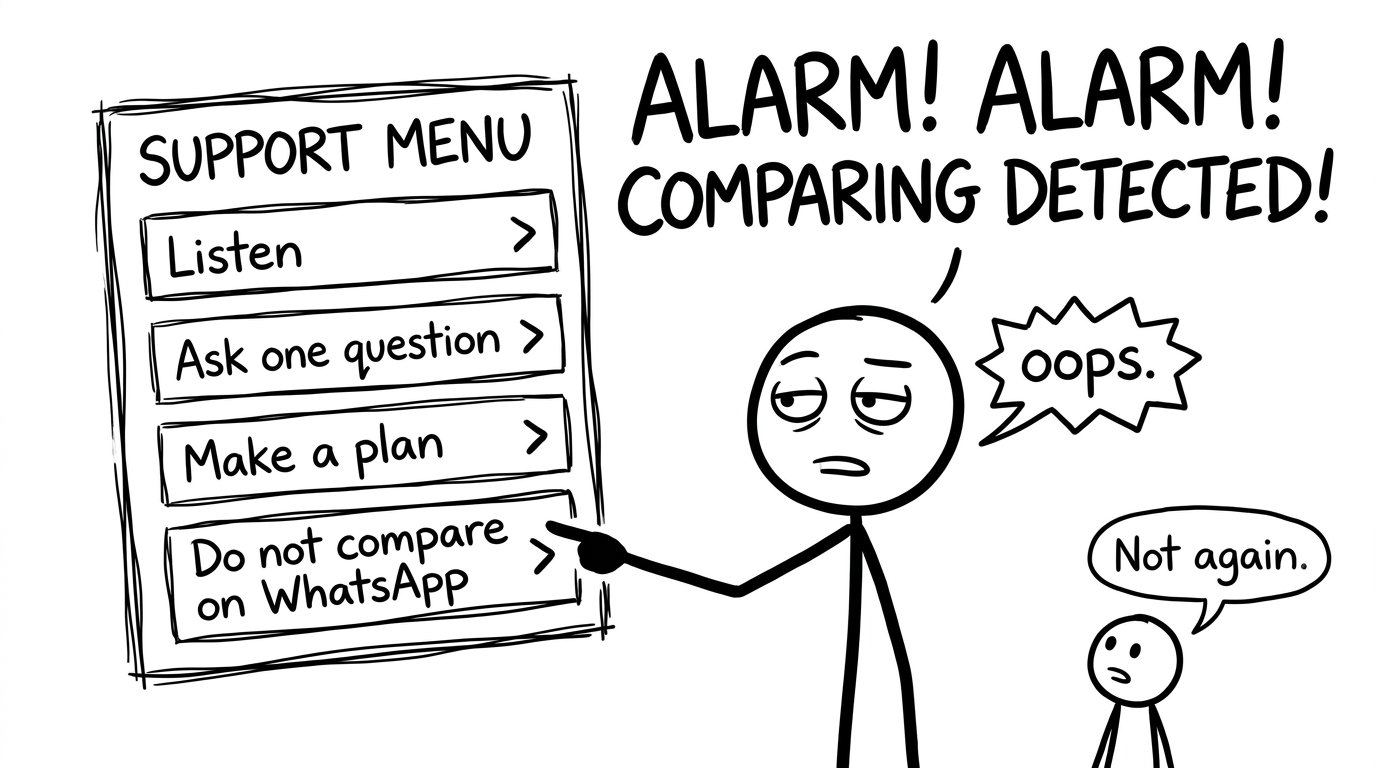
- Avoid comparisons (friends, cousins, classmates, school averages).
- If university offers matter, draft a calm email template ahead of time.
- After results, focus on facts first: points, subject grades, diploma status, core points.
- If needed: contact the IB coordinator about component marks, boundaries, and options.
- If rebuilding is required: choose one next action that creates options (not panic).
For the student-side logistics, this RevisionDojo guide is a helpful companion: What Should I Do on the IB Results Day? A Step-by-Step Guide.
Why IB results day hits so hard (even for strong students)
The IB is unusually narrative-heavy. Students don't just say, "I finished exams." They say, "I survived two years." So results day feels like a verdict on endurance, identity, and effort.
It also compresses time. A student can go from "maybe I'll be fine" to "I need a new plan" within minutes. That fast emotional swing is normal. What matters is what happens in the first hour.
Parents often accidentally add pressure by chasing certainty:
- "What do you think you got?"
- "Should we call your grandparents?"
- "Is the university going to accept you?"
These questions make sense. They also turn the moment into an interrogation. The better move is to help your student slow the moment down.
Before results: set the conditions for calm
Make the login boring
The best results day is the one where nothing technical becomes symbolic.
Ask your student (a day or two before) to do the dull things: check the portal link, confirm the code/PIN, and note the timing. RevisionDojo has a clear walkthrough here: How to Check Your IB Results Online (Step-by-Step).
Also helpful for expectations: IB Results Day 2025: Exact Date, Key Timings, and What to Expect.
Agree on privacy rules
Some students want a parent beside them. Others want space, then a debrief. Either is fine.
A simple script you can offer:
- "Do you want me in the room, in the next room, or out?"
- "Do you want a hug, food, or silence first?"
- "Do you want to tell anyone today, or wait?"
The hidden gift here is control. IB results day steals control. Give some back.
Pre-write the "if it goes wrong" plan
This is not pessimism. It's emotional insurance.
If your student is worried, share this calmly: "Let's assume we might need a next step. We won't decide today, but we'll know what options exist."
RevisionDojo's article is useful for understanding the practical pathways: IB Results Day: What If Everything Goes Wrong?.
On IB results day: what supportive parents actually do
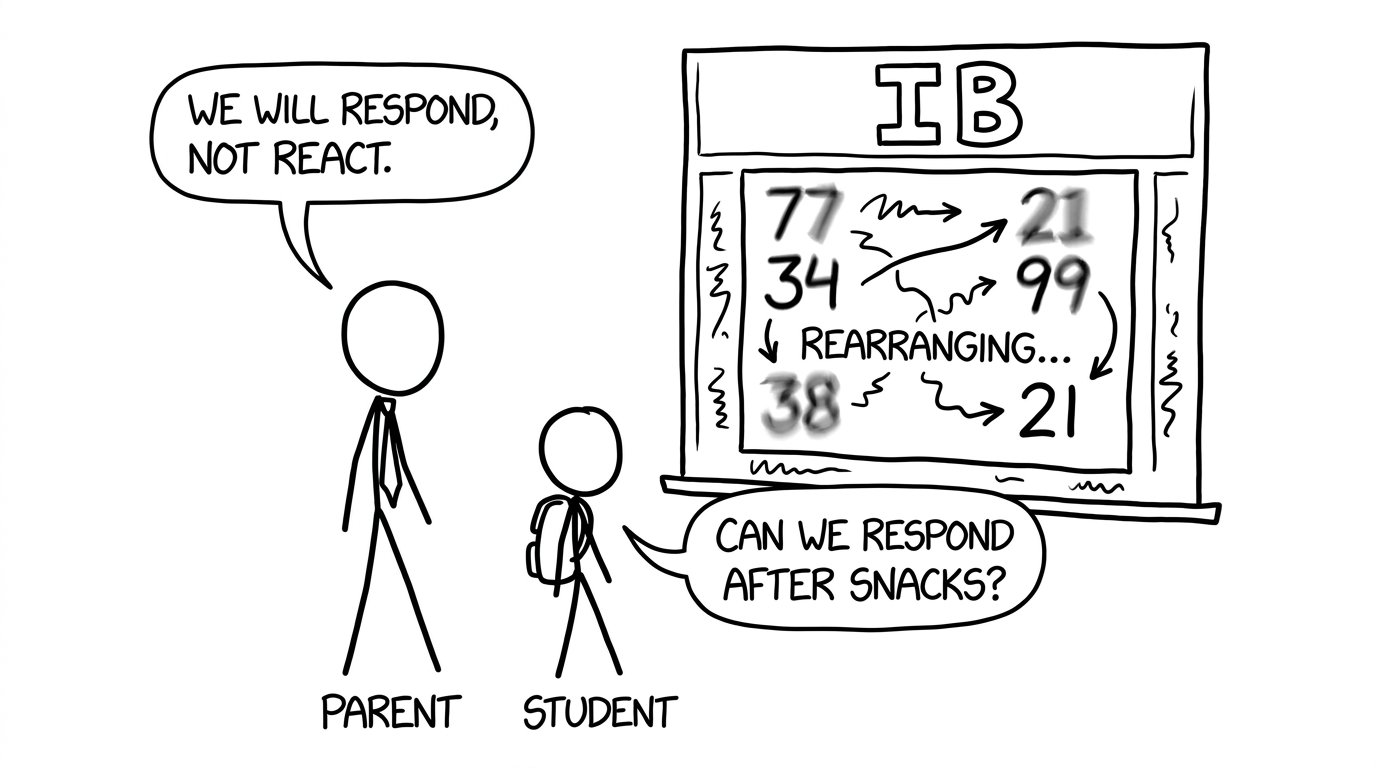
Start with response, not reaction
When the numbers appear, your student's nervous system will look to yours.
That doesn't mean you must be emotionless. It means you should be steady. Say one of these, slowly:
- "Thank you for telling me. I'm here."
- "I love you. This doesn't change that."
- "Let's take ten minutes, then we'll look at it together."
Then stop talking.
Help them read the results correctly
IB results can look simple and still be confusing under stress. Parents can anchor the first read-through.
Ask your student if you may sit with them and write down:
- Total points (out of 45)
- Each subject grade (1 to 7)
- TOK/EE grades and core points
- Diploma status
This "write it down" moment sounds small. It prevents the most common spiral: doom-scrolling the page and mentally rewriting the outcome every 30 seconds.
Protect them from comparison for 24 hours
Comparison is not information. It's emotional noise.
Group chats on results day are not built for nuance. They're built for highlights and panic. If your student can mute them for a day, that is a form of self-respect.
If you want a clean, practical explanation of timing and why schools see results earlier, point them here: Do Students See IB Results Before Schools? Timing Explained.
Ask only one useful question
Parents often ask ten questions because they are anxious. Students hear ten questions as ten new responsibilities.
Pick one:
- "Do you want comfort right now, or do you want a plan?"
If they say comfort, your task is presence and food. If they say plan, your task is structure.
If the IB results are better than expected
Celebrate. But celebrate in a way that keeps your student human.
Try:
- "I saw how hard you worked when no one was watching."
- "What part are you most proud of?"
- "What do you want to do today that has nothing to do with school?"
Then, if university confirmation matters, help them do the boring admin. Great outcomes can still become stressful if students have to manage everything alone.
Also: avoid turning success into a new standard. Students who score high in IB often immediately feel pressure to keep being "the one who's fine." Let them rest.
If the IB results are disappointing: how parents create options
Disappointment on IB results day is not just sadness. It can be shame, fear, and humiliation bundled together. Parents can remove the shame by focusing on action.
Separate identity from outcome
Say this plainly:
- "These are results, not a definition."
- "We can be disappointed and still be okay."
- "Let's learn what happened before we decide what it means."
A student may argue. That's fine. Keep the tone calm.
Get the facts (with the IB coordinator)
If the result affects diploma status or a conditional offer, contact the school's IB coordinator quickly. Ask for:
- Component marks
- How close the student is to the next grade boundary in key subjects
- Deadlines and costs for any remark process
- Retake registration timelines and policies
Your role is not to negotiate the universe. Your role is to help your student replace panic with information.
Create a "two-week evidence plan"
If a retake or rebuilding is on the table, the student needs evidence that improvement is possible. Evidence beats reassurance.
RevisionDojo is built around this kind of loop. The story many students live after IB results day is: "I don't know where I lost marks, so I don't know how to fix it." RevisionDojo turns that into a workflow:
- Study Notes to rebuild understanding without rewriting everything
- Flashcards to keep recall alive daily
- Questionbank to practice by topic with immediate feedback
- AI Chat (Jojo) to fix misconceptions fast
- Grading tools to improve written responses and coursework drafts
- Mock Exams and Predicted Papers to make timing feel normal
- Coursework Library to see what strong work looks like
- Tutors when you need a human plan, not just motivation
If your student needs a reset, start here: RevisionDojo App: The Smarter Way to Prep for IB Exams.
And for practice structure: Comprehensive IB Question Bank: Thousands of Practice Questions.

What parents can say (and what to avoid) on IB results day
Phrases that usually help
- "You don't have to perform your feelings for me."
- "We can take this one step at a time."
- "Let's not tell anyone until you choose."
- "Tonight is for recovery. Tomorrow is for decisions."
Phrases that usually hurt (even if you mean well)
- "At least you passed." (Minimizes grief.)
- "But you studied so much." (Creates confusion and self-blame.)
- "Your friend got X." (Turns love into ranking.)
- "This is going to ruin everything." (Makes the future feel smaller than it is.)
The goal is not perfect language. The goal is to keep your student's mind from turning the IB into a life sentence.
A small results-day ritual that works
Parents often ask for a "script." Scripts fail because students are not robots.
Rituals work because they create predictability.
Try:
- Open results in private.
- Ten-minute pause afterward (walk, shower, breathe, sit silently).
- One debrief question: "Comfort or plan?"
- If plan: write the next three actions on paper.
That paper matters. It's the first proof that the day didn't win.
FAQ: Parents supporting students on IB results day
Should parents be in the room when students check IB results?
It depends entirely on the student, not on what looks supportive from the outside. Some IB students feel grounded when a parent is physically present, because it reduces the feeling of facing judgment alone. Others experience an observer as pressure, even if the parent says nothing, because it turns a private moment into a performance. The best approach is to ask the day before and to make it easy for them to change their mind. You can offer three options: in the room, nearby, or available later, and treat each as equally valid. If you are in the room, your job is to be quiet first, then kind, and only then practical.
What should parents do if the IB results threaten a university offer?
Start by slowing the situation down so your student can think clearly, because panic leads to rushed messages and unnecessary shame. Then focus on facts: what the offer requires, what the student achieved, and what the university policy says about near-misses and appeals. Many students benefit from drafting an email immediately while details are fresh, but sending it only after a calm review. Contact the school's IB coordinator to ask about component marks, boundary proximity, and timelines for formal processes, because universities often respond better when a student can explain the next step. Parents can help by proofreading, keeping the tone respectful, and ensuring the email is short and specific rather than emotional. Even when the answer is uncertain, prompt, professional communication creates options.
How can parents help an IB student who is embarrassed or shutting down?
Treat shutdown as protection, not disrespect. A student who feels embarrassed on IB results day is often trying to avoid being seen as "less than," and silence is the easiest shield. The most helpful move is to reduce demands: offer food, water, and space, then make one gentle point of connection like, "I'm here when you want me." Avoid forcing optimism, because it can feel like you're asking them to stop feeling what they feel. Later, when they are calmer, ask whether they want comfort or a plan, and respect the answer. If they choose a plan, start with one small action that creates evidence, like a short topic drill in RevisionDojo's Questionbank feature or a simple recall session using Flashcards, because progress is the fastest antidote to shame.
If a student plans to retake, how can parents support without becoming controlling?
Support works best when it protects consistency, not when it micromanages content. You can help your IB student by setting up the environment: quiet blocks of time, fewer distractions, and predictable routines that reduce decision fatigue. Ask them what kind of accountability they want, because the same check-in can feel caring to one student and suffocating to another. Encourage a system, not willpower: a loop of Study Notes, practice questions, feedback, and timed work, repeated weekly. RevisionDojo is designed to make that loop easier to run, especially when motivation is fragile, because tools like AI Chat, Grading tools, and Mock Exams reduce the time between effort and clarity. The healthiest parent posture is this: "I will fund time, space, and structure. You will own the work and the choices."
Closing: Make IB results day smaller, then make the next step real
IB results day is a single page of numbers that tries to impersonate a whole story.
Parents can break that spell. Not by denying disappointment, and not by inflating celebration, but by giving the day a shape: privacy, calm, facts, and one next step.
If your student needs to rebuild, the fastest way back to confidence is evidence: practice that produces feedback, and feedback that becomes a plan. RevisionDojo exists for exactly this moment, with connected tools like Questionbank, Study Notes, Flashcards, AI Chat, Grading tools, Predicted Papers, Mock Exams, the Coursework Library, and Tutors.
On IB results day, don't try to solve their entire future. Help them take the next honest step. Then take the next one.