
The night you plan to revise, you open your laptop… and somehow spend 40 minutes deciding what a “good practice paper” should even look like.
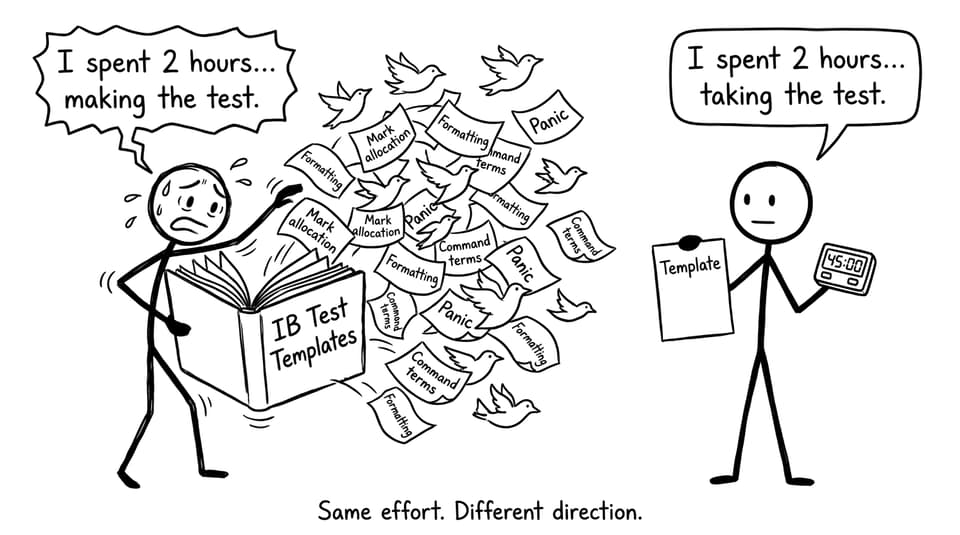
That hesitation is normal in IB season. Not because you’re lazy, but because building a realistic exam from scratch is secretly hard: correct structure, mark allocation, command terms, timing, and topic balance. IB test templates remove that friction. You start sooner, practice under pressure sooner, and improve sooner.
What are IB test templates (and why they work)
IB test templates are pre-made exam shells or full mock-style papers designed to reflect real IB paper structure. The point isn’t just “more questions.” It’s practicing the feel of the exam: the pacing, the instructions, and the decision-making when the clock keeps moving.
Used consistently, IB test templates help you:
-
Build timing instincts (minutes per mark becomes automatic)
-
Get familiar with IB command terms and question styles
-
Reduce anxiety through repetition and predictability
-
Turn revision into a loop: attempt -> feedback -> targeted fixes
If you want a bigger-picture routine around practice, pair templates with a weekly plan like How to Study for IB Exams: Step-by-Step Guide.
Quick checklist: using IB test templates the smart way
Before you start a template, run this fast checklist:
-
Choose one IB subject and one paper style you’re training today
-
Set a timer (strict, no pausing)
-
Keep only allowed tools on your desk
-
Finish the full template (or the chosen section)
-
Mark it immediately and write down 3 “mistake patterns”
-
Do a short follow-up drill set within 48 hours
That final step is where scores move. Templates create the pressure; your review creates the improvement.
Where to find high-quality IB test templates
Not all templates are equal. In IB, realism matters: structure, language, and difficulty need to feel like the exam you’ll actually sit.
Official IB specimen materials
Your school can usually provide official specimen exams. These are valuable because they show official structure, typical mark allocations, and the “voice” of questions.
Use specimen material when:
-
A syllabus has updated and you want the newest formatting
-
You’re learning what “good IB questions” look like
-
You want a clean reference for exam layout
RevisionDojo templates: faster practice with feedback loops
RevisionDojo is built for the exact problem most IB students face: you don’t just need practice, you need practice that’s structured, repeatable, and easy to review.
Here are a few ways students use RevisionDojo for IB test templates:
-
Build targeted exams using Test Builder
-
Drill weak areas with the free Questionbank
-
Patch understanding using Study Notes
-
Lock in recall with Flashcards
-
Use predicted exam-style practice via IB Predicted Papers
If you want a deeper walkthrough of building templates around your weaknesses, see How to Build Perfect IB Practice Tests for Your Weak Areas.
And if your current issue is “I practice a lot but nothing sticks,” this is a helpful reset: IB: I Study All Day but Remember Nothing.
How to use IB test templates to actually gain marks
The simplest way to waste a good IB template is to treat it like a one-off event. The best way is to treat it like training.
Use templates for pacing, not just difficulty
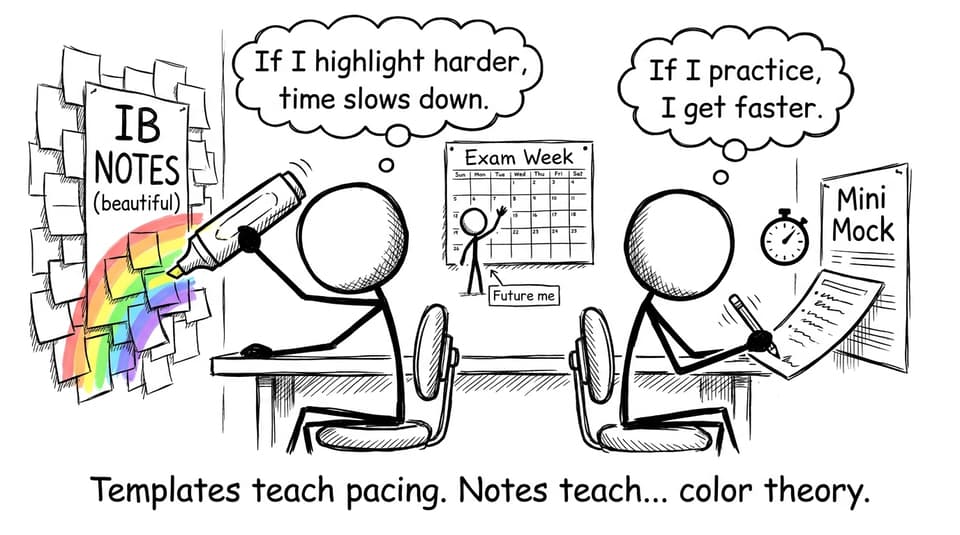
When you do an IB test template, you’re practicing decisions: when to move on, when to write a shorter answer, when to bank easy marks. Templates teach you what your brain does under time.
To tighten exam-day execution, keep this page bookmarked: IB Exam Day Checklist: The Ultimate Guide.
Review with precision (the “mark leak” method)
After each IB template, write:
-
One content gap (what you didn’t know)
-
One technique gap (what you did poorly even if you knew it)
-
One timing gap (where you over-invested time)
Then fix each gap with a specific RevisionDojo tool: Study Notes for clarity, Flashcards for recall, Questionbank drills for technique, Mock Exams for realism, and Tutors if you want human coaching on stubborn patterns.
FAQ
Are IB test templates reliable for exam preparation?
Yes, as long as the templates reflect real IB structure and you use them with feedback. The most reliable sources for format are official specimen materials, because they show the exact style and layout used in the IB. High-quality third-party templates can also be reliable when they mirror the same command terms, mark allocation logic, and paper pacing. The key is not just doing a template, but marking it properly and learning the marking logic behind your missed points. On RevisionDojo, that reliability comes from combining exam-style templates with tools like Questionbank practice and grading support. Over time, the template becomes less “a scary test” and more “a predictable routine.”
Can I use IB test templates for specific topics instead of full papers?
Yes, and it’s often the fastest way to improve. Full-paper templates build stamina, but topic templates build accuracy where you actually lose marks. The smart IB approach is to alternate: one timed template for realism, then a few smaller topic-focused templates to repair gaps. RevisionDojo’s Test Builder makes this easy because you can generate targeted sets by subject, level, and topic, then repeat them until the weakness stops showing up. After that, you can return to broader templates to make sure the improvement survives under time pressure. This “zoom in, then zoom out” cycle is how practice turns into points.
Do IB test templates come with mark schemes or feedback?
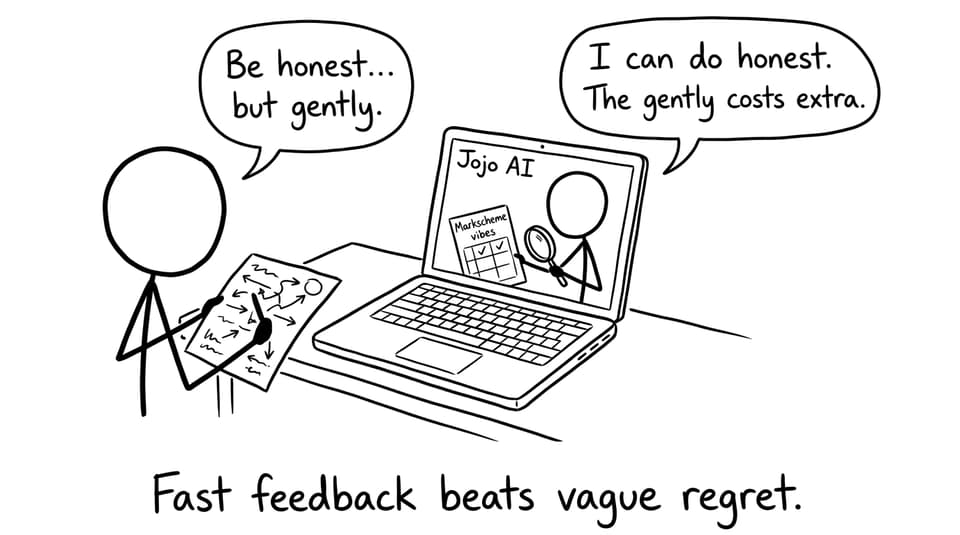
Sometimes. Official specimen materials often include mark schemes, but access depends on your school. With third-party templates, you should look for either mark schemes, model answers, or a feedback system that explains where marks are awarded and why they’re lost. RevisionDojo focuses on making feedback fast and usable: you can practice through the Questionbank, get support from AI Chat when you’re stuck, and use grading tools to understand the marking logic. The goal is to leave each IB template session with clear next steps, not just a score. If you finish a template and don’t know what to do next, feedback is the missing piece.
A calm way to practice more (without studying more)
The quiet power of IB test templates is that they remove decision fatigue. You don’t need to design practice; you just need to show up and take it.
If you want one place to run the full loop, including templates, Questionbank drills, Study Notes, Flashcards, AI Chat, Grading tools, Mock Exams, Predicted Papers, Coursework Library, and Tutors, RevisionDojo is built for exactly that. Pick one IB paper to train this week, start with a template, review the mark leaks, then rebuild your weakest points with targeted practice. That’s how “quick practice” becomes real progress.