
Starting the IB Diploma can make collaboration feel like an obvious solution. Six subjects, internal assessments, Theory of Knowledge, CAS, and an extended essay eventually compete for the same limited hours. Surely sharing the load should help.
It can. But an IB study group is useful only when it produces learning that would have been difficult to achieve alone. The best groups retrieve knowledge, explain difficult ideas, compare methods, and diagnose mistakes. The worst simply relocate procrastination from your bedroom to the library.
For an IB DP1 student, the goal is not to build the largest group. It is to create a small, dependable system that turns conversation into measurable progress.
The useful study group checklist
Before arranging the first session, use this checklist:
- Invite 3-5 students who will prepare and participate.
- Choose one subject or tightly defined topic.
- Set a 45-60 minute limit.
- Share two or three questions before meeting.
- Spend most of the session answering, explaining, or marking.
- Record unresolved questions rather than debating indefinitely.
- Finish with individual next steps.
A group that follows these rules may feel less social than an unstructured gathering. That is precisely why it works. Friendship can bring people together, but structure is what makes the hour valuable.
Choose people for reliability, not similarity
The person sitting beside you in class may be good company without being a good study partner. Those are different roles.
Look for students who arrive prepared, admit when they are confused, and can disagree without turning every discussion into a contest. A useful group also benefits from some variation. One student might explain Biology processes clearly, while another notices command terms or mathematical errors.
Avoid making the group too large. With eight people, it becomes easy to hide. With 3-5, everyone must think and speak. If someone repeatedly arrives without preparing, address it calmly. A study group should not become a free tutoring service provided by its most organised member.
Agree on three expectations at the beginning:
- Everyone attempts the material before the meeting.
- Everyone explains at least one answer.
- Everyone leaves with work to complete independently.
This is one of the most useful IB study tips for new students: protect the quality of the system before trying to increase its size.
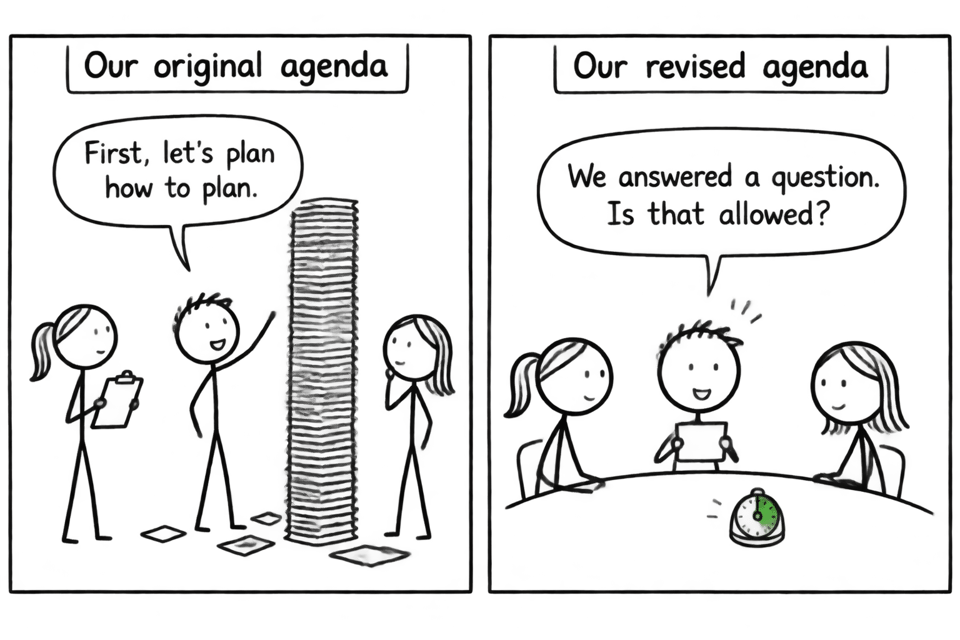
Three students discover that answering one question is more productive than planning how to plan.
Give every meeting one concrete outcome
“Revise Chemistry” is not an agenda. It is a hope.
A concrete outcome describes what the group will be able to do by the end. For example:
- Explain how competitive and non-competitive inhibition differ.
- Solve three Mathematics: Analysis and Approaches differentiation problems.
- Build two possible thesis statements for an English comparative response.
- Identify why each incorrect option in a multiple-choice question is wrong.
- Practise evaluating one Psychology study without reading prepared notes.
The distinction matters because broad topics encourage passive review. Specific outcomes encourage decisions. You can tell whether the work was completed.
Use resources before the meeting to establish a shared starting point. One student might select questions from the RevisionDojo IB Questionbank, while everyone reviews the relevant RevisionDojo Study Notes independently. The meeting can then focus on application rather than silently reading the same material together.
Use a repeatable 60-minute agenda
New groups often lose time because every meeting starts with a negotiation about what to do. A fixed agenda removes that decision.
| Time | Activity |
|---|---|
| 0-5 minutes | State the outcome and assign roles |
| 5-15 minutes | Complete a closed-book retrieval warm-up |
| 15-35 minutes | Solve or analyse the main questions |
| 35-50 minutes | Compare answers and explain disagreements |
| 50-57 minutes | Record errors and unresolved questions |
| 57-60 minutes | Set individual follow-up tasks |
Rotate three simple roles. The facilitator keeps the group on the question. The timekeeper protects the agenda. The recorder writes down misconceptions and questions that need checking. These roles are not positions of authority; they prevent useful minutes from disappearing.
If the group needs more time, schedule another session. Do not quietly turn a focused hour into an entire evening.
Study actively instead of sharing notes
Exchanging attractive notes can feel productive because everyone leaves with more pages. But possession is not understanding.
A stronger session requires each person to retrieve, apply, explain, or evaluate information. Try these methods:
Teach, challenge, repair
One student explains a concept without notes for two minutes. A second student asks a question or offers a counterexample. A third identifies what was missing. The original speaker then gives a repaired explanation.
In Economics, for instance, someone might explain how a price ceiling affects a market. The group can challenge the explanation by asking about shortages, stakeholder effects, and the assumptions behind the diagram.
Answer first, discuss second
Everyone completes the same question silently before any conversation begins. Compare reasoning only after each person has committed to an answer. This prevents the most confident voice from becoming the group’s answer before others have thought.
Questions from the RevisionDojo Questionbank and grading tools can support this routine. After comparing answers, use feedback to locate the missing step rather than merely checking whether the final response was correct.
Use flashcards in both directions
Do not let one student read every prompt while everyone else guesses aloud. Give each person several cards and require individual answers. Then reverse selected cards: start with the definition, example, or consequence and ask for the underlying concept.
The RevisionDojo Flashcards collection can provide a shared deck, but each member should mark difficult cards separately. A group can expose uncertainty. Individual review is what repairs it.
Make the group IB-specific
IB subjects ask students to do more than remember content. Command terms, argument quality, methodology, interpretation, and time management all influence the strength of a response. Your sessions should reflect those demands.
For Biology, compare two answers to the same data-based question and identify which statements are supported by the evidence. For History, give each student the same claim and ask them to challenge it using different perspectives. For English, compare thesis statements rather than trying to write one essay collectively. For Mathematics, require each student to explain why a method works and where an error entered the calculation.
Coursework requires firmer boundaries. You may discuss assessment criteria, clarify concepts, or exchange general planning methods when your school permits it. You should not write, rewrite, or supply another student’s assessed work. Follow your teacher’s instructions and your school’s academic integrity policy whenever you are uncertain.
RevisionDojo can support the distinction between practice and submitted work. Use RevisionDojo AI Chat and Coursework Library to clarify concepts, inspect examples responsibly, and generate questions for your own thinking. Grading tools can help you interpret feedback, while Tutors can provide individual guidance when a problem needs more attention than a peer discussion can offer.
Know when studying alone is better
Groups are excellent for explanation, debate, practice, and feedback. They are less effective for everything else.
Study alone when you need to learn unfamiliar content for the first time, memorise vocabulary, complete sustained writing, or repair a personal weakness. If one student struggles with stoichiometry and another struggles with organic chemistry, forcing both through the same hour may waste time.
The most efficient pattern is often cyclical:
- Learn or review independently.
- Test understanding with the group.
- Identify errors through discussion and feedback.
- Repair those errors independently.
- Retest later.
Near assessments, RevisionDojo Predicted Papers and Mock Exams can add realistic timed practice. Complete the work individually first. Use the group afterwards to compare methods, classify mistakes, and decide what each person should revisit.
A routine you can start today
You do not need a complicated schedule. Send this message to 2-4 classmates:
Would you like to try a 45-minute study session this week? We will each answer two questions on one topic beforehand, compare our reasoning, and finish with one individual follow-up task.
Then do the following:
- Pick one topic taught during the last two weeks.
- Choose three practice questions.
- Set a date, location, and firm finishing time.
- Ask everyone to bring one point they cannot yet explain.
- Use the 60-minute agenda, shortened proportionally if needed.
- Schedule another meeting only if the first one produces useful work.
The value of an IB study group is not measured by how often it meets. It is measured by what becomes clearer because it met.
RevisionDojo brings the Questionbank, Study Notes, Flashcards, AI Chat, grading support, Predicted Papers, Mock Exams, Coursework Library, and Tutors into one learning system. That makes it easier to arrive with a question and leave with a next step. To begin simply, save the flashcard deck for your current topic to your free account. It gives your group a shared starting point while preserving the individual review each student still needs to do.