

A new anthropology student can understand every sentence in an ethnography and still produce a weak response. The problem is rarely intelligence or effort. Understanding what happened is not the same as analyzing it anthropologically.
That gap causes many IB Social and Cultural Anthropology first term struggles. Students arrive ready to discuss culture, identity, power, and belief. Then they discover that personal reactions and broad social commentary are insufficient. The course expects precise ethnographic evidence connected to anthropological concepts, methods, ethics, context, and the anthropologist's position.
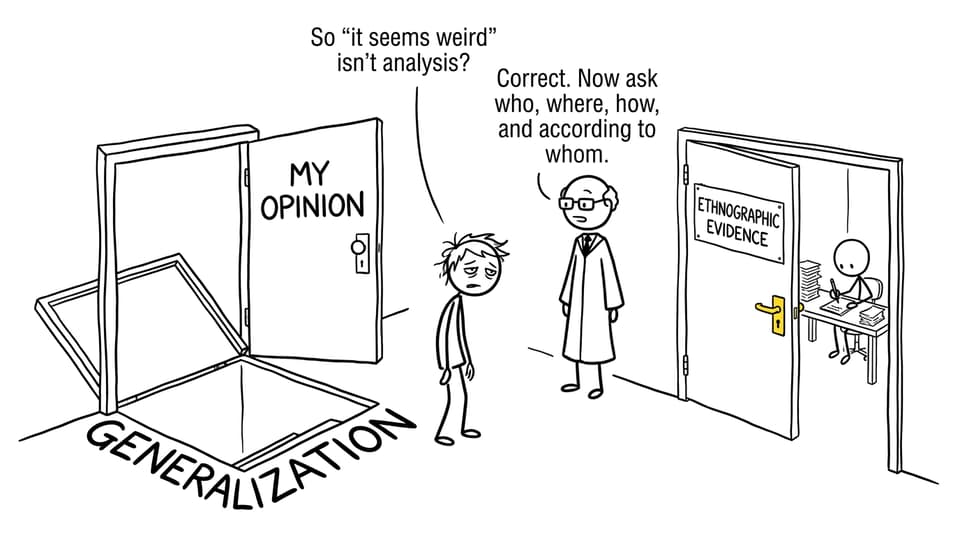
The biggest adjustment is moving from opinion and description to evidence-based anthropological interpretation. You do not need to master that shift immediately, but you should practise it deliberately from the first term.
The first-term adjustment checklist
Use this checklist whenever you read an ethnography or prepare a response:
- Identify the people, place, practice, and context.
- Record concrete evidence rather than only the main theme.
- Connect that evidence to one relevant anthropological concept.
- Explain what the evidence suggests, not merely what occurred.
- Consider how the researcher collected and interpreted the information.
- Note any ethical issue, limitation, or alternative perspective.
- Avoid presenting one community as representative of an entire culture.
The IB Social and Cultural Anthropology resource hub can help you connect vocabulary, ethnographies, and writing instead of treating them as unrelated tasks.
Why anthropology feels different at first
In some subjects, students can learn content first and add evaluation later. Anthropology resists that separation because how knowledge was produced is part of the knowledge itself.
The official IB subject brief places ethnographic material at the heart of the course. Students must use ethnographic examples in arguments, analyze methods and ethics, apply concepts, and consider the anthropologist's viewpoint. HL adds theoretical interpretation, but the foundational shift is similar at both levels.
Imagine reading that members of a community exchange gifts during a ceremony. Description reports who exchanged what. General commentary says gift-giving strengthens relationships. Anthropological analysis uses details from the ethnography to examine how exchange creates obligations, expresses identity, redistributes status, or reproduces power in that particular context.
The reasoning follows a simple chain:
Evidence → concept → interpretation → qualification
Students often begin with the concept instead. They decide that a passage is "about power" and repeat the word power. That is labeling. Stronger work explains how a practice creates, challenges, conceals, or negotiates power.
Build notes that preserve usable evidence
Ordinary chapter summaries often erase the details needed for analysis. Notes saying "identity is important" may feel efficient, but they provide little usable evidence.
Create an evidence record for each significant ethnographic example. Include:
- Context: community, location, period, and relevant conditions
- Practice: what people did, said, exchanged, avoided, or contested
- Concept: identity, symbolism, materiality, power, or another justified lens
- Meaning: how participants understood the practice
- Method: observation, participation, interview, or visual material
- Researcher position: how access, identity, or relationships shaped the account
- Use: questions or arguments the example could support
This turns ethnographies from disconnected stories into evidence you can retrieve. RevisionDojo's IB revision notes can strengthen your conceptual foundation, while IB cheatsheets support quick review. Neither should replace your record of the ethnographic material assigned by your teacher.
Design Flashcards for application too. "Define symbolism" tests vocabulary. "How did one object acquire symbolic meaning in the ethnography?" tests the thinking the course requires.
Practise analysis in small paragraphs
Waiting for a full essay can leave uncertain evidence, vague concepts, weak structure, and limited evaluation tangled together. Instead, write one analytical paragraph at a time.
Start with a precise claim that fits the specific context. Introduce an observed action, statement, relationship, object, or interaction. Apply a concept as a lens, then explain what the connection reveals. Finish by acknowledging a methodological limitation, ethical tension, researcher perspective, or plausible alternative interpretation.
Use the RevisionDojo Questionbank and IB resources for retrieval and application rather than repeated rereading. Grading tools can help reveal whether a response makes a genuine analytical connection or only repeats terminology. Social and Cultural Anthropology coursework exemplars can also demonstrate how stronger writing connects claims, evidence, and interpretation.
AI Chat works best as a critic, not a substitute author. Ask Jojo AI to identify where your paragraph becomes descriptive, test whether a concept fits the evidence, or suggest a counter-question. The guide to using Jojo AI as an IB study assistant provides a practical starting point. Keep assessed ideas and final writing your own, follow school rules, and use AI transparently.
A realistic first-term routine
You do not need an elaborate revision system. You need a repeatable one. After each lesson, spend 20-30 minutes reviewing one concept, recording one detailed ethnographic example, creating two application-focused Flashcards, and writing one evidence-to-concept sentence from memory. Add one question about methods, ethics, or researcher position.
Once a week, write a complete analytical paragraph. Seek teacher feedback, discuss it with a Tutor, or use a Grading tool to diagnose its structure. At the end of each month, complete a short timed Questionbank response and compare it with your earlier writing.
Predicted Papers and Mock Exams become useful when you need sustained timing and broader synthesis. During the first term, targeted practice matters more. Study Notes establish meaning, Flashcards strengthen retrieval, the Questionbank develops application, and AI Chat or Tutors help diagnose thin interpretations.
What to do if you feel behind
Do not rewrite every note. Choose one ethnography and rebuild your understanding around three strong examples. For each, identify its context, concept, interpretation, method, and limitation. Then write three short paragraphs using different concepts.
If concepts remain vague, return to focused notes. If you understand them but cannot apply them, prioritize questions and paragraph practice. If your writing is fluent but unsupported, rebuild your evidence records. The guide to effective IB practice resources can help turn that diagnosis into a targeted study loop.
The adjustment becomes the advantage
Anthropology asks you to question shortcuts that make ordinary conversation easy. "That culture believes" becomes too broad. "The researcher discovered" becomes too certain. "This proves" demands qualification.
That discomfort is the beginning of anthropological thinking. Build the habit of moving from evidence to concept, then from interpretation to reflection. RevisionDojo's Questionbank, Study Notes, Flashcards, AI Chat, Grading tools, Predicted Papers, Mock Exams, Coursework Library, and Tutors support each stage. The goal is not to sound complicated. It is to observe carefully, argue precisely, and become slower to mistake assumption for understanding.