



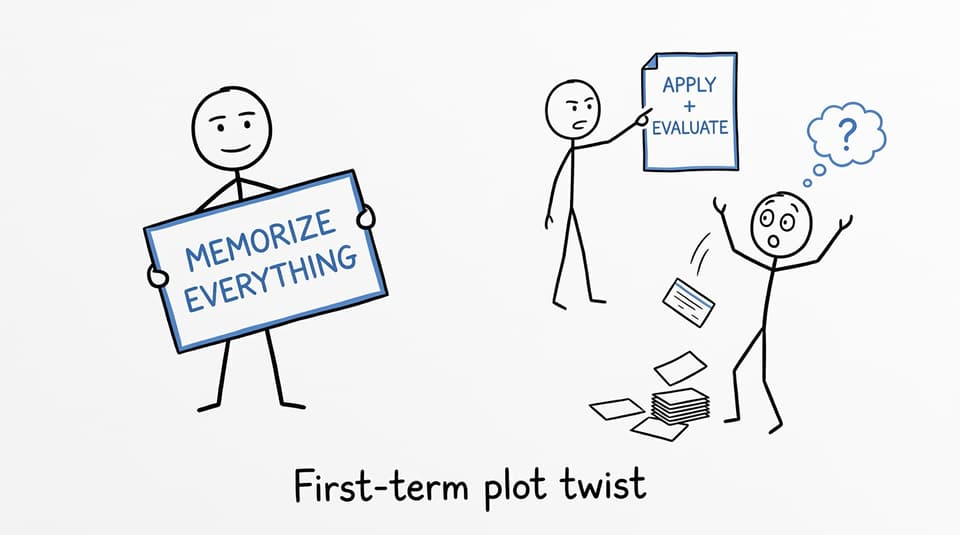
The biggest adjustment shock in IB Psychology is not the volume of material. It is discovering that knowing the material does not automatically mean you can answer a Psychology question well.
Many new students expect a memory subject. They learn definitions, researcher names, theories, and findings. Then a written response asks them to apply a concept, select evidence, or evaluate a conclusion. Suddenly, accurate notes feel less useful than expected.
This is the source of many IB Psychology first term struggles: the course rewards a chain of thinking, not a pile of facts. You need to understand a claim, choose relevant research, explain the connection, examine its limits, and return to the question. That process can be trained from the first few weeks.
The first-term adjustment checklist
If you are adjusting to IB Psychology, concentrate on these habits:
- Confirm that you are following the revised course pathway used for first assessment from 2027 onward.
- Learn concepts and studies as connected units.
- Record what each study supports and what it cannot establish.
- Practise applying knowledge to unfamiliar situations every week.
- Explain why a methodological limitation affects a conclusion.
- Write short responses before attempting polished essays.
- Use feedback to identify one weakness, then rewrite.
Your teacher or IB coordinator remains the best source for your school's sequence. RevisionDojo keeps the pathways separated in its IB Psychology resource hub, while the guide to IB Psychology curriculum changes explains the wider changes in content and assessment.
Why memorization stops feeling sufficient
Psychology contains theories, concepts, methods, ethical considerations, procedures, and results. It is natural to assume that collecting more details will produce better answers.
Recall, however, is only the first layer. The revised IB course develops knowledge and understanding, application and analysis, and synthesis and evaluation. A student may remember a study accurately and still produce a weak response if it is not connected to the precise question.
Imagine learning an experiment on memory. You can recite the sample, procedure, and findings. When asked how context may influence a cognitive process, however, you simply retell the experiment. The information is correct, but its purpose is missing.
A stronger answer identifies the relevant finding, explains how it illustrates the process, considers whether the method supports the conclusion, and acknowledges uncertainty. That movement from description to reasoned use of evidence is the real first-term shock.
Build a study bank around relationships
A useful study bank should not read like a collection of miniature research reports. Each entry should help you answer a psychological question.
For every important study, record:
- The concept, theory, or claim it addresses
- The research aim and essential method
- The finding that matters for your argument
- The conclusion the evidence reasonably supports
- One methodological or ethical issue
- The consequence of that issue for interpretation
- Other questions where the evidence may be useful
The consequence is what beginners often omit. Writing "the sample was small" is not yet evaluation. Explain whether the sample affects representativeness, transferability, statistical power, or another specific feature of the conclusion.
The introduction to IB Psychology provides a map of the subject. Use Study Notes to clarify one narrow concept and Flashcards to retrieve its terminology and evidence. The aim is not to make enormous notes. It is to make relationships visible.
Use the concept, evidence, limit loop
A simple loop can turn knowledge into analysis.
| Step | Question to ask |
|---|---|
| Concept | What psychological idea directly answers the prompt? |
| Evidence | Which finding supports, challenges, or qualifies that idea? |
| Limit | What affects how confidently the evidence can be interpreted? |
First, explain the relevant concept or mechanism. Next, introduce only the study details needed to support your explanation. Finally, examine whether the method, measurement, sample, or design limits the conclusion. Add a sentence linking everything back to the prompt.
Practise this loop with short tasks in the IB Psychology Questionbank. Begin without a timer. Once the connection is clear, introduce gentle time limits. Speed should follow understanding.
Build a repeatable weekly routine
An effective early routine is small enough to repeat. A long weekend spent rewriting notes may feel productive, but it often strengthens recognition rather than independent recall.
Try this cycle:
- Learn: Read one focused section of Study Notes and identify its central claim.
- Retrieve: Close the resource and reconstruct the idea and evidence from memory.
- Apply: Answer one unfamiliar prompt or apply the concept to a scenario.
- Evaluate: Add one specific limitation and explain its consequence.
- Review: Use teacher feedback, AI Chat, or Grading tools to classify the problem.
- Rewrite: Produce a cleaner answer without copying the feedback.
- Retest: Return several days later with a different question.
This separates problems that students often confuse: missing knowledge, weak application, vague evaluation, unclear structure, and poor timing. A low mark does not reveal which one occurred. An error log can.
After each response, record one issue and one repair action. "Weak answer" is too broad. "I described the procedure but did not connect the result to the cognitive claim" gives you something concrete to change. The RevisionDojo Psychology review explains how notes, retrieval, questions, and feedback can work together.
Write early and treat methods as evidence
Do not postpone written practice until you feel fully prepared. Writing exposes missing connections that rereading can hide. Start by defining a concept precisely, explaining one relevant finding, linking it to a claim, and turning a generic limitation into a specific consequence. Then combine these components into longer responses using the guide to earning a 7 in IB Psychology.
Research methods should not sit in a separate mental folder. As you meet each study, ask how participants were selected, how concepts were measured, what the design permits researchers to conclude, and which biases may be present. Terms such as validity and generalisability become useful only when attached to an actual research decision.
Early in the course, the Questionbank is usually best for isolating one skill. Predicted Papers and Mock Exams become more useful after you have enough coverage to learn from timed performance. The Coursework Library can clarify structure and conventions, while Tutors can provide human guidance when the reasoning remains difficult.
What successful adjustment looks like
By the end of the first term, success does not mean knowing every possible study. It means your knowledge has become usable. You can identify a prompt's psychological demand, select relevant evidence, explain the relationship, and state what the evidence does not establish. That restraint is part of thinking psychologically.
The first surprise is that memory alone cannot carry you. The more encouraging discovery is that strong answers grow from repeatable decisions: learn narrowly, retrieve actively, apply deliberately, evaluate specifically, and rewrite after feedback.
RevisionDojo brings that cycle together through its complete IB Psychology coverage, including the Questionbank, Study Notes, Flashcards, AI Chat, Grading tools, Predicted Papers, Mock Exams, Coursework Library, and Tutors. Used purposefully, these resources can turn first-term confusion into a clear method for becoming a psychological thinker.