RevisionDojo was developed independently of the IBO and as such is not endorsed by it in any way.
The quiet reason IB Psychology feels harder than it looks
The first time most students meet IB Psychology, it feels strangely familiar. You already have opinions about memory, relationships, stress, and why people do what they do. Then the course asks you to take those opinions, hold them up to research, and defend them with evidence and evaluation.
That is the real shift in IB Psychology: you are not collecting “interesting facts.” You are learning how to think like a psychologist under exam conditions.
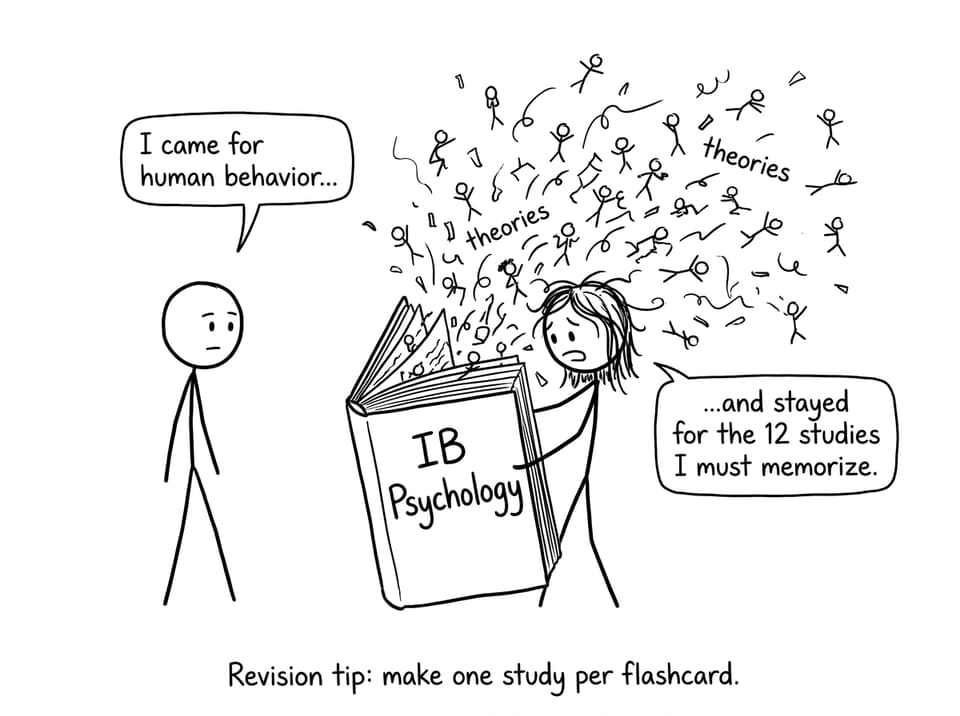
IB Psychology theories spilling out
If you want a syllabus-aligned home base while you revise, start with IB Psychology resources. It keeps your IB topics, practice, and feedback in one place.
IB Psychology at a glance (a quick checklist)
Before you dive into revision, anchor yourself with a simple overview of what IB Psychology expects:
Learn the three core approaches: biological, cognitive, sociocultural
Understand (and evaluate) research methods and ethics
For HL, add Paper 3 demands and optional topic depth
Practice SAQs and LAQs using real studies and tight structure
The core of IB Psychology: three approaches, one mindset
Biological approach (behavior has a body)
The biological approach asks how physiology shapes behavior: neurotransmitters, hormones, genetics, and brain regions. In IB exams, the marks often live in your precision: naming mechanisms clearly, linking them to behavior, and then evaluating the research quality.
The cognitive approach is where you learn to respect the gap between what we think happened and what actually happened. Memory models, biases, and decision-making are not just content. They are also testable claims, built from experiments you must describe and critique.
A practical IB revision rule: every cognitive concept should have at least one flexible study attached to it, plus one evaluation point you can reuse.
Sociocultural approach (behavior has a context)
Sociocultural psychology is where “common sense” is most tempting and most dangerous. The course wants you to argue carefully about identity, conformity, stereotypes, and culture using evidence, not vibes.
This is also where strong examples separate top scripts from average ones. RevisionDojo’s Questionbank and Flashcards can help you keep studies retrievable, not just recognizable.
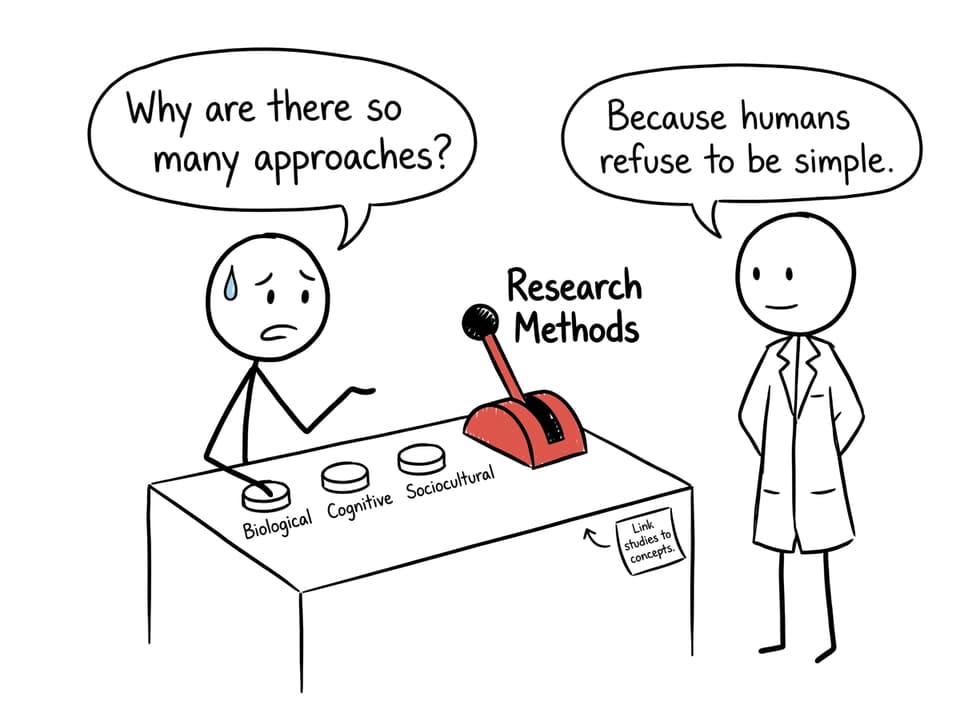
Three approaches and one stressed student
Research methods: the part of IB Psychology you cannot “cram”
Research methods in IB Psychology are not a standalone chapter you tick off. They are how you earn evaluation marks everywhere.
You will need to compare and critique:
Experiments, interviews, observations, case studies
Reliability vs validity
Sampling, controls, demand characteristics
Ethical considerations and how they shape conclusions
If you are HL, get comfortable with the extra expectations by using IB Psychology Paper 3 Notes & Questions (HL). It is the fastest way to see what “methods marks” look like in real practice.
Optional topics: depth that rewards smart selection
Higher Level students choose optional topics that add both content and opportunity. Options like abnormal, developmental, health psychology, and human relationships can feel huge, but they revise well when you treat them like systems.
How to score higher in IB Psychology (without studying longer)
Build answers around “concept + study + evaluation”
Every IB response becomes easier when you stop trying to remember “everything” and start building repeatable answer units:
Define the concept precisely
Explain one relevant study (aim for clarity over detail)
Evaluate with 2-3 strong points tied to methods/ethics/generalizability
RevisionDojo’s AI Chat is useful here: you can test your explanation, then refine the evaluation until it sounds like an examiner expects.
Practice the writing, not just the reading
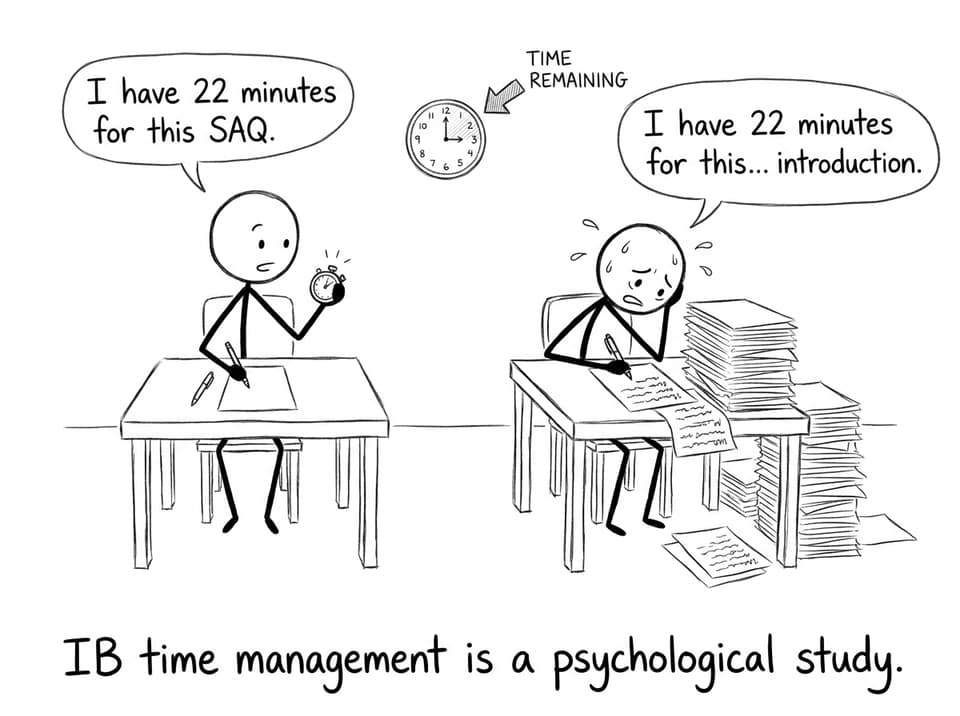
The biggest surprise in IB Psychology is timing. You can understand a topic and still lose marks because your writing is slow or unfocused. Use Mock Exams and timed Questionbank sets to make structure automatic.
Timed writing struggle
Use feedback loops
High performers do something unglamorous: they seek marking. RevisionDojo’s Grading tools (including essay marking) and predicted practice papers make your weaknesses obvious fast, which is exactly what you need close to exams.
The secret is that IB Psychology is big only when you hold it all at once. When you break it into approaches, methods, and a personal set of studies you can deploy confidently, it becomes manageable and even enjoyable.
If you want one place to revise smarter, practice harder, and get feedback faster, use RevisionDojo’s IB Psychology hub. Your future self in the exam room will feel the difference.