
IB English Paper 2: the calm skill hiding inside the panic
The night before IB English Paper 2, most students do the same strange ritual: they reread whole chapters they already know, hoping familiarity will turn into argument. It rarely does.
Paper 2 is not a memory contest. It’s a decision-making contest. Under a loud clock, you choose a question, choose two works, and then keep choosing: what to compare, what to ignore, what to quote, what to explain. When you practice those choices, IB English Paper 2 becomes predictable in the best way.
If you want a single home base for your practice, start with the English Paper 2 hub for IB English A: Lang & Lit. It’s where students usually realise that the goal isn’t “more notes”; it’s rehearsing an exam behaviour.
Quick overview: what Paper 2 demands (and what it doesn’t)
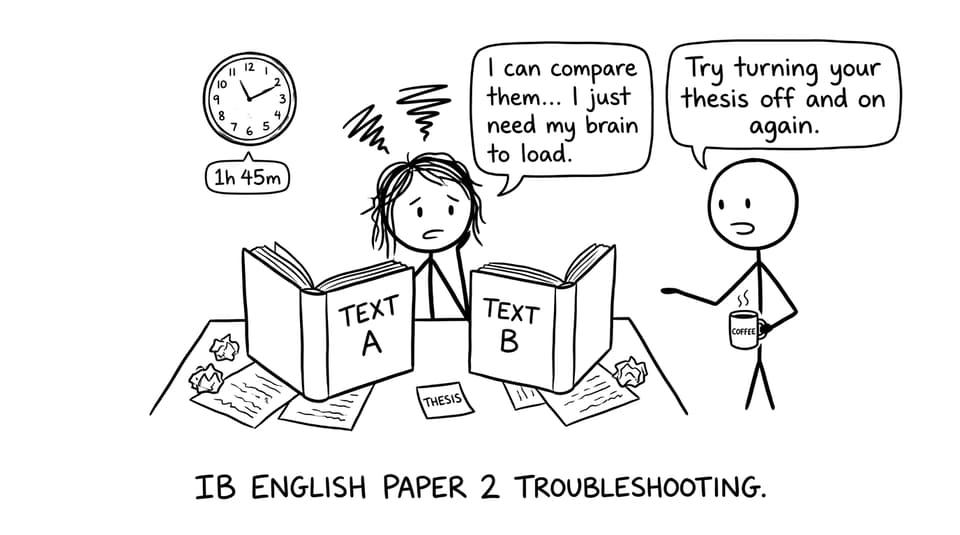
In IB English, Paper 2 asks for one comparative essay on two works you studied. It’s closed-book, so preparation has to build recall you can actually use. You typically pick one question from a set (often six), and you write for 1 hour 45 minutes.
The Paper 2 readiness checklist
-
I can answer at least 3 common prompt styles (theme, character, authorial choices, structure).
-
I have 8-12 “micro-evidence” moments per text (short quotes or precise references).
-
I can produce a one-sentence comparative thesis in under 2 minutes.
-
My paragraphs compare both works (not “Text A then Text B”).
-
I’ve practiced timing at least weekly.
For a structure you can drill until it becomes automatic, use Structuring Your IB English Paper 2 Essay.
How IB English Paper 2 questions really work
Paper 2 questions feel broad on purpose. They’re designed to let any class set of texts fit, which means your score comes from how sharply you narrow the prompt.
In IB English, narrowing looks like this:
-
Prompt says “themes” -> you define a specific theme angle (e.g., “hope as performance” instead of “hope”).
-
Prompt says “characters” -> you focus on method (voice, dialogue, perspective, contrast characters).
-
Prompt says “setting” -> you treat setting as an authorial tool (confinement, surveillance, fragmentation).
A practical way to train this is to pull exam-style prompts and force yourself to write only: thesis + 3 comparative topic sentences. You can do that with the IB English Paper 2 Questionbank, then scale up to full essays once your planning is fast.
The backbone of a high-scoring IB English Paper 2 essay
Your thesis must be comparative, not dual
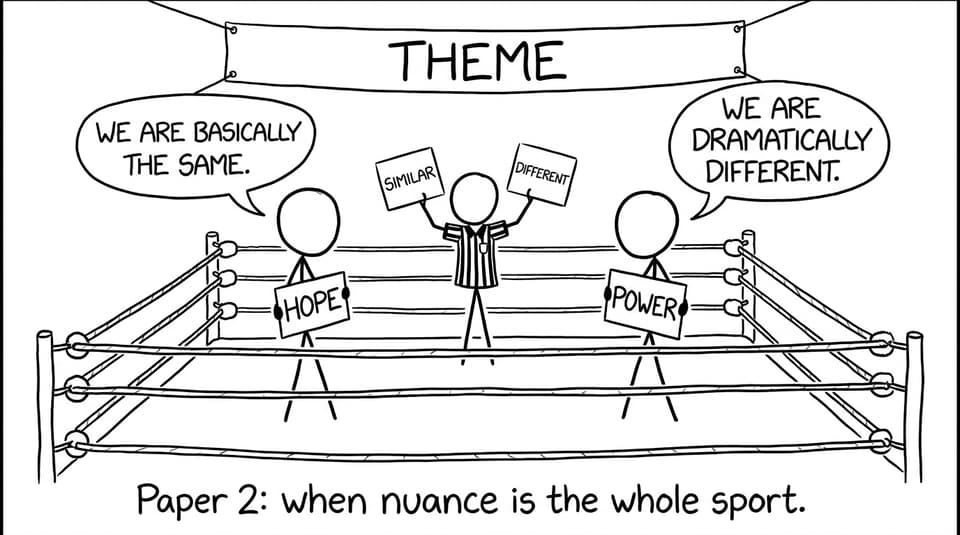
A common Paper 2 mistake in IB English is writing two mini-theses, one for each work. Examiners want one argument that contains both.
Try this template:
Although both works explore X, Work A uses Y to suggest Z, while Work B uses Y differently to argue Q.
That single sentence gives you comparison (similarity) and tension (difference), which is where marks live.
Build paragraphs that “braid” the texts
Integrated comparison usually reads stronger than block comparison.
A reliable paragraph pattern:
-
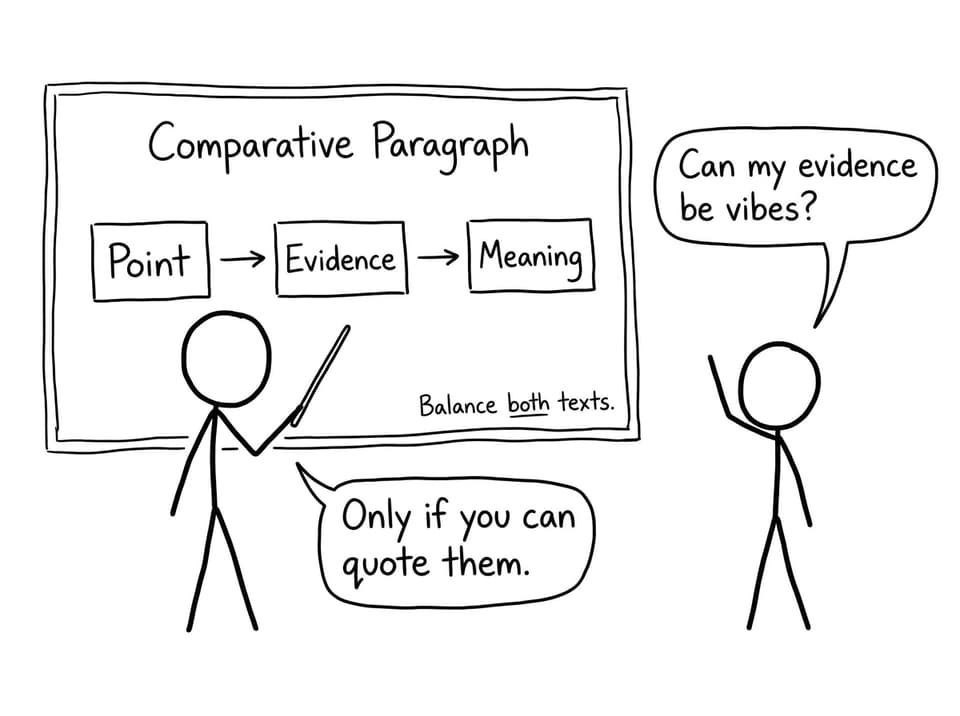
Point: one comparative claim
-
Text A evidence: micro-quote or precise moment
-
Meaning: technique -> effect -> idea
-
Text B evidence: micro-quote or precise moment
-
Meaning: technique -> effect -> idea
-
Link back: answer the question again, in sharper words
When you’re practicing, RevisionDojo’s Essay and grading-style tools inside the platform help you check whether your paragraphs stay analytical (technique and meaning) rather than summary.
Evidence: stop memorising “famous quotes”
In IB English, the best Paper 2 evidence is flexible. You want lines or moments that can support multiple prompts.
Instead of chasing long quotations, build a bank of:
-
6-8 short micro-quotes (2-6 words)
-
6-8 “scene anchors” (what happens, where, why it matters)
-
3-5 technique clusters per work (imagery + structure + voice)
Then convert them into spaced repetition using RevisionDojo Flashcards so recall becomes automatic under time pressure.
Time management: a simple schedule that works
In IB English Paper 2, time disappears when planning is vague. Use a schedule you can repeat:
-
10 minutes: choose question, build thesis, outline 3 body paragraphs
-
80 minutes: write (about 25-27 minutes per body paragraph including transitions)
-
15 minutes: edit for comparison, clarity, and evidence
If timing is your main enemy, practice with the method in IB English Paper 2 Under Time Pressure. It’s built around rehearsing the exact moments students usually freeze.
A RevisionDojo practice loop for IB English Paper 2
Students improve fastest when practice creates feedback, and feedback changes the next practice. That loop is what RevisionDojo is built for.
Here’s a sustainable weekly routine for IB English:
-
2 sessions: learn and organise with IB English A Lang & Lit resources and Study Notes
-
2 sessions: targeted prompts in the Questionbank feature (plan + one paragraph)
-
1 session: timed essay section using Paper 2 Sample Papers and Exemplar Responses
-
Always: ask one specific question to AI Chat when you’re stuck (“Is this thesis comparative enough?”), then rewrite it
To balance Paper 2 with the rest of the course, pair this with IB English: Best Way to Study for Paper 1 vs Paper 2.
FAQ
How many quotes should I memorise for IB English Paper 2?
For IB English Paper 2, aim for memorising fewer quotes than you think, but knowing them better. A strong target is 6-8 micro-quotes per work plus 6-8 precise “moment references” you can describe clearly. Micro-quotes are powerful because they’re easy to remember and easy to embed smoothly in sentences, which keeps your writing academic. Moment references matter because you won’t always remember the exact wording, and the exam rewards accurate textual knowledge even without long quotation. The bigger skill is choosing evidence that fits multiple prompts, not collecting impressive lines that only fit one theme. If you build these into RevisionDojo Flashcards and review them briefly each day, your recall becomes dependable.
What’s the biggest mistake students make in IB English Paper 2 essays?
The most common high-cost mistake in IB English Paper 2 is writing two separate mini-essays inside one response. It often happens when you discuss a point in Text A for a full paragraph, then “switch” to Text B in the next paragraph with little connection. Even if both paragraphs are good, the comparison feels accidental rather than designed, and that limits marks. Examiners want to see you making comparative decisions: what is similar, what is different, and why the author’s choices matter. A simple fix is integrated comparison inside each body paragraph, even if it’s just A then B within the same paragraph. Practice this using RevisionDojo’s Paper 2 Questionbank prompts and make “balance both texts” your non-negotiable rule.
How do I practice IB English Paper 2 when I don’t have time for full essays?
You can train IB English Paper 2 without writing full essays by practicing the parts that create the essay. Start with a 12-minute drill: pick a prompt, write a one-sentence comparative thesis, then draft three comparative topic sentences. Next, do a 20-minute drill: write one full integrated paragraph with two pieces of evidence (one from each work) and explicit technique analysis. These short drills build speed and reduce panic because you’re rehearsing the same exam moves repeatedly. Once a week, convert those drills into a timed 60-90 minute partial essay to build stamina. On RevisionDojo, this is easy to manage because you can move from Study Notes to Questionbank practice to feedback tools without losing momentum.
Closing: make IB English Paper 2 feel familiar
The best preparation for IB English Paper 2 is not inspiration. It’s familiarity: the feeling that you’ve been in this room before, you’ve made these choices before, and you know what “good” looks like.
Build a thesis habit. Build an integrated paragraph habit. Build an evidence habit. Then use RevisionDojo to keep the loop tight: Study Notes for clarity, Flashcards for recall, Questionbank for exam-shaped practice, AI Chat and grading tools for feedback, and Sample Papers plus Mock Exams for realistic timing.
When exam day arrives, you don’t need luck. You need a routine you’ve already proven, the kind IB English rewards.