


The decision that quietly changes your whole week
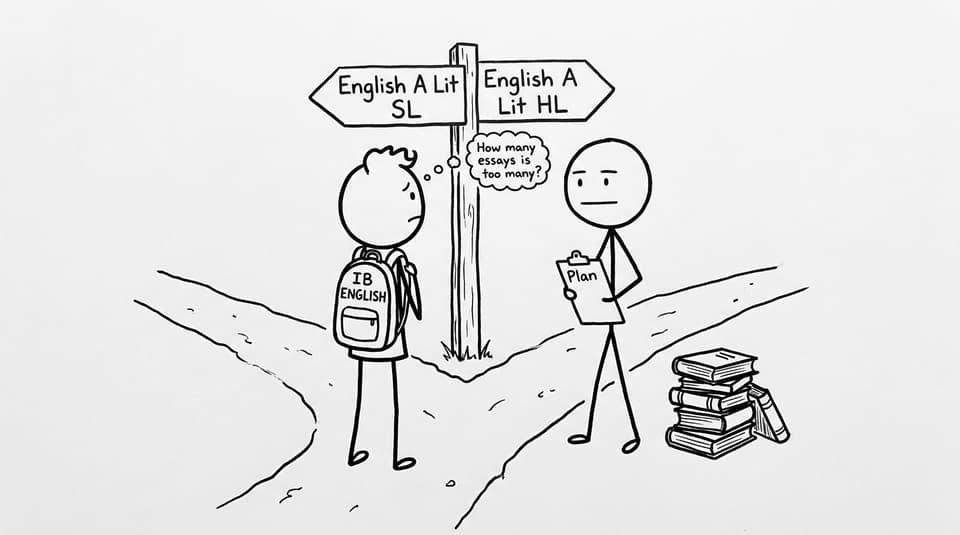
There’s a moment every IB student recognizes: you’re not even studying yet, but your calendar already feels full. Then someone asks whether you’re taking English A: Literature at SL or HL, and suddenly it feels like you’re choosing a lifestyle, not a class.
In IB English, the difference between SL and HL isn’t just “more reading.” It’s more time in lessons, more time shaping arguments, and more pressure to sound precise when the clock is loud and your brain is tired. The good news: you can make this decision calmly if you know what changes, what stays the same, and what kind of student you are when deadlines get close.
Quick checklist: SL vs HL in IB English A: Literature
Use this as your fast filter before you overthink it:
-
Teaching hours: SL is about 150; HL is about 240.
-
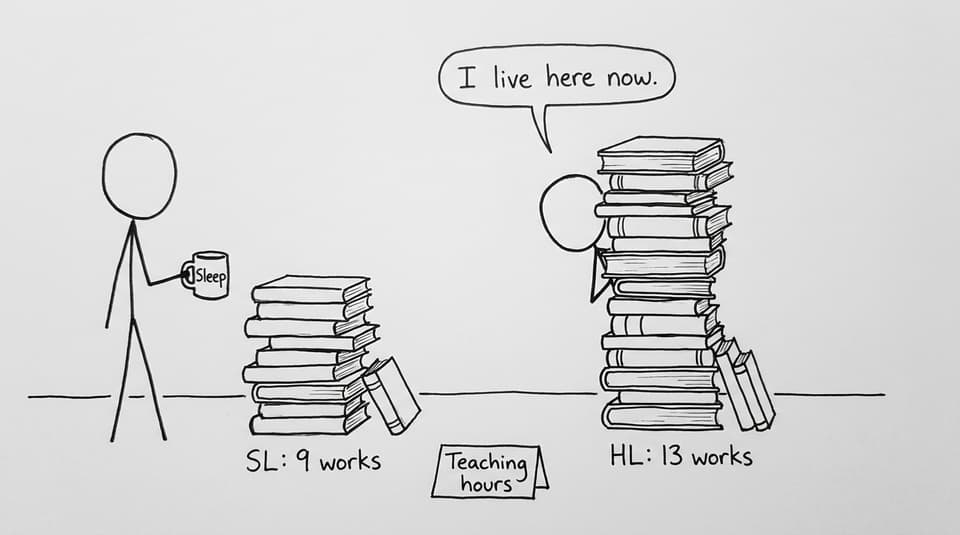
Works studied: SL typically covers 9 works; HL typically covers 13 works.
-
Depth: both analyze literature, but HL expects more sustained sophistication.
-
Extra task: HL includes the HL Essay.
-
Best fit: SL favors balance; HL favors depth and stamina.
If you want a course hub you can keep open all year, bookmark IB English A Lit Resources so your IB English revision tools are in one place.
What actually changes between SL and HL
Teaching hours and pace
The cleanest difference is time. HL adds roughly 90 extra teaching hours, and those hours usually translate into more drafting, more discussion, and more structured practice. In IB English, extra time can be a gift if you enjoy revising your thinking out loud. It can also become friction if you’re already running three other heavy subjects.
A useful question: do extra hours make you calmer because you get more support, or more stressed because they eat the time you need for everything else?
Number of works (and the real cost of “just four more”)
HL students don’t just read four additional works. They also build four additional sets of quotes, themes, context notes, and comparative pairings. That matters because Paper 2 in IB English rewards flexible comparison. More works can mean more options, but only if you revise them well enough to actually use them.
Assessments and pressure points
Both levels require strong reading and writing, but HL adds an additional component: the HL Essay (roughly 1,200-1,500 words). If coursework writing is where you shine, this can raise your overall performance. If coursework drains you, HL can feel like your to-do list never closes.
If you’re leaning HL, read Understanding the HL Essay for IB English A and How to Prepare for the IB English HL Essay early, before the task becomes urgent.
How to choose: match the level to your real habits
Choose SL if you need room to breathe
SL can be the smarter choice if your schedule is already crowded, or if English is not your most efficient subject. In IB English, your grade is less about “being naturally good at reading” and more about producing repeatable exam performance. SL gives you more space to build that repeatable routine without sacrificing sleep.
SL is also a strong choice if you’re taking other demanding HL subjects and want one humanities class that stays steady rather than spiking.
To keep SL revision sharp, build a method for each assessment. Start here: Preparing for IB English A: Literature Exams.
Choose HL if you genuinely like depth
HL is best when you enjoy sitting with a paragraph until it gives you something new. The students who thrive in HL are usually the ones who don’t panic when an interpretation takes time. They can draft, revise, and keep improving without needing constant novelty.
HL can also help if you’re aiming for literature-heavy university courses. It signals you chose the more demanding route in IB English and stayed with it.
If you want a realistic snapshot of what HL expects, use IB English: Crafting a Strong HL Essay Thesis as a self-test: do you enjoy building arguments that narrow, sharpen, and deepen?
A calm revision plan (works for SL and HL)
Most students decide SL or HL based on workload, but your results depend on your system. A simple loop for IB English:
-
Learn with RevisionDojo Study Notes and topic pages like Paper 1 Lit (SL/HL)
-
Drill with the Questionbank to make analysis automatic
-
Lock recall with Flashcards (quotes, techniques, theme claims)
-
Get feedback fast using AI Chat and Grading tools
-
Simulate exam conditions using Mock Exams and Predicted Papers like English A Lit SL & HL Predicted Paper 1
If you want the bigger system that supports this loop across subjects, see RevisionDojo App: The Smarter Way to Prep for IB Exams.
Choosing your level, then choosing your habits
SL and HL are both legitimate paths in IB English. The honest difference is how much time you have, how much depth you enjoy, and whether you can sustain writing pressure without burning out.
If you want the decision to feel lighter, make it practical: choose the level, then build the loop. Use RevisionDojo’s Questionbank, Study Notes, and Flashcards to keep revision consistent, lean on AI Chat when you’re stuck, polish with Grading tools, and run Mock Exams and Predicted Papers to make exam day feel familiar. Add the Coursework Library and Tutors when you need models and human feedback.
Pick the route that fits your real week, then train like you mean it. That’s how IB English becomes manageable, and then quietly becomes yours.