


A hook before the blank page wins
Every IB English student meets the same moment sooner or later: you open a fresh document, type a title you do not believe in yet, and feel the topic sliding around like a bar of soap. The HL Essay is supposed to be “your chance to go deep.” But depth is hard when your idea is wide.
The good news is that strong HL Essays are rarely born from brilliance. They are built from constraints: a precise line of inquiry, a manageable set of passages, and a clear promise to the reader about what you will prove.
If you want the fastest way to feel calm, start by understanding what the assessment actually wants. Keep Understanding the HL Essay for IB English A open in one tab while you brainstorm.
HL Essay topic checklist (use this before you commit)
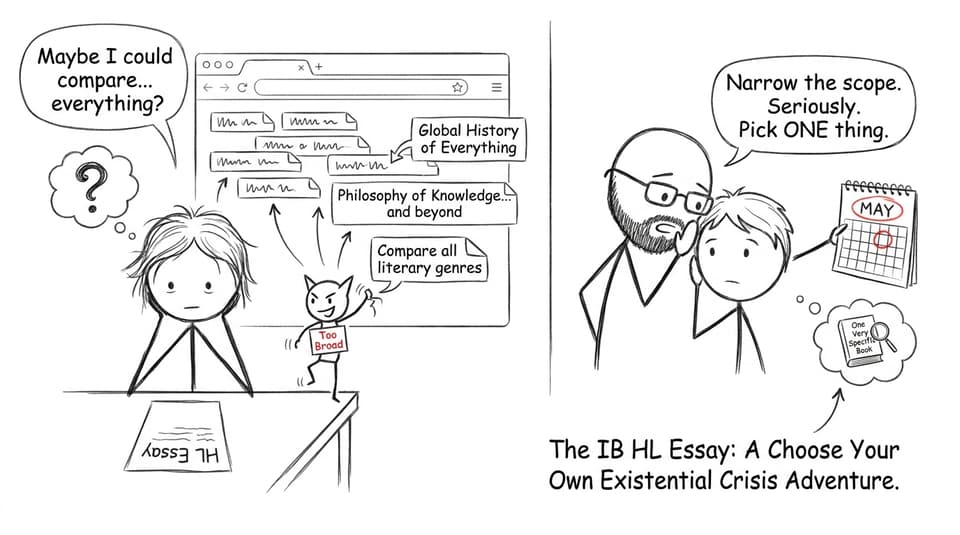
Before you fall in love with an idea, run it through this quick filter. In IB English, this checklist saves you from essays that become summaries.
-
Focused claim: Can you state a thesis in one sentence? If not, it is not ready.
-
Technique-first: Can you name 2-3 authorial choices you will analyze (structure, narrative voice, imagery, diction, symbolism, etc.)?
-
Evidence-rich: Can you list 6-10 short quotations or moments you already know you will use?
-
Scope control: Can the argument fit within the HL Essay word limit (1,200-1,500)? If you are unsure, read IB English HL Essay word limit and why it matters.
-
Original angle: Would your teacher read your inquiry and think, “Interesting… I have not seen that exact approach”?
When you are ready to lock in your central claim, use Crafting a Strong HL Essay Thesis as your template.
HL Essay ideas for IB English A: Literature
A good IB English Literature HL Essay topic usually has two parts: a what (theme or concern) and a how (craft).
Theme-driven ideas (with a built-in “how”)
-
Isolation as a design choice: How does physical space (rooms, landscapes, borders) create emotional distance between characters?
- Example angle: isolation built through setting shifts, recurring motifs, and silence.
-
War as afterimage: How do narrative gaps, fragmented chronology, or understatement represent trauma?
- Example angle: what the text refuses to say becomes the meaning.
-
Identity under pressure: How does the writer use naming, code-switching, or competing points of view to show identity as unstable?
- Example angle: identity as performance, not essence.
Character-focused ideas (that avoid plot retell)
-
Transformation with a cost: How does a character’s change reshape the moral logic of the text?
- Look for: turning points, reversals, repeated phrases that evolve.
-
Complex antagonists: How does the author invite partial sympathy for a villain through perspective, irony, or dramatic structure?
- Look for: moments where readers are made complicit.
-
Heroism and sacrifice: How does the narrative frame “duty” as noble, tragic, or self-serving?
- Look for: contrasts between public language and private thought.
Technique-centered ideas (high-scoring when done well)
-
Symbolism that changes meaning: Track one recurring symbol and show how its meaning shifts across the text.
-
Narrative perspective as a trap: How does limited or unreliable narration control what the reader can judge?
-
Imagery and atmosphere: How do sensory patterns (light/dark, heat/cold, sound/silence) build a moral mood?
If your class texts feel overwhelming, RevisionDojo’s English A Literature resources help you break works into techniques, key passages, and examinable moves.
HL Essay ideas for IB English A: Language and Literature
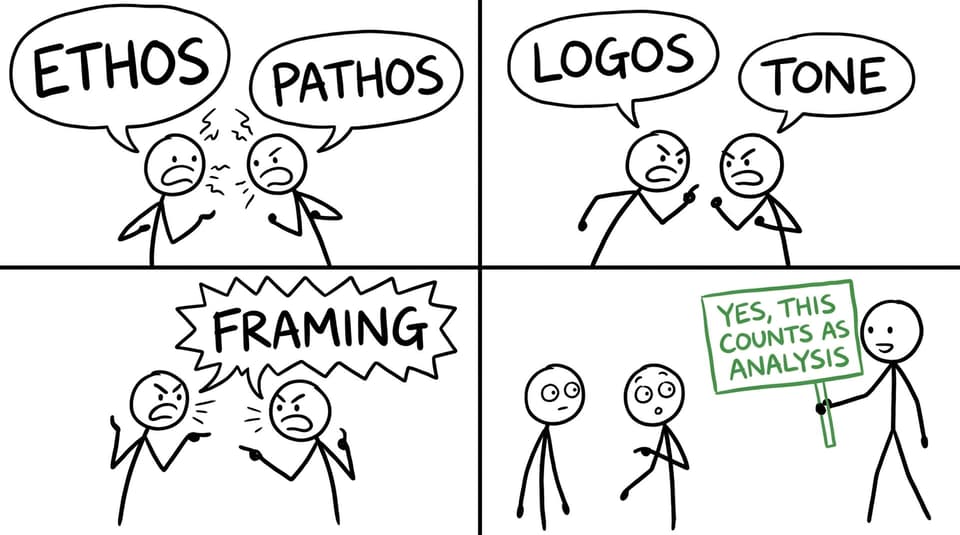
In IB English Language and Literature, your HL Essay can still be literary, but it often shines when you show how language operates in the real world: persuasion, identity, power, and representation.
Literary text ideas (Lang & Lit-friendly angles)
-
Gender roles as a rhetorical system: How do dialogue patterns, narrative framing, or genre conventions reward certain identities?
-
Power and corruption: How do “official” voices (law, tradition, leadership) justify harm through euphemism or moral language?
-
Love and relationships: How does the text construct intimacy through metaphor, omission, and miscommunication?
Non-literary text ideas (where students often score higher)
-
Advertising and desire: How does an ad campaign build identity stories (who you become) rather than product claims (what you buy)?
-
Political rhetoric and belonging: How do speeches use pronouns (“we”), rhythm, and repetition to manufacture unity?
-
Media representation of global issues: How do headlines, images, and framing choices shape what the audience believes is “normal” or “urgent”?
To build your toolkit fast, RevisionDojo’s IB English A Lang & Lit resources pair Study Notes and Flashcards with practice prompts you can turn into HL Essay lines of inquiry.
The easiest way to turn an “idea” into a line of inquiry
Most IB English HL Essay drafts fail for a simple reason: the student starts with a theme (“identity”) instead of an argument (“identity is constructed through naming and misdirection”).
Try this conversion:
-
Start with a concept (identity, power, perspective, culture, conflict).
-
Add a technique (structure, imagery, diction, symbolism, characterization, framing).
-
Add an effect (creates ambiguity, limits empathy, manufactures authority, invites complicity).
Examples:
-
How does shifting narrative perspective limit the reader’s empathy, and what does that suggest about moral responsibility?
-
How does recurring light imagery construct hope as both desire and self-deception?
-
How does political language use “we” to blur accountability and normalize exclusion?
If you want a step-by-step process with planning milestones, use How to Prepare for the IB English HL Essay: 10 Key Steps.
A practical workflow (so you actually finish)
Here is a calm, repeatable workflow that fits real exam-season schedules and keeps IB English writing from turning into panic-writing.
Gather evidence first, then decide your thesis
Pick 8-12 moments that feel “loaded” (a shift in tone, an image that repeats, a scene everyone argues about). Then ask: what do these moments have in common?
RevisionDojo makes this easier because you can:
-
Use Study Notes to spot high-yield techniques.
-
Drill Flashcards on literary devices and rhetorical terms.
-
Pull prompts from the Questionbank to pressure-test your angle.
Draft with feedback loops
Write one body paragraph early and get it evaluated.
-
Use AI Chat to challenge your claim (“What is the counterargument?”).
-
Use Grading tools to check whether you are analyzing or summarizing.
-
If you have access, the Coursework Library helps you see how top responses sound without copying them.
Simulate exam skills alongside coursework
Even though the HL Essay is coursework, your overall IB English performance depends on timed skills too. RevisionDojo’s Mock Exams and Predicted Papers (mock-style practice sets) help you stay sharp for Paper 1 and Paper 2 while you polish the essay.
If you are deciding between courses, read Is IB English Literature more difficult than Language and Literature? to match your strengths to the right expectations.
Closing: choose the idea you can live with for three drafts
The best HL Essay ideas are not the fanciest. They are the ones you can return to on a tired Tuesday and still feel curious. When your IB English topic is narrow, your writing gets calmer. When your evidence is chosen early, your analysis gets deeper. And when your thesis is a real claim, your conclusion feels earned.
If you want to move from “I have a theme” to “I have a line of inquiry and a plan,” use RevisionDojo as your home base: Questionbank for practice prompts, Study Notes and Flashcards for technique, AI Chat and Grading tools for feedback, Predicted Papers and Mock Exams for exam readiness, plus the Coursework Library and Tutors when you want guidance that is actually specific.