
If you have ever listened to two IB students compare schedules, you have heard the same argument dressed up in different outfits: IB English Literature is brutal because the reading never ends, while IB English Language and Literature is brutal because everything counts as a text and nothing stays in one lane.
That disagreement is not just noise. It is a clue. In IB Languages, “difficulty” is rarely about which course is objectively harder. It is about which course punishes your weakest habits.
So, is IB English Literature more difficult than IB English Language and Literature? Sometimes. But not for the reasons people expect.
Quick checklist: which course will feel harder for you?
Use this as a fast self-test before we go deeper. In IB Languages, the “harder” option is usually the one that asks you to do more of what you avoid.
-
Reading stamina: Do you genuinely keep up with long novels, plays, and poetry?
-
Close analysis: Can you explain how a technique creates meaning, not just spot it?
-
Context switching: Can you move from a poem to an advertisement without losing clarity?
-
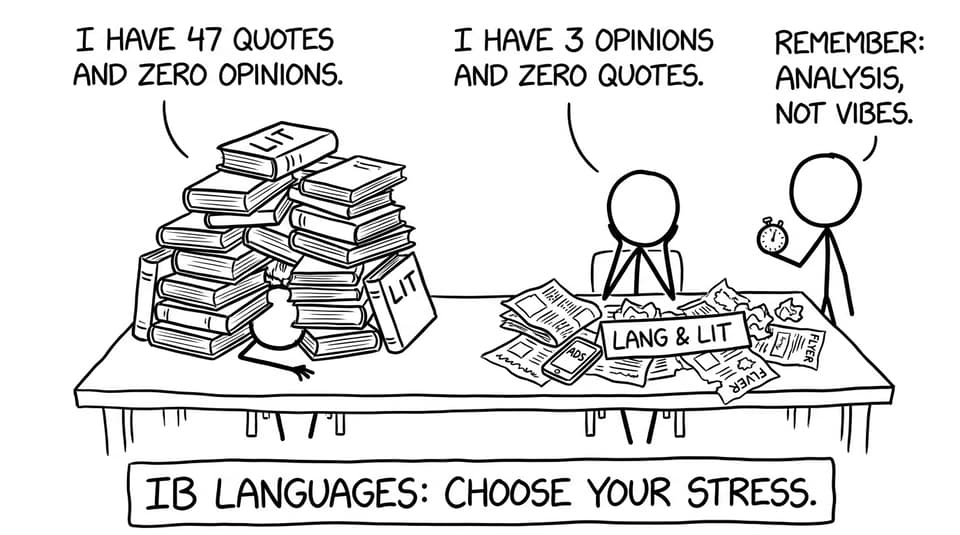
Memory vs method: Do you rely on memorised quotes, or do you build flexible arguments?
-
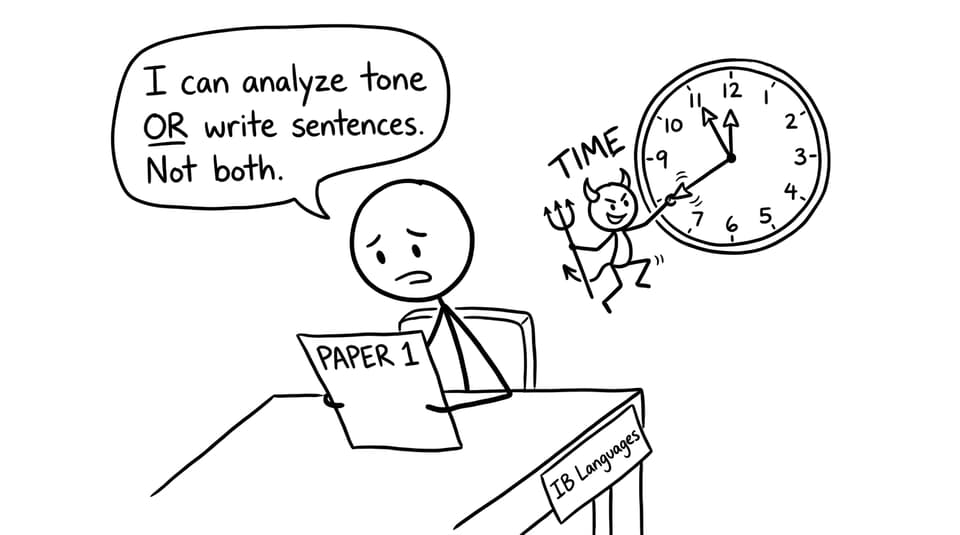
Timing under pressure: Can you plan quickly and write cleanly in exam conditions?
If you want a clear map of the course components and revision workflow, keep a home base like IB English A Lang & Lit Resources open while you study.
What makes IB English Literature feel difficult?
IB English Literature is depth-first. In the world of IB Languages, it is the course that says: “Stay here. Look closer. Now look closer again.”
The challenge is sustained interpretation
Lit rewards the student who can live inside a text for weeks and keep finding fresh angles: symbolism that accumulates, motifs that evolve, irony that changes meaning across contexts. If you enjoy that, Lit can feel oddly fair. If you do not, Lit can feel like being asked to describe a painting while someone keeps dimming the lights.
A useful way to think about it: Lit is not primarily testing whether you “understand the plot.” It is testing whether you can build an interpretation and defend it with precise evidence and authorial choices.
RevisionDojo helps here because the work is repetitive in the best way: practice, feedback, improvement. The Questionbank and Study Notes reduce the time you waste deciding what to do next, and the Flashcards turn your strongest insights into recallable tools instead of fragile memories.
For essay craft specifically, How to Write a Good Essay for IB English Literature is worth revisiting when your paragraphs start drifting into summary.
The challenge is precision with literary vocabulary
Lit expects you to speak the language of analysis: diction, syntax, narrative perspective, enjambment, stagecraft. You do not need fancy words. You need accurate ones.
Keep a reference tab for English Literature Glossary. In IB Languages, clarity often beats cleverness.
What makes IB English Language and Literature feel difficult?
IB English Language and Literature is breadth-first. In IB Languages, it is the course that says: “Great, now apply that same analytical discipline to a speech, a campaign poster, a photo essay, and a news article.”
The challenge is versatility across text types
Students often underestimate how mentally expensive switching can be. One day you are discussing narrative voice; the next you are unpacking layout, typography, and audience manipulation.
If you are new to this, start with What Does IB Consider a Non-Literary Text? and then move to a practical framework like How to Analyze Non‑Literary Texts in IB English Language and Literature. Those two links usually remove a lot of unnecessary confusion.
The challenge is “context” without waffle
Lang & Lit students are told to talk about context, then punished for writing vague context. The best responses connect context to purpose: why this text exists, who it targets, and what it tries to make the audience feel, believe, or do.
In RevisionDojo, this is where AI Chat becomes more than a gimmick: you can test your thesis by asking it to challenge your assumptions about audience, bias, and effect. Then you rewrite. That rewrite loop is how IB Languages gets easier.
Difficulty factor that matters most: depth vs breadth
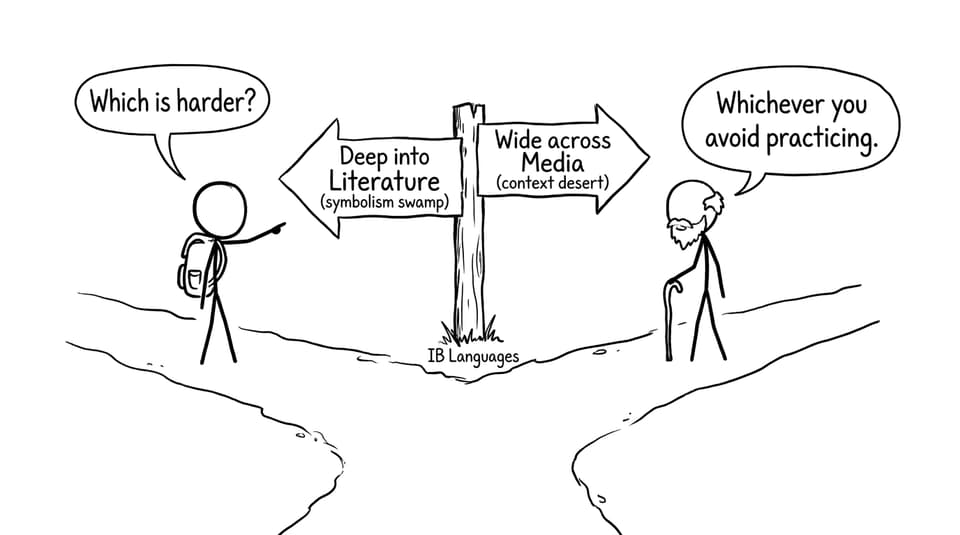
Students love to ask which course is harder, but a better question in IB Languages is: What type of hard do I handle well?
-
Literature hard: fewer text types, heavier interpretive depth, more sustained engagement with literary works.
-
Language & Lit hard: more text types, heavier flexibility, more frequent context and media analysis.
Neither is automatically “more difficult.” But they fail different students.
Assessment reality check: where students lose marks
In IB Languages, marks disappear in predictable places. Not because students are incapable, but because they prepare in a way that feels productive and is not.
Paper 1 pressure exposes weak habits
Paper 1 is where timing meets clarity. Many students can annotate. Fewer can turn annotation into a line of argument quickly.
If Paper 1 is your stress point, build a routine using IB English Paper 1: Best Ways to Prepare and the more strategic approach in Effective Study Techniques for IB English A: Language and Literature.
RevisionDojo’s Mock Exams and Grading tools make this measurable. You can do a timed response, submit it, get structured feedback, and then redo only the weakest paragraph. That is how you train the skill, not just rehearse the anxiety.
Paper 2 is not about memorising quotes
Paper 2 rewards comparative thinking: patterns, contrasts, choices, implications. Students often over-invest in quote banks and under-invest in comparative frameworks.
Use IB English Paper 2: Essential Guide for Success and Understanding the IB English A Literature Paper 2 Exam Structure to keep your essays anchored to what is actually assessed.
The Individual Oral is “easy” only if you practise like it matters
Both courses include an Individual Oral component, and it often becomes a last-minute performance. The best IOs are engineered, not improvised.
Start with IB Oral (IO) Guide: Language & Lit and Literature, then practise using the rubric mindset via IB Language A: Individual Oral Grader. RevisionDojo’s Tutors can also help you tighten your global issue and pacing when you feel stuck.
So which is more difficult in IB Languages?
If you want a clean conclusion: IB English Literature tends to feel harder if you struggle with sustained close reading and writing about literary technique with precision. IB English Language and Literature tends to feel harder if you struggle with flexibility, context, and switching analytical lenses across media.
Your best choice is the course that turns your effort into results. In IB Languages, the worst choice is the one you pick because it sounds easier.
Closing: pick the course, then build the system
A quiet truth about IB Languages is that difficulty is not fixed. It shifts as your routines improve.
Whether you are in Literature or Language & Literature, RevisionDojo is built to turn effort into marks: Study Notes for clarity, Questionbank for targeted practice, Flashcards for recall, AI Chat for rapid feedback, Grading tools for rubrics, Predicted Papers and Mock Exams for realism, a Coursework Library for structure, and Tutors when you want human coaching.
Choose the course that fits your mind. Then practise like it is learnable. That is how IB Languages stops being a label and starts being a skill.